2.1 - Inverse hyperbolic functions
An inverse hyperbolic function returns an argument rather than a reciprocal. You will choose real inverse branches, derive the logarithmic formulae from exponentials, and use those formulae to evaluate expressions and solve equations with their domains intact.
Choosing inverse branches
If , which argument should return? An inverse function must give one output for each input, so the full cosh graph needs a branch choice.
Sinh is strictly increasing from to , and tanh is strictly increasing from to . Each already has a unique real argument for every value in its range. Cosh is even; we define its inverse using the increasing branch with argument at least zero.
The three basic inverse functions
Here the superscript means the inverse function, not a reciprocal. For example, , whereas is positive.
The domain of an inverse is the range of the chosen original branch. Its range is that branch's domain. Reflecting in swaps those two roles.
[DIAGRAM: asset_name: Choosing the real inverse of cosh; asset_slug: cam9231-inverse-cosh-branch; caption: Restricting cosh to nonnegative arguments gives one inverse output for each input at least 1; description: Left panel shows the even cosh graph with its nonnegative-argument branch highlighted and the negative branch grey. A horizontal line meets both branches. Right panel shows the selected cosh branch and its reflection in y equals x, the inverse cosh graph. Corresponding points zero comma one and one comma zero are marked.]
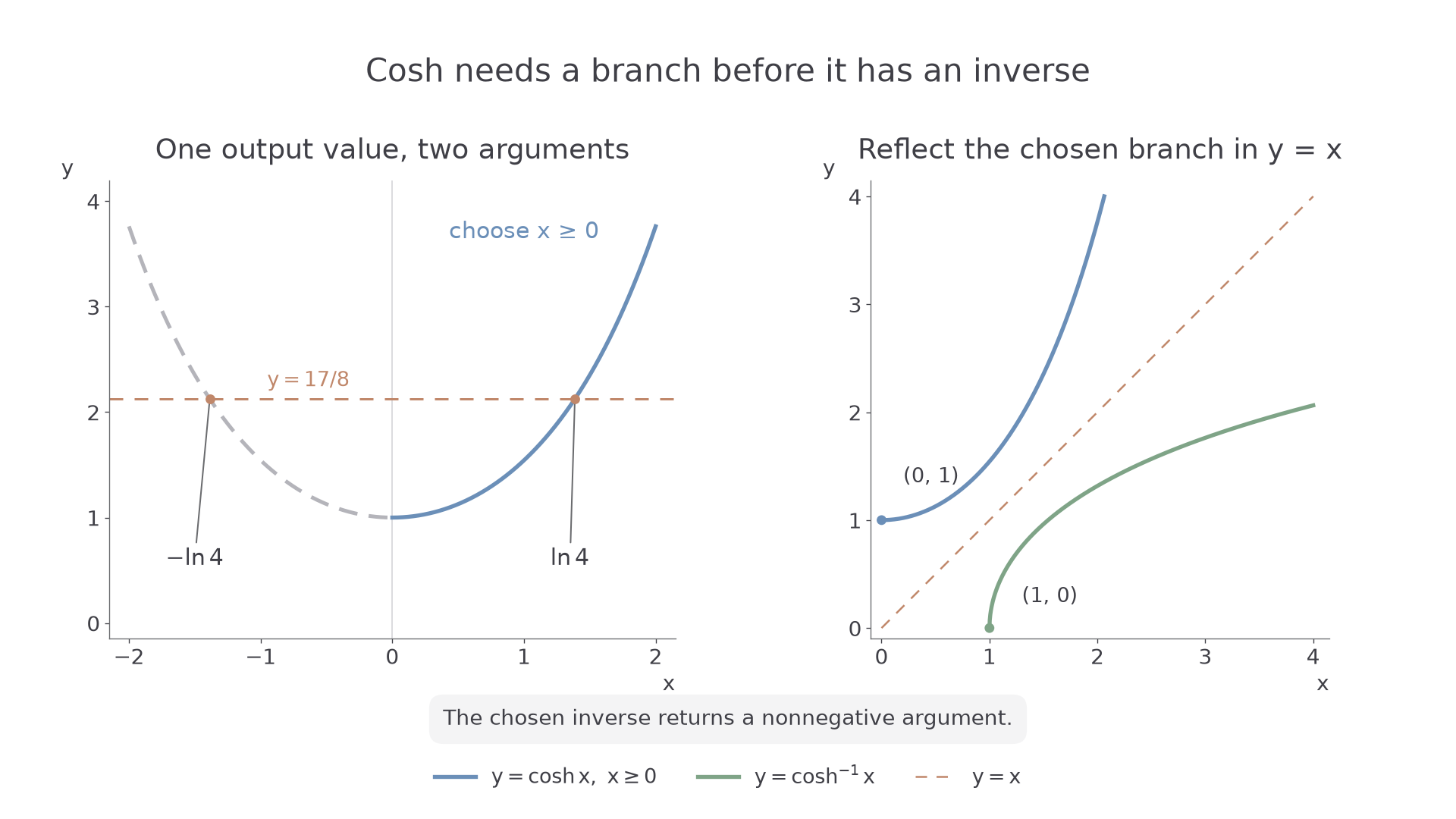
The reciprocal functions can be inverted by first taking the reciprocal of the input. For sech, choose the branch with argument at least zero, just as for cosh. Cosech and coth are each one-to-one over their full nonzero real domains, even though those domains have two separate intervals.
| Inverse | Definition through a basic inverse | Real domain | Range of the chosen inverse |
|---|---|---|---|
| $ | x |
For instance, has two real solutions, but the chosen inverse names only the nonnegative one. Stating the branch is essential whenever an even function is inverted.
Worked example 1: an inverse of an even function
Question. Simplify and .
Plan. Use each inverse's range to decide which argument it can return.
Cosh is even, so . Its inverse must return a nonnegative number, hence
Sinh has no branch restriction and is one-to-one on all real numbers, so
Answer. The values are and , respectively.
Check. Direct exponentials give and . Of the arguments , only is in the cosh inverse's range; only has the required negative sinh value.
Replace the functions by their reciprocals while keeping the same argument. The same branch issue survives for sech.
Worked example 2: reciprocal-function inverses
Question. Simplify , and , using the branches above.
Plan. Reduce each reciprocal inverse to one of the three basic inverses.
Answer. The values are , respectively.
Check. The inner values are . They lie in the required inverse domains , , and . Substituting the proposed arguments into sech, cosech and coth recovers those values directly.
In particular, and, with the chosen branch, . In contrast, sinh and tanh undo any real argument. This answers the opening question: the inverse cosh returns .
Watch out
The inverse notation is different from . The first requires ; the second requires .
Apply the branch rule to a fresh argument.
Deriving logarithmic forms
To turn an inverse hyperbolic function into logarithms, solve its exponential definition for . The same positivity condition used in hyperbolic equations now determines which algebraic root belongs to the inverse.
First consider . With , the equation is , so or . The inverse branch requires , equivalently , so it selects .
For a general input , the same argument gives
The two roots have product . The plus root is at least ; the minus root is at most . For , only the plus root gives the selected nonnegative argument. At , both coincide at . Thus
The branch restriction chooses a root here even though both roots are positive.
Worked example 3: deriving the inverse sinh formula
Question. Starting from the exponential definition of sinh, derive a logarithmic expression for , valid for every real .
Plan. Write , solve a quadratic in , and justify the accepted root.
The quadratic formula gives
Since , the plus root is positive and the minus root is negative for every real . Only the positive root can equal . Taking its logarithm gives the result.
Answer. for .
Check. Put . Its reciprocal is , so . The expression works for negative inputs too, without any absolute value being added to the logarithm's argument.
Continue this lesson.
You’re previewing NovaLearn without an account. Create a free account to read the rest.
Create free account