1.6 - Angles and distances involving planes
Normals turn spatial angle and distance questions into scalar products. You will distinguish a line-plane angle from a normal angle, find the angle between planes, and calculate the shortest distance from a point to a plane.
Angle between a line and a plane
A line points upwards through a horizontal plane. Is the angle found by taking its scalar product with a vertical vector the angle with the plane? It is the angle with the normal, so we need its complement.
For a line with nonzero direction and a plane with nonzero normal , let be the smaller angle between their directions, taking it between and . The line-plane angle is . This angle measures the line's inclination above the plane and also lies between and .
[DIAGRAM: asset_name: A line-plane angle is a complement; asset_slug: cam9231-line-plane-angle; caption: In a normal section, the line-plane angle and the line-normal angle add to 90 degrees; description: Exact cross-section through a plane normal and an intersecting line. The plane appears as a horizontal grey line, its normal as a vertical sage arrow, and the line direction as a blue arrow at 35 degrees above the plane. The 35 degree angle alpha and 55 degree angle beta are drawn in distinct arcs. A right-angle marker identifies the plane-normal angle.]
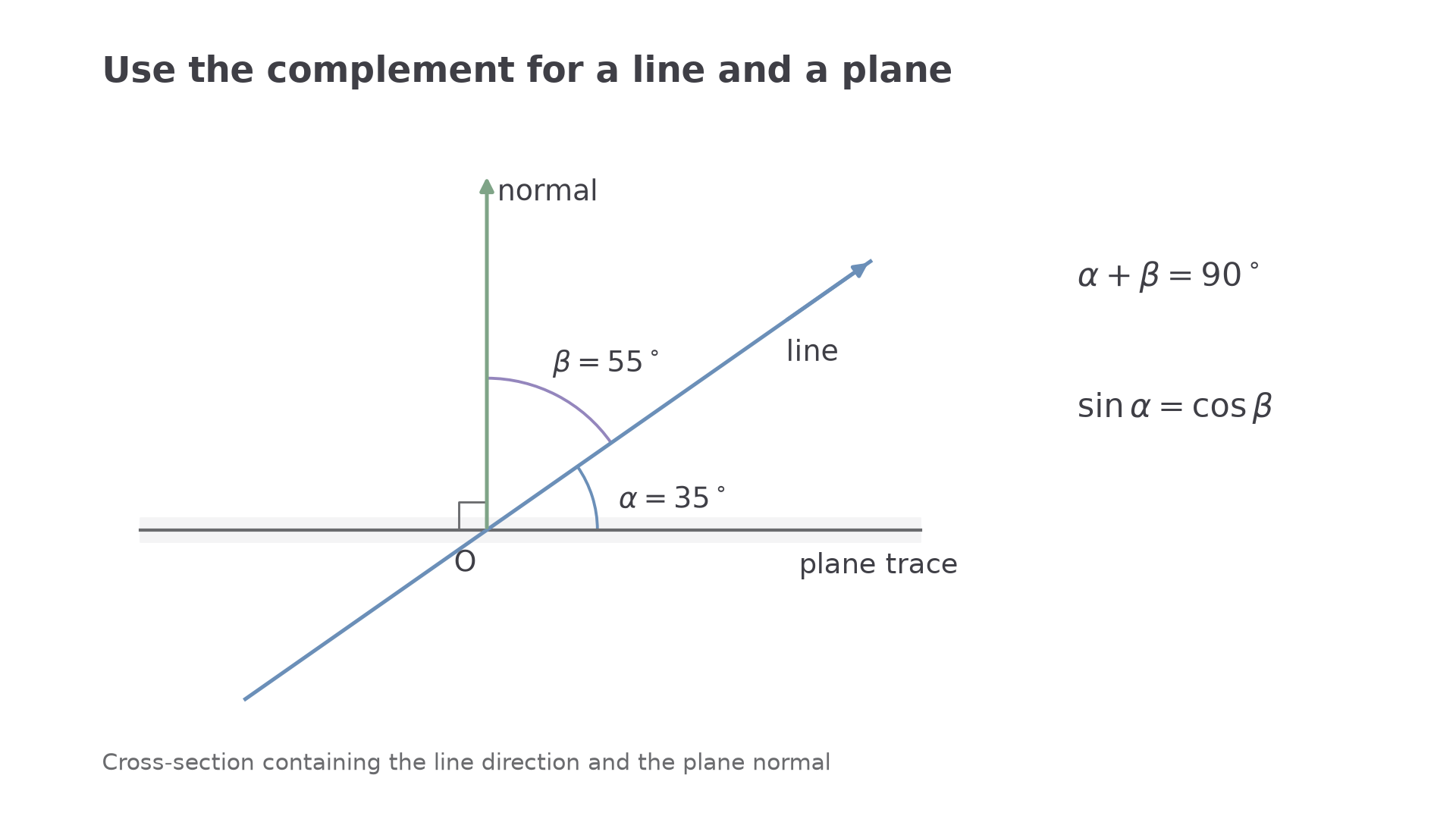
Line-plane angle
The absolute value makes the result independent of which sense of the line or normal you choose. This follows from .
Not in the formula booklet: learn it. The scalar-product angle formula used to derive it is in the booklet.
When , the angle is : the line is parallel to, or contained in, the plane. When the directions and are parallel, the angle is : the line is perpendicular to the plane. At this boundary its projection onto the plane has zero length, so the formula supplies the angle directly.
Worked example 1: inclination to a horizontal plane
Question. Find the acute angle between and the plane .
Plan. Use the direction of the line and the plane's normal, then take an inverse sine.
Here , , so
Answer. , to one decimal place.
Check. The line rises units for a horizontal displacement of length . Thus , which gives the same angle independently.
Reverse only the line's direction. A geometric line has no preferred sense, so its inclination must remain the same.
Worked example 2: a negative scalar product
Question. Find the acute angle between and .
Plan. Take the magnitude of the scalar product before applying the line-plane formula.
Answer. The angle is again .
Check. The line's direction is the negative of the previous direction, so both equations describe the same geometric line. Its ratio of vertical to horizontal displacement magnitudes is unchanged.
A cosine applied directly to the positive ratio would give , the smaller angle with the normal. Decide which angle is requested before pressing an inverse-trigonometric key.
Watch out
For a line and a plane, use sine of the angle with the plane, or find the normal angle with cosine and subtract it from .
Use a tilted plane in the next calculation.
Angle between two planes
The smaller angle between two planes equals the smaller angle between their normals. In a cross-section perpendicular to the planes' intersection, each normal is a quarter-turn from its own plane trace; rotating both traces by a quarter-turn preserves their angle.
Unlike the line-plane calculation, this uses cosine of the required angle directly. Unless a different dihedral angle is specified, take the smaller angle, including the limiting values and .
Angle between planes
For nonzero normals , the smaller plane angle satisfies
Parallel or coincident planes have angle ; perpendicular planes have orthogonal normals and angle .
Not in the formula booklet: learn it. The underlying scalar-product formula is in the booklet.
Continue this lesson.
You’re previewing NovaLearn without an account. Create a free account to read the rest.
Create free account