3.6 - Oblique impact of smooth spheres
In an oblique collision, the line joining the sphere centres plays the role of a wall's normal. In this part of 3.6, you will conserve momentum and apply restitution along that line, preserve each sphere's perpendicular component, then reconstruct its final velocity.
The impulse direction
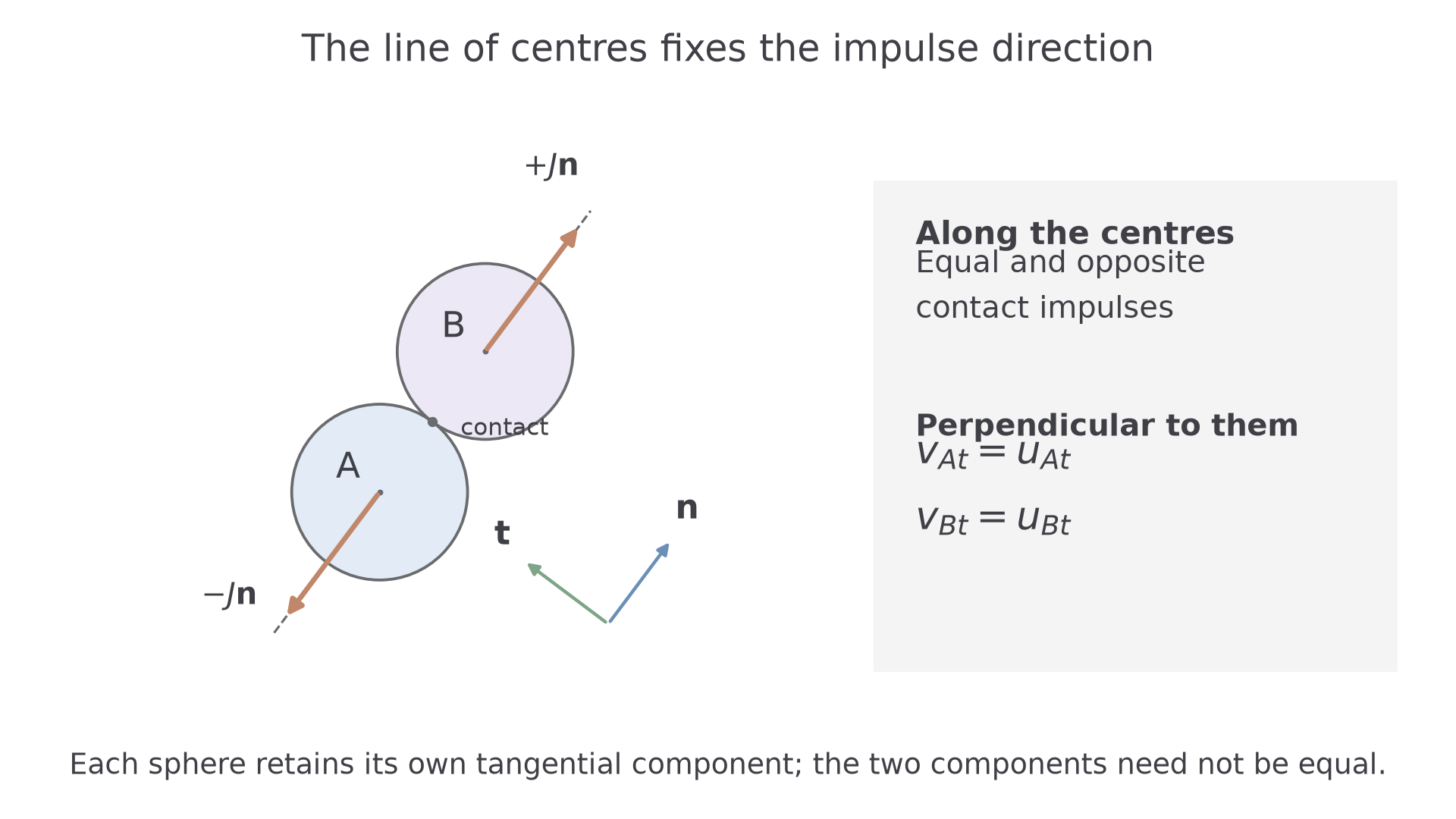
Can a perfectly elastic collision change a sphere's direction without stopping it? For two smooth spheres, the contact impulse acts along their common normal: the line of centres at impact. The perpendicular components survive the collision unchanged.
Choose a unit direction from 's centre towards 's, and a perpendicular unit direction . These are fixed axes for the instant of impact. Write each velocity as a normal component along plus a tangential component along .
[DIAGRAM: asset_name: Smooth spheres exchange a normal impulse; asset_slug: cam9231-sphere-impact-axis; caption: Contact impulses lie along the centres, leaving each tangential component unchanged; description: Two touching equal-radius circles have their centres on an inclined common normal n directed from A to B. Opposite contact impulse arrows on A and B lie on the centre line. A perpendicular t direction is shown separately. A side panel states that each sphere keeps its own tangential velocity, while its normal velocity can change.]
Smooth-sphere tangential components
During the short impact of two smooth spheres, neglect other impulses in the plane of motion. Then
Each sphere has zero tangential contact impulse. The two tangential velocities need not be equal to each other.
Not in the formula booklet: learn it.
Along the normal, an approaching pair has . It is this relative normal motion that brings the surfaces together, even if either sphere also moves sideways.
Worked example 1: a horizontal line of centres
Question. At impact the line of centres points horizontally right from to . Their initial velocities are and , with rightwards and upwards. Find their normal approach speed and identify the unchanged tangential components.
Plan. Read horizontal components along the centres and vertical components perpendicular to them.
Answer. The normal approach speed is . keeps its upward component , and its downward component .
Check. Their relative initial velocity is . Its projection onto the centre line is , confirming that the full relative speed is not the speed to use in restitution.
Keep the same physical velocities but incline the line of centres. Components must now be resolved along the new impact axes.
Worked example 2: an inclined line of centres
Question. The initial velocities are again and . Now
Find the normal approach speed and both unchanged tangential components.
Plan. Project each velocity onto the new normal and tangent using their direction cosines.
For example, the normal component of is ; the tangent component is . Thus
Answer. The normal approach speed is . The unchanged tangential components are for and for .
Check. Reconstructing 's velocity gives . For , , so both projections are consistent.
The tangent is defined relative to the line of centres, rather than to either incoming path. Choose it once and retain its sign convention throughout.
Momentum and restitution
The collision along the line of centres is a direct-impact problem. Both spheres can change their normal velocities, so we need momentum and restitution together. Unlike a fixed wall, neither sphere is generally constrained to remain at rest.
For positive normal from towards , the equations are
The tangential components do not enter these equations. Once the normal velocities are found, restore each sphere's own unchanged tangent.
Worked example 3: a normal rebound
Question. On a smooth horizontal surface, spheres and have masses and . At impact the line from to is horizontal, with rightwards and upwards. Their initial velocities are and . Given , find all final components.
Plan. Solve the normal sum and difference equations, then retain the two tangents.
Since the spheres are smooth, and .
Answer. and . 's normal component reverses, but its tangent does not.
Check. The normal impulses are and , equal and opposite. The positive separation speed is .
Change only the coefficient to . This changes the normal exchange without changing either tangent.
Worked example 4: the elastic normal collision
Question. Repeat Worked example 3 with .
Plan. Keep momentum unchanged and double the required normal separation speed.
The tangential components remain and .
Answer. and .
Check. Initial normal kinetic energy is . Final normal energy is . The tangential energies are unchanged too, agreeing with .
Continue this lesson.
You’re previewing NovaLearn without an account. Create a free account to read the rest.
Create free account