1.1 - Roots and coefficients
You can discover the sum and product of an equation’s roots without solving the equation. In this first part of 1.1, you will see why the coefficients of quadratics and cubics contain that information, then use it to recover missing coefficients.
Roots counted with multiplicity
Can you find the sum of the roots of without finding the roots themselves? By the end of this lesson, you will be able to read the answer from two coefficients.
Start with a polynomial already in factorised form:
The equation has two distinct roots, and , but its three linear factors give the root list . That repeated matters when we add or multiply the roots.
Root and multiplicity
A root of is a value that makes zero. A root has multiplicity when is a factor and is not.
For , has multiplicity and has multiplicity .
The graph has only two intercepts. It crosses at the single root and touches the axis at the double root: one visible intercept can represent more than one factor.
[DIAGRAM: asset_name: A double root is counted twice; asset_slug: cam9231-repeated-root; caption: The cubic has two distinct intercepts but three roots when multiplicity is counted; description: Exact graph of y equals (x minus 1) squared times (x plus 2), crossing the horizontal axis at minus 2 and touching at 1. Labels identify minus 2 as a single root and 1 as a double root. A side panel shows the root list minus 2, 1, 1 and their sum zero.]
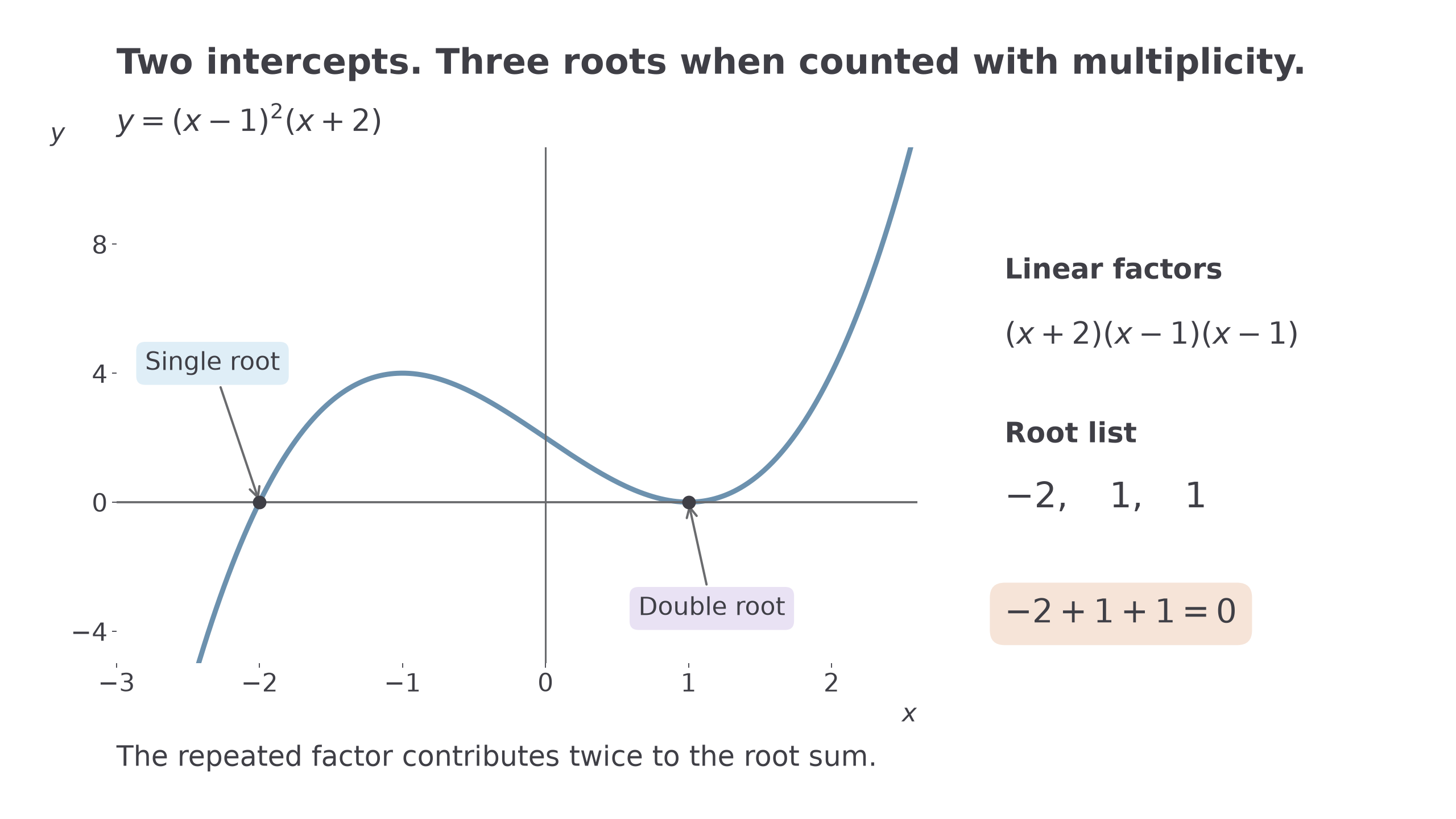
The same counting rule applies when a polynomial has non-real roots. The root relations below use every root, including repeated and non-real roots, even when those roots do not appear as intercepts on a real graph.
Key idea
In a sum or product of roots, count each root as many times as its factor occurs.
Try applying that distinction to a different cubic.
Sums and products for quadratics
For , the coefficient comes from , while the constant comes from . The sum and product are already in the expansion.
For roots and , write the same argument with letters:
Comparing with gives and . Divide by the nonzero leading coefficient .
Quadratic root relations
For , where , with roots counted with multiplicity:
Not in the formula booklet: learn it.
There is no need to use the quadratic formula if the question asks only for a sum or product.
Worked example 1: reading a non-monic quadratic
Question. The roots of are and . State their sum and product.
Plan. Identify the signed coefficients, then divide by the leading coefficient.
Answer. The sum is and the product is .
Check. Factorising gives . The roots have sum and product .
Now change only the sign of the coefficient of . Watch which root relation changes.
Worked example 2: changing the middle coefficient
Question. State the sum and product of the roots of .
Plan. Use the same two relations with .
Answer. The sum is and the product is .
Check. The factorisation gives roots : their sum changes sign, but their product stays positive.
The sign belongs to the coefficient: in the first example, , not .
Watch out
has the wrong sign. The expansion contains , so the sum is .
Use the two coefficients directly in this check.
The three relations for cubics
A cubic has one more factor. In , each term in the expansion comes from choosing one term from each bracket.
To obtain an term, choose one root term and two copies of . To obtain an term, choose two root terms and one copy of . Choosing all three root terms gives the constant.
[DIAGRAM: asset_name: How a cubic stores its roots; asset_slug: cam9231-cubic-coefficients; caption: Choosing one, two or three root terms gives alternating signs; description: Three rows expand (x minus alpha)(x minus beta)(x minus gamma). The x squared row lists minus alpha x squared, minus beta x squared and minus gamma x squared. The x row lists alpha beta x, alpha gamma x and beta gamma x. The constant row is minus alpha beta gamma. Pale blue, lavender and peach fills distinguish the three coefficient groups.]
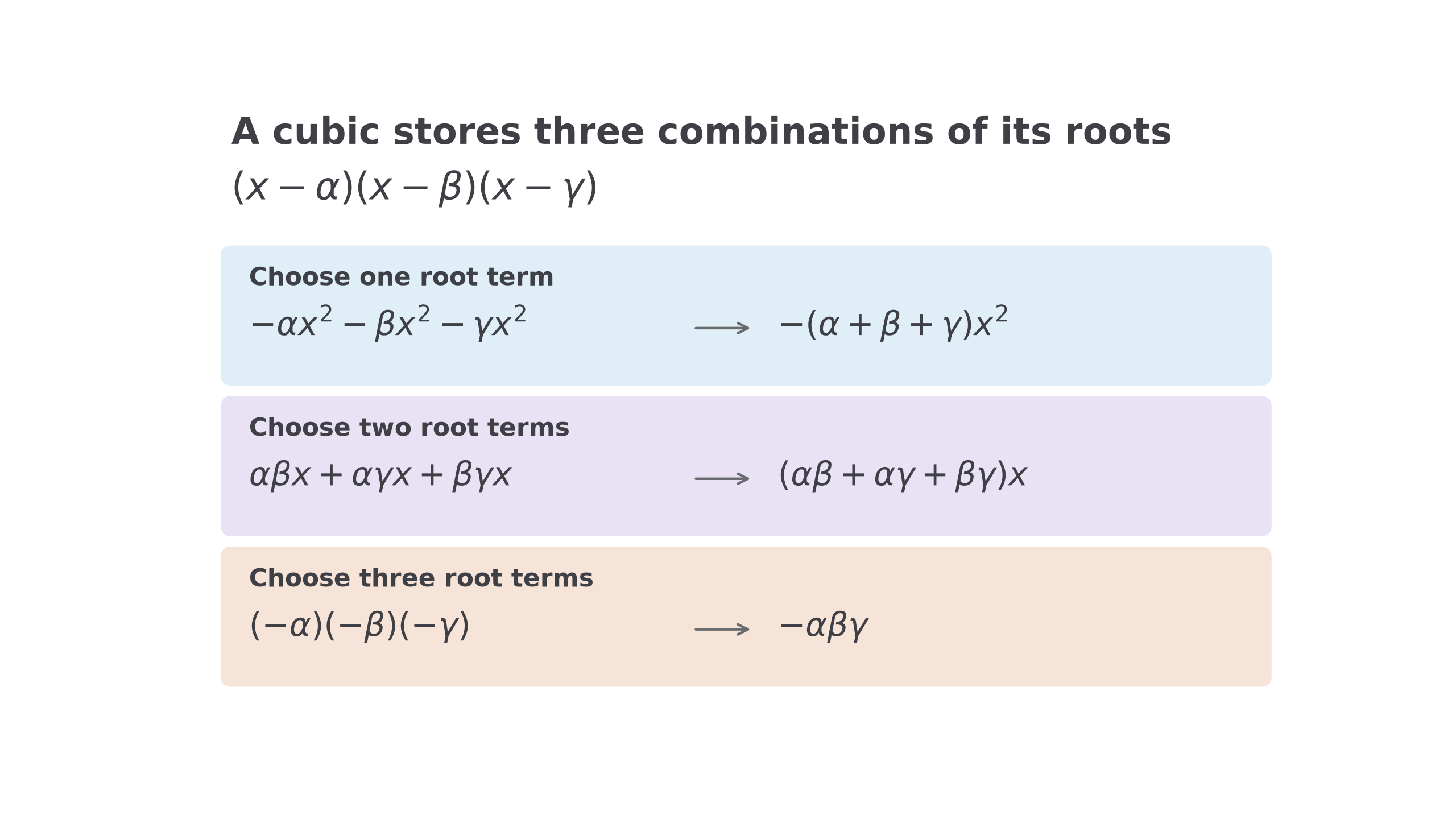
Collecting those terms gives
Each pair occurs once. In particular, is not the product of all three roots.
Cubic root relations
For , where , with roots counted with multiplicity:
Not in the formula booklet: learn it.
The signs alternate because each selected root term carries a minus sign.
Worked example 3: the three combinations
Question. The roots of are . State their sum, sum of pair products and product.
Plan. Match the three coefficients to the three root relations.
Answer. The three values are , respectively.
Check. The factorisation is . Its pair products add to ; its sum and product are both .
Multiply the entire equation by . Its roots cannot change, so our method must give the same three values.
Worked example 4: scaling the equation
Question. State the same three combinations for the roots of .
Plan. Divide every relevant coefficient by .
Answer. The values are still .
Check. Dividing the equation by recovers the preceding equation exactly, with roots .
This gives a useful check on any proposed rule: multiplying an equation by a nonzero constant must leave its root combinations unchanged.
Watch out
For a cubic, the product is , not . Three negative root terms produce a negative constant term.
Now use an equation with a different leading coefficient and different roots.
Recovering missing coefficients
The relations work in both directions. Coefficients reveal combinations of roots; combinations of roots also determine coefficients once the leading coefficient is fixed.
For a cubic with root sum , sum of pair products , product and leading coefficient , the expansion above gives
So missing coefficients can be found directly, without solving a cubic.
Worked example 5: recovering two coefficients
Question. The roots of are . Find and .
Plan. Find the sum and pair products, then match their coefficients.
Answer. and .
Check. Direct expansion gives . The given constant agrees too: .
Keep the same roots but change the leading coefficient from to . Every coefficient must scale with it.
Worked example 6: a different leading coefficient
Question. A cubic with roots has the form . Find .
Plan. Use the same root combinations, multiplying each by the new leading coefficient.
Answer. .
Check. The polynomial is times the one in Worked example 5. Substituting , or therefore gives zero.
Return to our opening equation, . Its root sum is . We can know that immediately, even before finding a single root.
Problem-solving
If a question asks for a combination of roots, look for its coefficient relation before trying to solve the equation.
Use that connection in reverse one more time.
Quick Recap
- Count repeated roots with their multiplicities.
- A quadratic gives the root sum and product .
- A cubic gives the root sum , pair-product sum and product .
- The leading coefficient matters: multiplying an equation by a nonzero constant leaves its roots unchanged.
The opening cubic’s roots add to . Its coefficients told us that before we solved it.