1.1 - Reciprocals and squares of roots
Reciprocating or squaring roots changes the equation in a different way from a shift. You will derive both substitutions, handle zero and repeated transformed roots correctly and use symmetric relations to construct and check an equation for pair products of cubic roots.
Reciprocal roots
Can an equation for reciprocal roots be obtained just by reversing its coefficients? Yes, provided none of the original roots is zero. The reversal follows from a substitution rather than a separate pattern to guess.
If the new root is , the inverse relation is . For a cubic, substitute and multiply by :
Writing this in descending powers reverses the coefficient list. The new constant is , so the polynomial does not accidentally introduce .
Equation for reciprocal roots
If , where and , has roots , then
has roots .
The same reversal works for quadratics and quartics when their leading and constant coefficients are nonzero. Keep missing powers as zero coefficients before reversing.
Not in the formula booklet: learn it.
The constant condition guarantees that the original root product is nonzero. If the original constant is zero, the list of all reciprocal roots is undefined; a lower-degree expression obtained by reversal does not fix that problem.
Worked example 1: reversing a cubic
Question. Find an equation whose roots are the reciprocals of the roots of .
Plan. Check the constant, substitute , then multiply by .
The constant is nonzero, so all reciprocals exist.
Answer. .
Check. The old factorisation is , with roots . The new polynomial factorises as , giving exactly .
Now change to a quartic with missing odd powers. Reversing the complete five-position list preserves the zero slots.
Worked example 2: a quartic with zero coefficients
Question. Find an equation for the reciprocal roots of .
Plan. Reverse , then simplify by a nonzero constant.
Answer. .
Check. The old roots are . The new factorisation gives , exactly their reciprocals.
For instance, the equation has a zero root, so no equation can represent three defined reciprocal values. State the problem with the requested transformation instead of silently discarding that root.
Watch out
Reverse coefficients only after checking the constant is nonzero. A missing constant is a zero root, whereas a missing middle coefficient is simply a zero slot to retain.
Apply the substitution to a new cubic.
Squared roots
For squared roots, set . Replacing every by and choosing only a positive square root can miss negative old roots. Instead, separate the odd and even powers so that can be eliminated algebraically.
For a cubic, group the equation as
Squaring then gives , a cubic in . Work from the specific equation rather than memorising the expanded general expression. Do not divide by : it could vanish at a required root.
Worked example 3: eliminating odd powers
Question. The roots of are . Find an equation with roots .
Plan. Isolate the odd terms, set , then square to eliminate the remaining .
Answer. .
Check. The original polynomial factorises as . Squaring its roots gives ; expanding gives the proposed equation.
Change the original roots so that two have opposite signs but the same magnitude. Squaring will merge their values; both positions in the transformed root list still count.
Worked example 4: opposite roots acquire the same square
Question. Find an equation for the squared roots of .
Plan. Eliminate by the same grouping, retaining factors that could be zero.
Answer. .
Check. The original factorisation is . Its squared-root list is , matching the single factor and double factor .
Dividing the penultimate equation by would lose both copies of a required transformed root. Retaining the factors is safer than cancelling expressions that might be zero.
For a monic cubic, symmetric relations offer another useful check. If its root combinations are , then the squared roots have sum , pair-product sum and product . The middle result follows by squaring : its cross terms total .
The same separation handles the other permitted degrees. For , write , giving . For , write
The eliminated equation for the quadratic has degree two in ; the eliminated equation for the quartic has degree four because . In each case, the even powers become polynomials in and squaring removes the single remaining factor of .
Problem-solving
Use odd/even separation to construct the equation. Use symmetric relations to check its coefficients without repeating the same expansion.
Try the same elimination with a different cubic.
Checking the transformed equation
The degree of the required equation counts transformed roots with multiplicity, not just distinct transformed values. Squaring can send two different old roots to the same new root, whereas reciprocation of nonzero roots is reversible and keeps distinct values distinct.
The exact reason that odd/even elimination works can be seen from factors. If the old roots are , multiplying the old polynomial at and gives, apart from a nonzero constant factor,
Grouping each opposite pair gives . Setting therefore yields exactly the squared-root equation. Squaring the separated odd/even parts produces this same product, so its degree in remains three. The factor argument also works for quadratics and quartics.
[DIAGRAM: asset_name: Opposite roots have the same square; asset_slug: cam9231-squared-root-collision; caption: The old roots minus 2 and 2 both become 4, which must be counted twice; description: Exact graph of y equals x squared with the old inputs minus 2, 2 and 5 marked at heights 4, 4 and 25. A horizontal guide at 4 joins the two opposite inputs. A side panel lists the old roots minus 2, 2, 5 and transformed roots 4, 4, 25, with 4 labelled as a double root.]
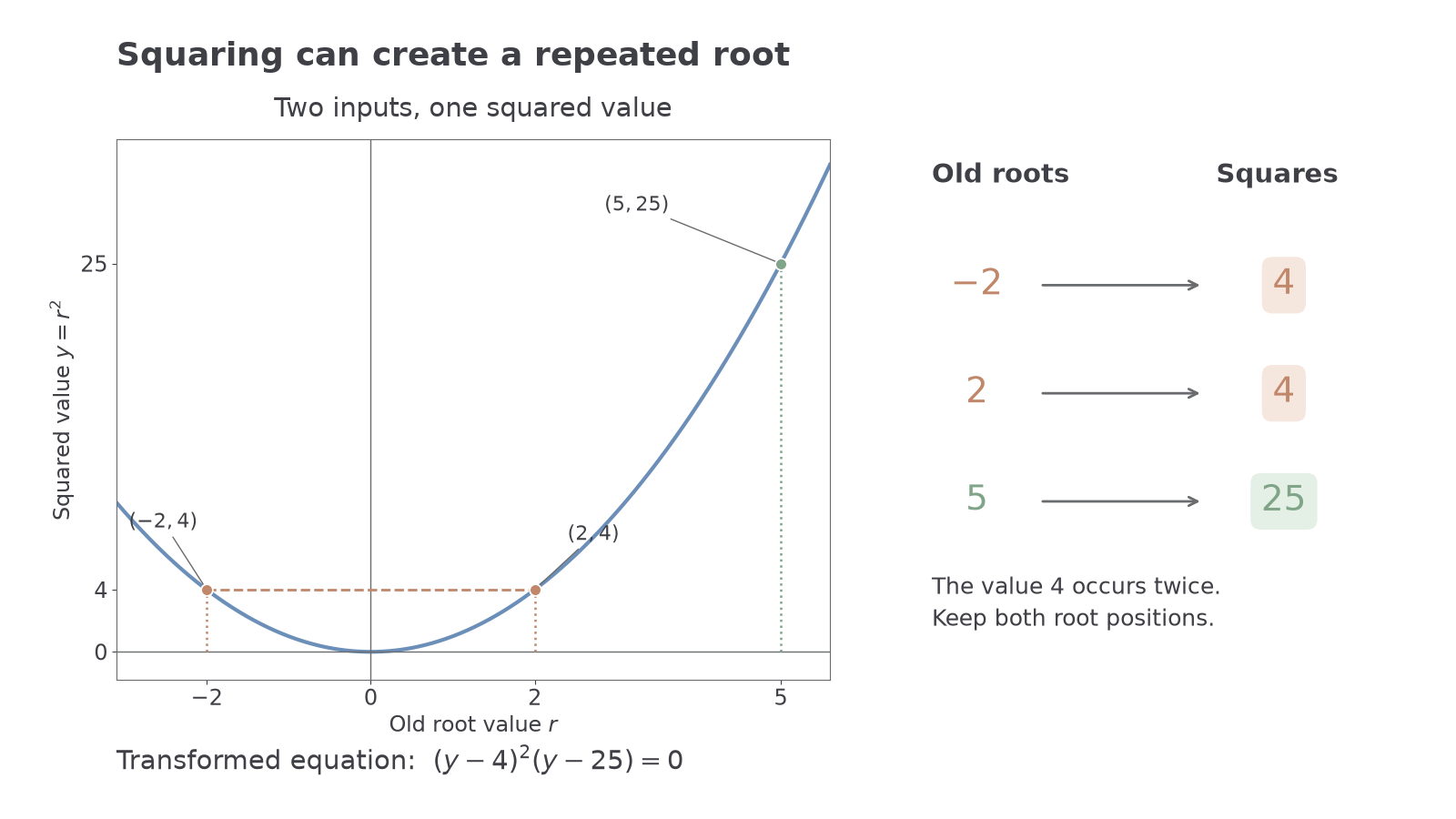
The graph displays the change of root values, rather than the graph of the old cubic itself. Its two equal heights explain why two old factors can produce a repeated new factor.
Worked example 5: detecting a lost repeated root
Question. A cubic has roots . A proposed equation for their squares is . Correct it to preserve the complete transformed root list and give the expanded equation.
Plan. Transform each position separately, retain multiplicities, then expand the resulting three factors.
Answer. , with a double root.
Check. The root sum is , pair-product sum , and product . These independently match the cubic coefficients. The proposed quadratic had the correct distinct values but lost one root position.
Symmetric relations can also construct a new equation when the new roots are pair products of three old roots. Their sum is . Their pair-product sum is
and their product is . Hence their monic equation is . No division was used, so this result still holds when an old root is zero. When , you could instead notice that the new roots are times the reciprocals of the old roots; the direct relations also cover the zero case.
Worked example 6: constructing an equation for pair products
Question. The roots of are . Find a cubic equation whose roots are .
Plan. Find the old symmetric combinations, then form the three combinations of the new roots.
The transformation has changed, but the coefficient check still follows the same three cubic relations. Keep the signs of those relations when assembling the new equation.
Answer. .
Check. The original polynomial is . Its pair-product roots are . Expanding gives , independently checking all coefficients.
A numerical check of one genuine transformed root can catch an error, but cannot prove the whole equation. The inverse substitution or factor argument establishes the complete correspondence; degree and coefficient checks then help catch arithmetic slips. This answers the opening question: reversing coefficients is valid because the substitution proves it, with the nonzero-root condition in place.
Watch out
Do not reduce the degree merely because transformed values coincide. Keep the multiplicity of the full transformed root list, and never use a claimed old root without checking it satisfies the original equation.
Use pair products with a zero old root to check why the direct symmetric method needs no nonzero-product condition.
Quick Recap
- Reciprocal roots use ; the old constant must be nonzero.
- Squared roots use , with odd/even separation to eliminate .
- Keep repeated transformed values with their multiplicities.
- Pair products of cubic roots have combinations , including when an old root is zero.
- Verify the complete substitution, then check coefficients or genuine numerical roots.
Coefficient reversal follows from the inverse substitution, and squared-root collisions explain why the new polynomial may have fewer distinct roots without having lower degree.