3.2 - Moments of forces
A force can turn a body as well as move it. In this part of 3.2, you will calculate moments using perpendicular distances, keep track of their directions and choose a reference point that makes a problem simpler.
Turning effect
Why is it easier to open a door by pushing near the handle than near the hinge? The force has a greater turning effect when its line of action is farther from the hinge. Pushing towards the hinge along the door gives no turning effect at all.
Moment of a force
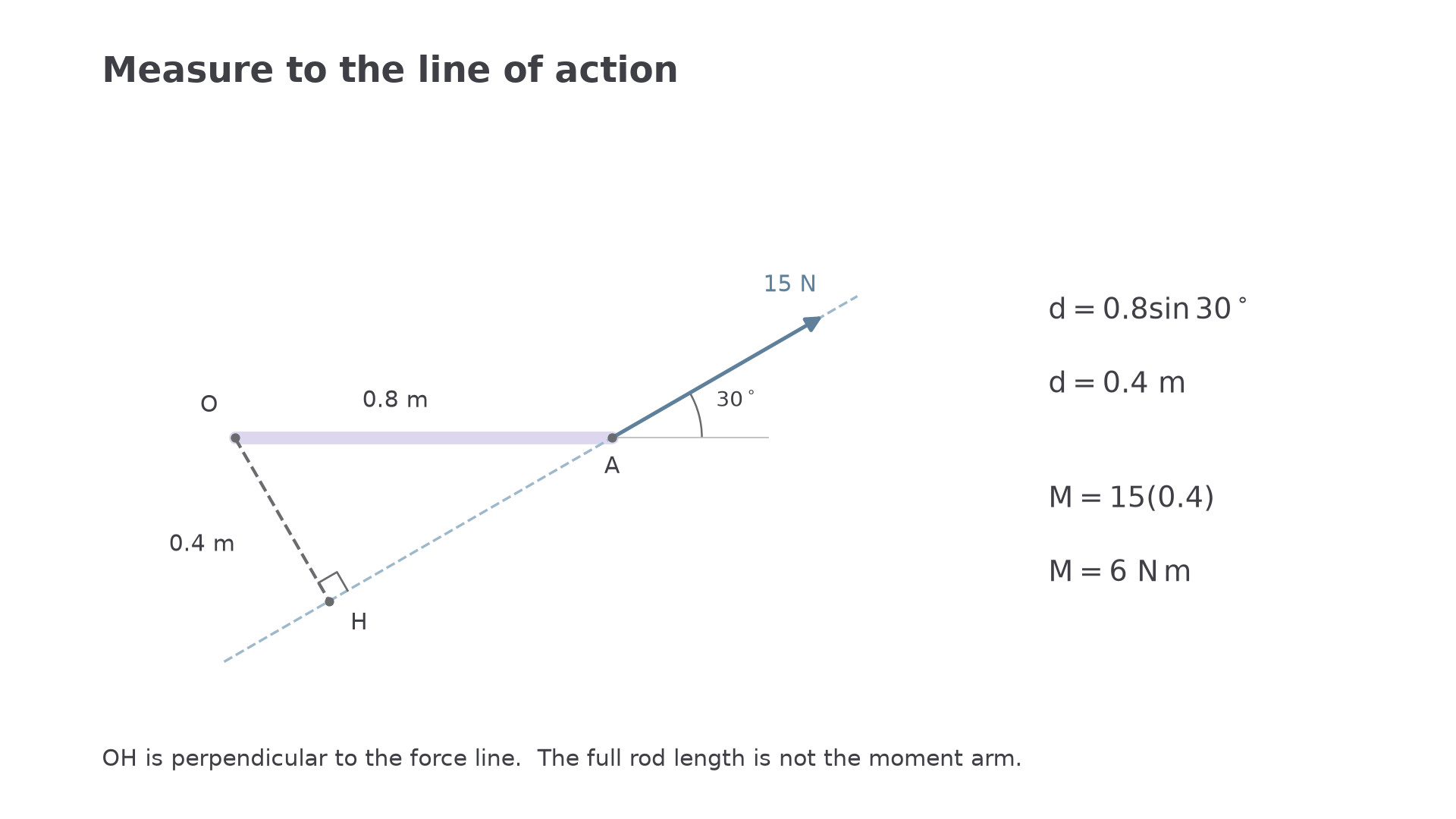
The moment of a force about a point is its turning effect about that point. Its magnitude is the force multiplied by the perpendicular distance from the point to the force's line of action, the straight line along which the force acts.
Imagine extending the force arrow into a complete straight line. Drop a perpendicular from the reference point to this line. That is the distance you need; it need not end on the physical body.
[DIAGRAM: asset_name: The perpendicular moment arm; asset_slug: cam9231-moment-arm; caption: The moment arm is perpendicular to the force line, not necessarily along the rod; description: A horizontal rod OA of length 0.8 metres carries an upward-right force of 15 newtons at A, inclined at 30 degrees to the rod. The force line is extended backwards. A dashed perpendicular from O meets this line at H, with OH labelled 0.4 metres and a right-angle marker at H.]
Magnitude of a moment
For a force of magnitude and perpendicular distance ,
If a point of application is distance from the reference point and the angle between that position line and the force is , then . Moments have units .
Not in the formula booklet: learn it.
You can instead resolve the force perpendicular to the rod and multiply that component by the rod length. These are two ways of describing the same geometry.
Worked example 1: an inclined force
Question. A horizontal rod has length . A force of acts at , upwards at to . Find its moment about .
Plan. Find the perpendicular distance to the force line, then identify the turning direction.
The upward force at the right end turns the rod anticlockwise.
Answer. anticlockwise.
Check. The vertical force component is . Its moment is ; the horizontal component acts through .
Keep the force and rod length fixed, but increase the angle. More of the force now acts perpendicular to the rod.
Worked example 2: changing the angle
Question. The force in the preceding geometry acts upwards at instead. Find its moment about .
Plan. Replace the perpendicular distance by .
Answer. , or , anticlockwise.
Check. A perpendicular force would give the maximum moment . The result lies between the value and this maximum.
A short sketch is often the quickest way to decide whether a sine or cosine is needed.
Watch out
The line is wrong unless the force is perpendicular to the position line. Use the perpendicular distance, or the perpendicular component of the force.
Try the component method or the distance method, and state the direction.
Clockwise and anticlockwise
Moments in opposite directions oppose each other, so add them with signs. Choose anticlockwise positive, for example, and keep that choice throughout the calculation.
The side of the reference point matters as well as the force direction. An upward force to the right turns anticlockwise; an upward force to the left turns clockwise. You do not need a three-dimensional vector treatment for these coplanar problems.
Total moment
The total moment about a point is the algebraic sum of the moments of all the forces about that same point. With anticlockwise positive, clockwise moments are negative.
For vertical forces applied on a horizontal line, let be the signed horizontal coordinate from , and let be positive upwards. Then the signed moment is . This is a convenient consequence of the turning directions, rather than a new sign rule to memorise.
Continue this lesson.
You’re previewing NovaLearn without an account. Create a free account to read the rest.
Create free account