3.1 - Flight time, range and height
Two projectiles launched at the same speed can have the same range but very different flight times and greatest heights. You will derive those quantities, then adapt the equations when the landing surface is above or below the launch point.
Landing at launch height
Can a steeper launch land at exactly the same horizontal distance as a shallower one? A particle launched at at returns to launch height after seconds and travels . Changing the angle to makes its horizontal speed smaller, but keeps it airborne longer. We will see why the range is unchanged.
Measure vertically upwards from launch. With initial speed and ,
At launch height , so
The root describes launch. The later root is the time of flight to the same height. Multiply it by the constant horizontal velocity to obtain the range, the horizontal distance from launch to landing.
Same-level flight time and range
For landing at launch height, without an earlier collision,
Here , and . These results are not listed separately in MF19; derive them from the supplied constant-acceleration equations.
The factor explains the surprising pair. Replacing by leaves unchanged. For fixed speed on a horizontal plane, the greatest range is , achieved at , because the largest value of the sine is . That conclusion depends on equal launch and landing heights and negligible air resistance.
[DIAGRAM: asset_name: Complementary launch angles; asset_slug: cam9231-projectile-range; caption: Launches at 30 degrees and 60 degrees share a range but have different flight times and heights; description: Exact trajectories for speed 20 metres per second with gravity 10 metres per second squared, launched from the origin at 30 degrees and 60 degrees. Both return to ground at x equals 20 root 3 metres. Their highest points are labelled 5 metres and 15 metres, and their flight times are labelled 2 seconds and 2 root 3 seconds.]
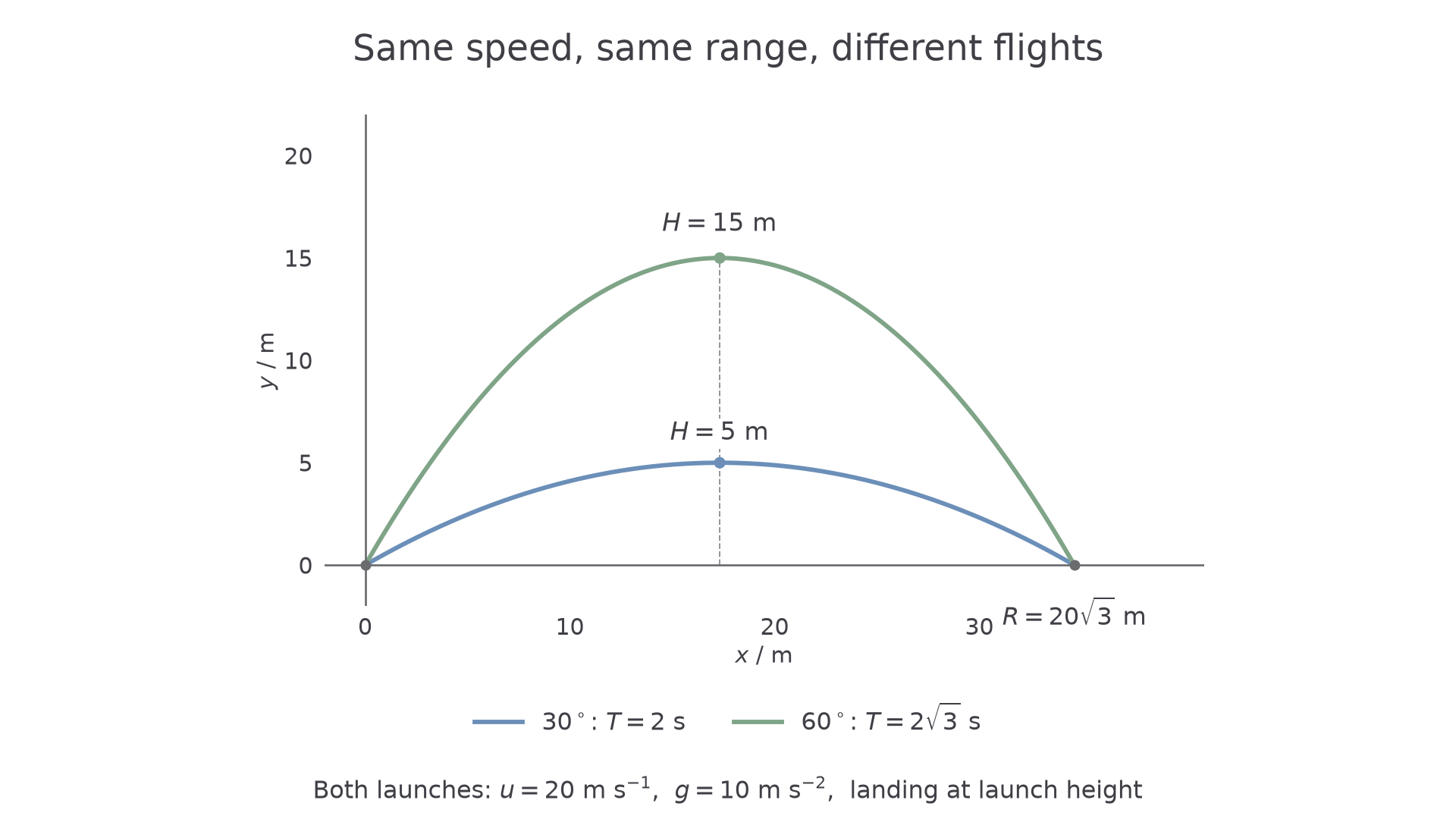
The diagram compares two complete free flights, with no obstacle before the landing point.
Worked example 1: a shallower launch
Question. A particle is projected at , at above a horizontal plane. Find its time of flight and range on that plane. Use .
Plan. Set the vertical displacement to zero, discard launch time, then use horizontal motion.
Answer. The time is , and the range is , or .
Check. The vertical velocity changes from to in two seconds, giving zero average vertical velocity and hence zero vertical displacement. Independently, the range formula gives .
Change only the angle to its complement. The horizontal component and flight time will change in opposite ways.
Worked example 2: a steeper launch
Question. The particle is instead launched at , with the same speed. Find its time of flight and range.
Plan. Use the new vertical component to find time, then multiply by the new horizontal component.
Answer. The time is , or , and the range remains .
Check. Substituting into gives . The horizontal speed is , compared with before, while the time is times as large. Their product is unchanged.
These results do not describe a launch from a cliff to lower ground. There the vertical displacement at impact is not zero.
Watch out
is a same-level result. For a different landing height, solve the vertical equation with that actual displacement.
Try another complementary-angle pair.
Greatest height
The projectile stops rising when its vertical velocity reaches zero, even though its horizontal velocity continues.
For initial upward velocity , the vertical velocity is . It reaches zero at , then becomes negative. Thus this time gives a maximum vertical position. Using at gives the rise above launch directly.
Greatest rise above launch
For an upward launch, with no impact before its highest point,
is the greatest height above launch, not automatically above the ground. These results are not listed separately in MF19; the constant-acceleration formulae used to derive them are supplied.
For a same-level flight, the top occurs halfway through the flight time. For a different landing level, that halfway statement generally fails. If the projectile starts horizontally or downwards, its maximum height during the flight may simply be its launch height; do not use a negative “time to the top” as a future event.
Worked example 3: greatest height above the plane
Question. A particle is projected from horizontal ground at at above the horizontal. Find the greatest height above ground and the time when it is reached. Use .
Plan. Set the vertical velocity to zero and use the time-free vertical equation for height.
The initial vertical velocity is . Therefore
Answer. The greatest height is , reached after .
Check. Completing the square gives . The subtracted square is nonnegative, so , with equality at .
Continue this lesson.
You’re previewing NovaLearn without an account. Create a free account to read the rest.
Create free account