1.3 - Sums to infinity
An infinite sum is defined through its finite partial sums. You will use 1.3 methods to decide whether those sums approach a finite limit, evaluate a convergent series, and measure the tail left after stopping at a finite number of terms.
Limits of partial sums
Can infinitely many positive terms add to a finite number? The series beginning does: its sum of the first terms is , always below and approaching .
The individual terms form a sequence. Adding them gives a series. For terms , write . For the example, , and .
Convergence of a series
The series converges with sum if its partial sums approach the finite real number as :
If there is no finite limit, the series diverges. For example, partial sums that grow without bound, or alternate between two fixed different values, do not converge.
For a rational expression in , divide numerator and denominator by the highest relevant power of , or rearrange to make the limiting behaviour visible. A denominator becoming large is insufficient by itself: the numerator may grow as fast or faster.
Worked example 1: a finite limit
Question. A series has partial sums for . Determine whether the series converges, and state its sum if it does.
Plan. Divide by to find the limit of the partial sums.
since .
Answer. The series converges with sum .
Check. Rearrangement gives . Its distance below is exactly , which tends to zero, independently confirming the limit.
Change only the leading numerator term from to . The denominator still grows, but now the numerator grows faster.
Worked example 2: unbounded partial sums
Question. A series has partial sums . Determine whether it converges.
Plan. Divide by and compare the growth in numerator and denominator.
The denominator approaches , whereas the numerator grows without bound. Thus , rather than a finite number.
Answer. The series diverges; it has no finite sum to infinity.
Check. Polynomial division gives . The lower expression grows without bound, confirming that cannot approach any finite value.
Divergence need not mean growth to infinity. For , the partial sums are . Odd-indexed partial sums stay at , while even-indexed partial sums stay at ; there is no single limit. In this definition, the series therefore has no sum to infinity.
Key idea
Investigate the sequence of partial sums. A finite limit gives a convergent series; unbounded partial sums or distinct odd-index and even-index limits give divergence.
Find the limit from the complete rational expression in this check.
Evaluating a convergent sum
To find an infinite sum by differences, first obtain a finite sum with its final boundary terms intact, then take the limit.
There is no last term of an infinite series to cancel. A finite calculation avoids that difficulty: the boundary terms are explicit functions of , so you can justify exactly what happens to them as increases.
You already know
. A gap of two leaves two terms at each end.
For reciprocal boundaries, for any fixed constant . A geometrically weighted boundary such as also tends to zero: it is positive and no larger than . State the limit of the actual expression that remains.
Worked example 3: two vanishing boundaries
Question. Show that converges and find its sum.
Plan. Split the summand into a difference with a gap of two, find , then take its limit.
Therefore
Both reciprocal boundaries tend to zero, so .
Answer. The series converges with sum .
Check. The proposed finite expression has , the original first term, and . Thus the expression whose limit we used has the correct start and every correct increment.
Change only the lower limit from to . The late boundary terms have the same limits, but one early term has been removed.
Worked example 4: a later starting point
Question. Find , justifying convergence.
Plan. Sum from to a finite upper limit , keeping the new starting boundaries.
For ,
The last two terms tend to zero.
Answer. The series converges with sum .
Check. Remove the first term from Worked example 3: , independently agreeing with the changed boundaries.
Removing any fixed finite number of terms changes the sum by their total but does not change whether a series converges: the new partial sums differ from the original ones by a fixed constant.
Watch out
Do not drop final terms while the upper limit is finite. Write the exact finite sum first, then show that its boundary terms tend to zero.
Move the starting point again, retaining the same summand.
Remainders and tails
Once a series converges, its finite-sum formula also tells you exactly how much is missing when you stop.
If , the remainder after terms is . This is the tail starting at term , not term . For a series with positive terms, is positive and measures how far the partial sum lies below the total.
For , the earlier telescoping result gives
The original terms are getting small, but the tail includes infinitely many of them. For example, after four terms the remaining sum is , while the next term alone is only .
[DIAGRAM: asset_name: Partial sum and remaining tail; asset_slug: cam9231-series-tail; caption: After four terms the partial sum is four fifths and the entire remaining tail is one fifth; description: Exact plot of S sub n equals 1 minus 1 over n plus 1 for integer n from 1 to 10, approaching the horizontal line L equals 1 from below. At n equals 4 the point is labelled S sub 4 equals four fifths, with a vertical arrow to the limit line labelled R sub 4 equals one fifth. A side panel distinguishes the next term u sub 5 equals one thirtieth from the entire tail R sub 4 equals one fifth.]
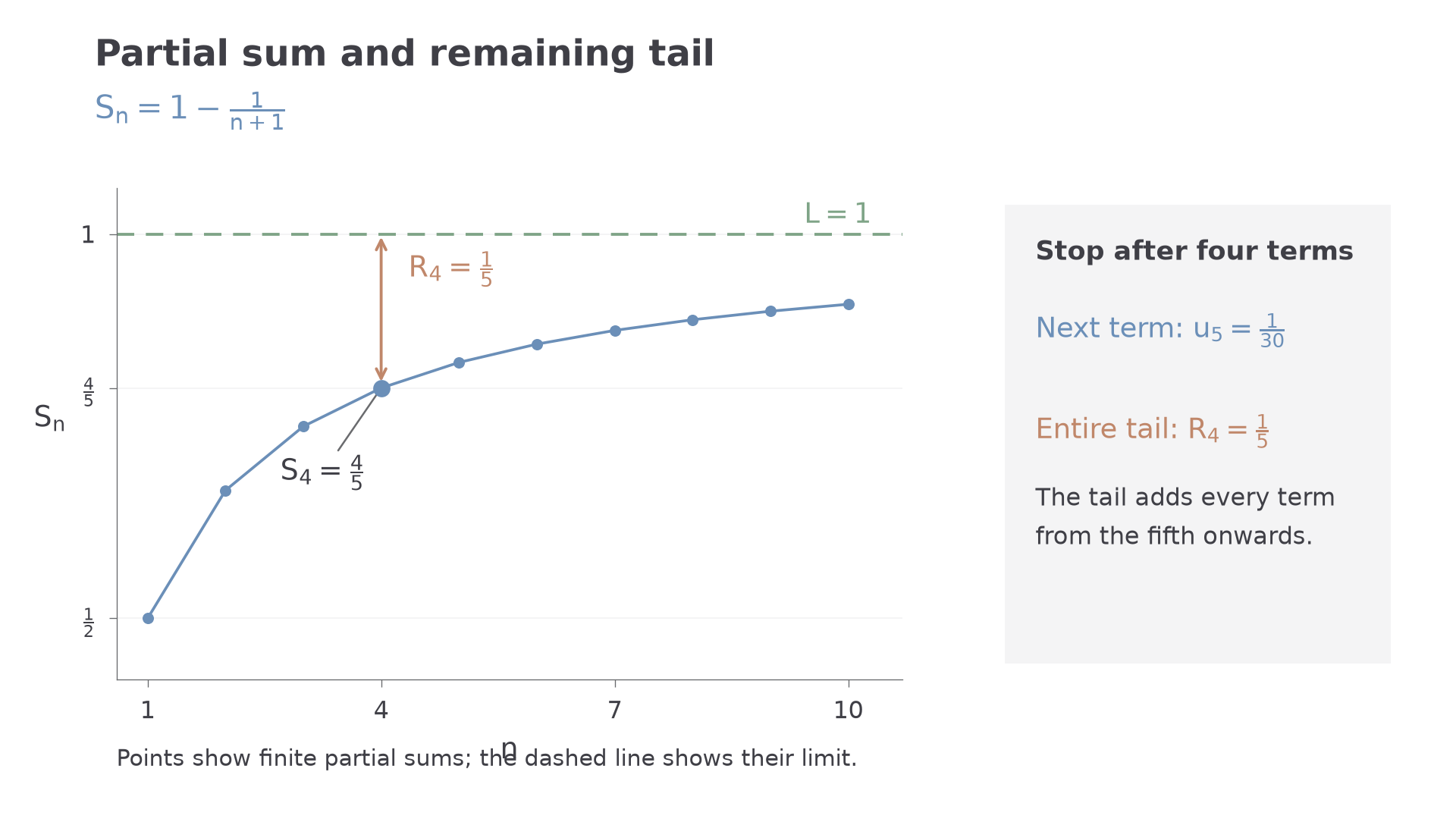
If a tail begins at term , remove only the first terms: . Thus, for this particular series, .
Worked example 5: a strict error bound
Question. For , find the least number of terms needed so that the remainder is less than .
Plan. Use the exact remainder and solve the strict inequality, remembering that is an integer.
The reciprocals are positive, so a smaller reciprocal has a larger denominator.
Answer. The least number is terms.
Check. With terms, the remainder is exactly , which fails the strict condition. With terms, it is .
Change only “less than” to “at most”. Equality is now allowed, so the least integer can change.
Worked example 6: an inclusive error bound
Question. For the same series, find the least number of terms needed so that the remainder is at most .
Plan. Solve the inclusive inequality using the same exact remainder.
Answer. The least number is terms.
Check. The tail starting at term is , which is allowed. Stopping one term earlier leaves the tail starting at , whose sum is too large.
A convergent series must have : since , both partial sums tend to the same , and their difference tends to zero. The reverse statement is false. Terms tending to zero alone do not establish convergence.
To see why, consider . Its terms tend to zero, but group its partial sum at powers of two:
In the block ending at , there are terms, each at least . Each block therefore adds at least . There are such blocks after the initial , giving . Those partial sums are unbounded, so the harmonic series diverges despite its terms tending to zero. This is a direct argument about partial sums, not a conclusion from the appearance of a few small terms.
Watch out
is necessary for convergence, but it is not sufficient. To justify a sum to infinity here, show that the finite partial sums approach a finite limit.
Use the exact tail, rather than the next term, in the final check.
Quick Recap
- A sum to infinity is the finite limit of partial sums, when that limit exists.
- Find the finite sum before taking a limit; justify what happens to every remaining boundary term.
- The remainder after terms starts at term and equals .
- Terms tending to zero do not by themselves prove convergence.
The opening positive series converges to , although every finite partial sum is smaller than .