3.4 - Elastic potential energy
An elastic element can store energy even when its ends are momentarily at rest. You will calculate that energy, track its transfer to kinetic and gravitational potential energy, and find greatest extensions without assuming that a turning point is an equilibrium position.
The energy formula
Does doubling a spring's extension double its stored energy? It doubles the force at the end, but stretching also takes place over twice the distance: the stored energy becomes four times as large.
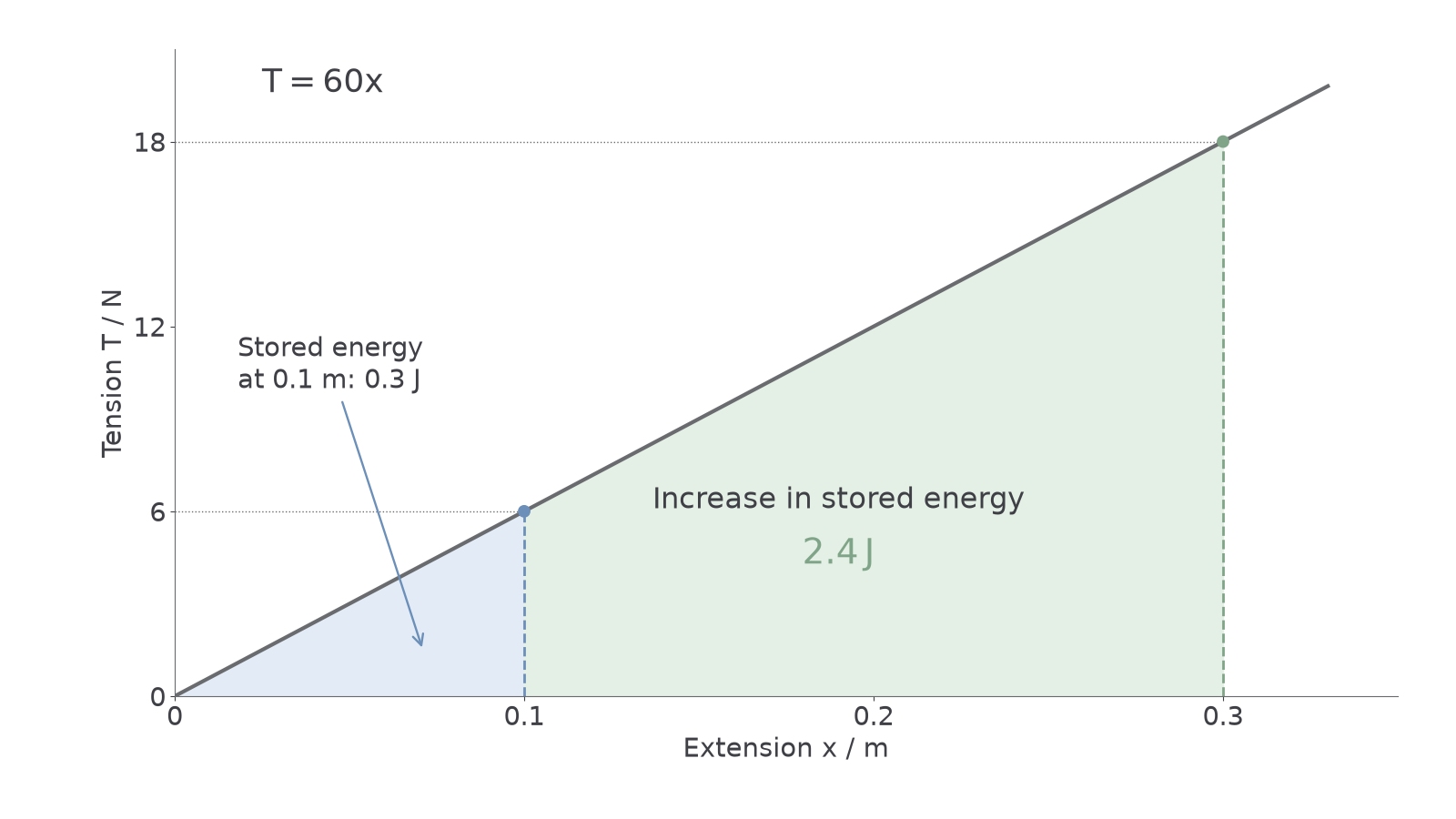
For a spring with stiffness , the force rises from zero to during an extension of . The work needed to stretch it slowly is the triangular area under its force–extension graph: . This work becomes elastic potential energy.
[DIAGRAM: asset_name: Elastic energy as area under a force graph; asset_slug: cam9231-elastic-energy-area; caption: The area from zero gives stored energy, while the area between two extensions gives its increase; description: An exact graph of tension T equals 60x has extension x in metres horizontally and T in newtons vertically. A pale blue triangle from zero to x equals 0.1 has area 0.3 J. A pale sage region from x equals 0.1 to x equals 0.3 has area 2.4 J. Labels show T equals 6 N and 18 N at those extensions.]
Elastic potential energy
An elastic string with natural length , modulus and extension stores energy
The same formula applies to a spring with signed extension : compression also stores positive energy. A slack string stores zero elastic energy.
In the formula booklet.
The area argument explains the factor ; a proof is not required. If the extension changes from to , calculate , not . Energy depends on both states, not just on the distance moved between them.
Worked example 1: increasing an extension
Question. A spring has natural length and modulus . Find the increase in its elastic potential energy when its extension increases from to .
Plan. Calculate the energy at each extension and subtract.
Answer. The stored energy increases by .
Check. The stretching force rises linearly from to . The trapezium under the graph has area .
Change only the initial state from extension to compression of the same magnitude. A spring still stores energy in that initial state.
Worked example 2: starting with compression
Question. The same spring is initially compressed by . Find the change in its elastic potential energy when it reaches extension .
Plan. Use and in the two energy values.
Answer. The stored energy again increases by .
Check. Uncompressing to the natural length releases ; stretching from there to requires . The net input is , although the end has moved .
For a string, do not insert a negative extension and square it. In that region the string is slack, so the elastic energy is zero. The distinction between string and spring survives in energy calculations.
Watch out
has units of force, not energy. The extension must be squared in . A compressed spring does not have zero stored energy.
Use the initial and final states separately.
Work and energy
When a stretched string pulls a particle upwards, some elastic energy can become gravitational potential energy and the remainder can become kinetic energy.
You already know
Kinetic energy is . A rise through vertical height increases gravitational potential energy by . Work by a constant force is its component in the direction of motion multiplied by the distance moved.
Choose one system containing the particle and its elastic element. Count the elastic force through its stored energy, and gravity through gravitational potential energy. Do not also add work by these same forces. Other forces, such as resistance or an applied pull, contribute their work separately.
Energy balance
For a particle and its elastic element,
Here , with one consistent height datum. Work opposing the displacement is negative. With no work by other forces, the total mechanical energy is conserved.
This balance follows from work and energy; the elastic energy formula is in the formula booklet.
A normal reaction does no work when the displacement is along a fixed smooth surface. Resistance does negative work even when the particle reverses its direction: its direction also reverses to oppose the motion.
Worked example 3: elastic energy lifts a particle
Question. A particle of mass hangs from a light elastic string fixed at its upper end. The string has natural length and modulus . The particle is held with extension , then released from rest. Find its speed when the extension first becomes . Neglect resistance and take .
Plan. Equate the elastic energy released to the gain in kinetic and gravitational potential energy.
The particle rises by . The string remains stretched throughout this interval.
Answer. The speed is .
Check. Over the upward displacement, tension falls linearly from to . Its average is , while weight is . Net work is therefore , agreeing with the kinetic energy gained.
Continue this lesson.
You’re previewing NovaLearn without an account. Create a free account to read the rest.
Create free account