3.4 - Forces in elastic strings and springs
An elastic string pulls harder as it stretches, while a spring can also push when compressed. You will use natural length and modulus of elasticity to calculate these forces, then combine them with force balance in vertical and inclined systems.
Extension and modulus
If a string is cut in half, does the same extra length still produce the same tension? The answer depends on the fraction of its natural length by which it stretches.
A string whose natural length is has extension when its length is . The extension is the extra length, not the distance between its ends.
Natural length and modulus of elasticity
The natural length is the length of an elastic element when it is unstretched and uncompressed. Its extension is , where is its current length.
The modulus of elasticity is the constant in Hooke's law. It has the units of force, usually newtons. In this model it equals the tension that would occur at extension , where the length has doubled.
For a stretched elastic string, Hooke's law makes tension proportional to extension. This is an ideal model: the element is light, and the law is assumed valid over the extensions considered. We do not infer that a real material can be stretched indefinitely.
Hooke's law
For an elastic string of natural length , modulus and extension :
The force pulls along the string towards its other end. The stiffness is , with units .
In the formula booklet.
The dimensionless ratio is the fractional extension. The modulus is not the stiffness: two pieces of the same uniform string have the same modulus, but the shorter piece has the larger stiffness.
Worked example 1: tension from the current length
Question. A light elastic string has natural length and modulus . Find its tension when its length is .
Plan. Find the extension before applying Hooke's law.
Answer. The tension is .
Check. The string has stretched by one quarter of its natural length. Its tension must therefore be one quarter of its modulus, which is , rather than a force exceeding .
Now keep the material and the extension unchanged, but halve the natural length. This isolates the effect of using a shorter piece.
Worked example 2: half of a uniform string
Question. The uniform string in Worked example 1 is cut into two equal pieces. One piece is stretched to length . Find its tension.
Plan. Use the piece's natural length with the original modulus.
Each piece has natural length and modulus . Thus
Answer. The tension is .
Check. The whole string extended by would consist of two identical pieces, each extended by . Its tension would be , agreeing with the force transmitted through each piece.
This answers the opening question: the same extra length produces twice the tension in the half-length piece. For an uncut uniform string attached at its midpoint, each half likewise has half the natural length and the same modulus.
Watch out
Using treats the entire current length as extension. Subtract the natural length first. When considering half a string, halve its natural length too.
Apply the same reasoning to a different uniform string.
Strings and springs
A stretched string and a stretched spring both pull, but shortening them below their natural length produces different behaviour.
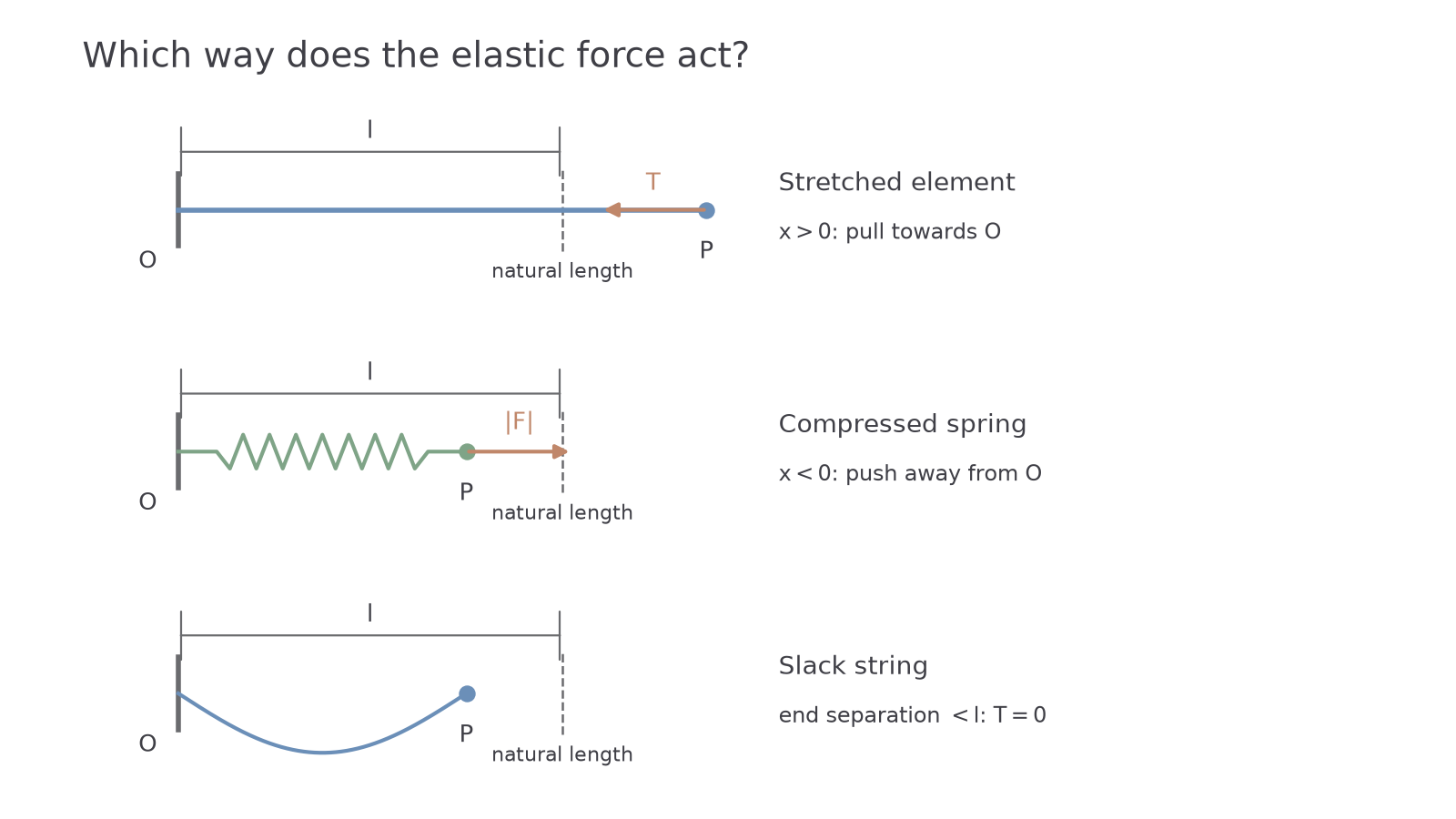
Put one end at a fixed point , with the other end to its right. A stretched element pulls left towards . A compressed spring pushes right, increasing its length towards the natural length. A string simply becomes slack: it cannot push.
[DIAGRAM: asset_name: Extension, compression and slackness; asset_slug: cam9231-elastic-force-directions; caption: A stretched element pulls, a compressed spring pushes, and a slack string exerts no force; description: Three horizontal constructions have a fixed left end O and a particle P on the right. Dashed reference lines mark natural length l. The stretched element has P beyond the reference and a leftward force arrow. The compressed spring has P before the reference and a rightward force arrow. The slack string joins O to a closer P with no force arrow. Lengths and signed extensions are labelled.]
Restoring force for a spring
Take the coordinate positive away from the fixed end, along a straight spring. With signed extension , its force on the moving end is
For , the spring is compressed and . Its force magnitude is . For a string with , the tension is zero instead.
The Hooke's law relation is in the formula booklet; the sign follows from the chosen direction.
The spring model assumes that the spring can remain straight and obey Hooke's law in compression. A stretched string must be straight and taut before its end-to-end distance can be used as its length. A slack string can curve between its ends.
Worked example 3: a spring pushes
Question. A light spring has natural length and modulus . Its left end is fixed at ; a particle at its right end is held to the right of on a smooth horizontal line. Find the spring's force on the particle.
Plan. Use the signed extension and take rightwards as positive.
Answer. The spring pushes the particle rightwards with force .
Check. A rightward movement would increase the spring's length towards , so the calculated force has the restoring direction. A leftward answer would compress the spring further.
Continue this lesson.
You’re previewing NovaLearn without an account. Create a free account to read the rest.
Create free account