1.5 - Areas in polar coordinates
A thin circular sector leads to an area formula for a changing radius. You will choose angular bounds from the geometry, count each region once, and combine sectors to find areas inside or between polar curves.
The polar sector formula
How can you find an area when its boundary is easier to describe by direction than by horizontal position? Divide it into thin wedges instead of vertical strips.
A circular sector of radius and angle has area . For a variable radius, split the angle interval into small pieces. Over a small angle , the radius is approximately constant, so the wedge area is approximately . Adding these and taking the limit gives the integral below.
[DIAGRAM: asset_name: Thin sectors approximate a polar region; asset_slug: cam9231-polar-sector; caption: A thin wedge has approximate area one half r squared times its angle; description: Equal-scale axes show the region swept from theta equals zero to theta equals pi over three under r equals 4 cos theta, shaded pale blue. Two nearby rays at theta equals 0.55 and 0.66 bound a pale clay circular wedge using radius 4 cos 0.605. The varying-radius boundary, wedge angle delta theta, representative radius r and outer angular bounds are labelled. A side panel shows the wedge area approximation and its limiting integral.]
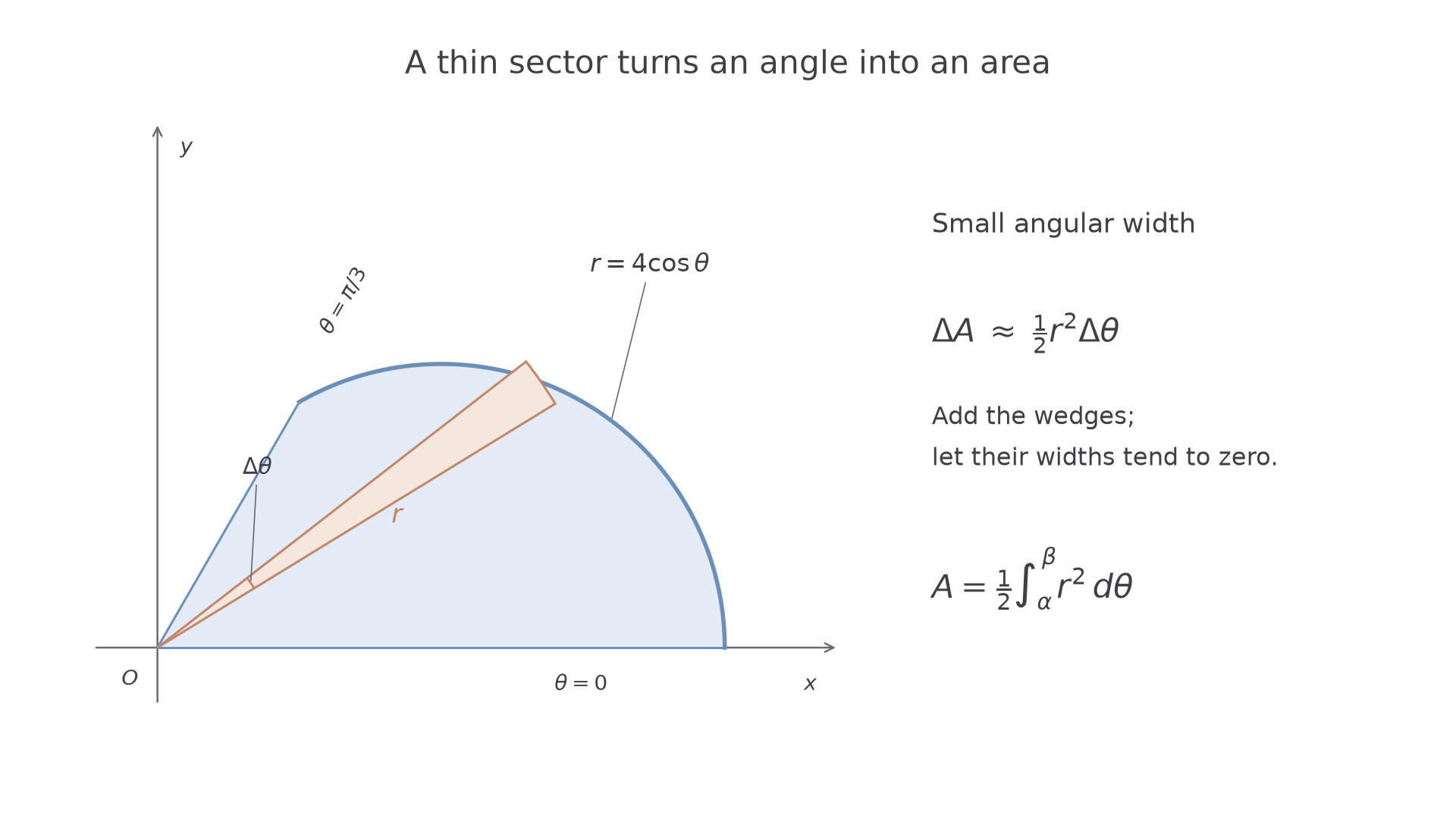
Polar sector area
For a continuous nonnegative radius , the area swept from to , with , is
provided the region is traced once. Angles must be in radians. The polar integral formula is not in the formula booklet: learn it. The circular-sector formula is supplied there.
The area includes every distance from the pole up to the boundary radius on each permitted ray. If a sector has an inner boundary, it will need a subtraction. If a curve is described by , use that expression directly in the integral; there is no need to square-root and then square it again.
Worked example 1: a constant radius
Question. Find the area swept by for .
Plan. Integrate one half of the squared radius over the stated angle interval.
Answer. square units.
Check. The sector is one sixth of a circle of area , giving independently.
Now let the radius decrease with direction while keeping the same starting radius and angular bounds. The answer must be smaller.
Worked example 2: a changing radius
Question. Find the area swept by for .
Plan. Square the radius and use .
Answer. square units.
Check. This is approximately , smaller than , as expected. It is greater than the sector with constant radius , whose area over the same angle is , since here.
The factor comes from the sector geometry, not from integrating a square. Keep it even when the equation already supplies .
Watch out
is not an area formula. Square the radius, retain the factor , and check that the interval uses only permitted nonnegative radii.
Apply the same calculation with a new radius scale.
Choosing angular limits
The integral needs the directions bounding the required region, rather than a memorised full-turn interval.
For a closed lobe that starts and ends at the pole, solve to find its end directions. Choose consecutive zeros that enclose that lobe, checking the sign between them. If a boundary is another curve, solve for its intersections as well. Sketch enough of the geometry to decide which solutions bound the required region.
Worked example 3: one complete circle
Question. Find the area enclosed by , using the nonnegative-radius convention.
Plan. Find the pole directions enclosing the circle, then integrate once between them.
The radius is zero at and positive between them. As the ray turns from to , it traces the circle once, apart from the shared pole endpoint.
Answer. square units.
Check. Cartesian conversion gives , a circle of radius and area .
Replace in the cosine by . The right-hand lobe now returns to the pole after a smaller angular sweep.
Worked example 4: a narrower lobe
Question. Find the area of the right-hand lobe of .
Plan. Find the two zero-radius directions surrounding , and integrate only across that lobe.
for the required consecutive endpoints. Between them, .
Answer. square units.
Check. Set . The integral becomes , half the preceding circle's integral. The same radial pattern is compressed into half the angle, so its area is halved.
For the circle in Worked example 3, integrating the squared expression over would give : the wrong answer. Half of that interval has a forbidden negative value of . Squaring before checking the geometry hides this problem.
For an intersection with , the equation gives on the circle's allowed interval. These directions will bound the region between the curves in the next part. Check the pole separately: two curves can meet there at different angle values, so equating radii at one common angle is not always a complete intersection test.
Problem-solving
Mark the required region, solve for its boundary directions, and check one interior angle. Count each sector once; a symmetry multiplier must match the region actually integrated.
Find a fresh lobe using the same endpoint test.
Regions between curves
Two boundaries on the same ray enclose a thin annular sector, so subtract their squared radii on that ray.
Suppose is outside throughout an interval, with . Subtracting their thin-sector areas gives
This follows from the sector formula and is not separately supplied in the formula booklet. It is the difference of squares, not . For a common interior, use the smaller boundary radius on each ray; split the integral wherever that boundary changes.
Worked example 5: inside one circle and outside another
Question. Find the area inside and outside .
Plan. Find where the first radius exceeds the second, then subtract sectors over those directions.
At the nonzero intersections, , so . Between them, ; outside them, no point is both inside the first circle and outside the second.
The second line uses horizontal symmetry; its factor cancels the original .
Answer. square units.
Check. Both circles have radius , with centres and . Their intersection chord is , with heights , agreeing with . The area is positive and below the area of the first circle.
Keep the two boundaries and change only the requested region. A common interior now includes directions all the way to , with a change of outer boundary at each intersection direction.
[DIAGRAM: asset_name: Subtraction and common interior use different radial bounds; asset_slug: cam9231-polar-overlap; caption: The same intersections separate an outer crescent from a common interior with switching boundary; description: Two equal-scale panels show circles r equals 4 cos theta and r equals 2, with centres (2,0) and (0,0). Intersections (1, plus or minus root 3) and rays theta equals plus or minus pi over three are labelled. Left shades the region inside the first and outside the second. Right shades the common interior and uses a sample ray below pi over three where r equals 2 is the boundary and a ray above pi over three where r equals 4 cos theta is the boundary.]
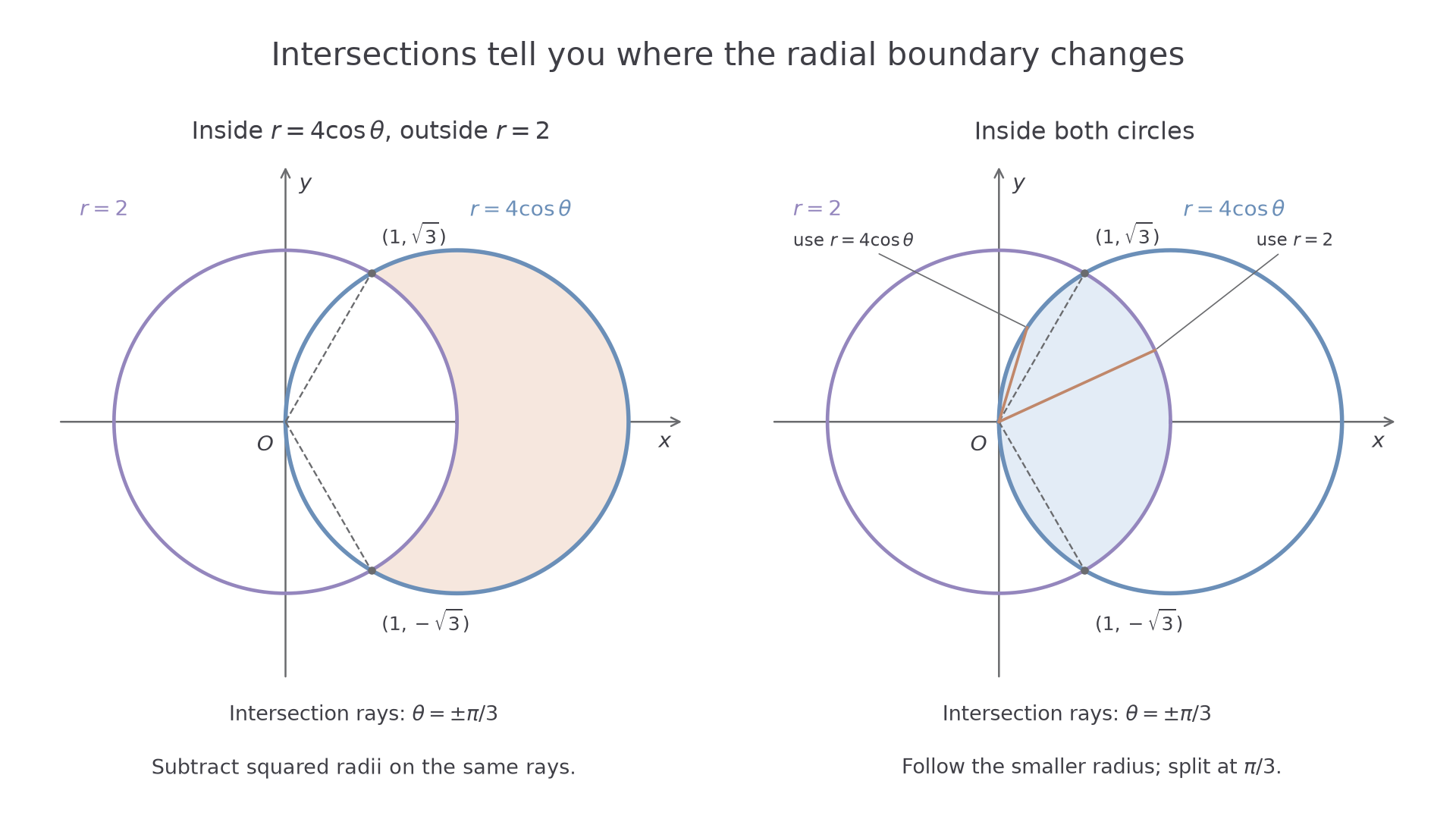
Worked example 6: the common interior
Question. Find the area inside both and .
Plan. Use horizontal symmetry and the smaller radius on each positive-angle ray.
For , the smaller radius is . For , it is . Thus
Answer. square units.
Check. Adding this to the outer-only area from Worked example 5 gives , the entire area of the circle . The two disjoint regions fill that circle exactly.
The wedges answer our opening question because their angular descriptions stay simple even when vertical strips would need several Cartesian equations. The geometry still decides which wedges to add or subtract.
Watch out
Subtracting two whole enclosed areas does not usually give an overlap or a crescent. Compare boundaries on the same ray, find their intersection directions, and split at a change of boundary.
Use a different scale for the common-interior calculation.
Quick Recap
- Start from , with radians and a single sweep of the region.
- Solve for zero radii and intersection directions before choosing limits.
- Between two radial boundaries, integrate one half of the outer square minus the inner square.
- For a common interior, follow the smaller radius and split wherever it changes.