1.4 - Invariant points and lines
A transformation can leave a point exactly where it was, or leave a whole line unchanged while moving its points along it. Find both kinds of invariance, including vertical lines and lines away from the origin, and distinguish an unchanged line from one that collapses to a point.
Invariant points
Can a line stay in the same place even when most of its points move? First settle the simpler question: which individual points stay exactly where they are?
For reflection in the -axis, . A point stays put exactly when , giving . Every point of the mirror line is fixed, although other points move.
Invariant point
An invariant point, or fixed point, has the same position before and after the transformation. Its position vector satisfies
The origin is an invariant point of every two-by-two matrix transformation.
Use the same coordinates for the input and output only when looking for fixed points. Rearranging gives . A two-by-two calculation becomes two simultaneous linear equations.
Finding invariant points
For , solve
Keep every solution: the answer may be only the origin, a whole line, or the whole plane. Not in the formula booklet: learn it.
The whole plane is fixed only for the identity matrix. If the two equations reduce to a single nonzero linear equation, the fixed points form a line through the origin.
Worked example 1: only one fixed point
Question. Find all invariant points of .
Plan. Equate each image coordinate to its original coordinate and solve the resulting simultaneous equations.
Subtracting the second simplified equation from the first gives , then .
Answer. The origin is the only invariant point.
Check. has determinant , so its homogeneous system has only the zero solution.
Change only the bottom-right entry from to . This makes the two fixed-point equations dependent.
Worked example 2: a line of fixed points
Question. Find all invariant points of .
Plan. Form the fixed-point equations and check whether they are independent.
in both cases. There is one condition, , not a unique pair of coordinates.
Answer. Every point on is fixed, and no point off that line is fixed.
Check. For an arbitrary point , the image is . Conversely, a fixed point must satisfy the derived equation .
A line of fixed points is stronger than a line that is merely invariant as a set. In the next part, a point may move to a different point on the same line.
Watch out
If both equations reduce to , do not set and separately. There are infinitely many solutions, including .
Find the full set, rather than one example of a fixed point.
Invariant lines through the origin
A line through the origin is unchanged as a whole when its direction is preserved and it does not collapse to a single point.
For example, the stretch maps the -axis onto itself. The point moves to , so the line is invariant even though most of its points are not fixed.
Invariant line
An invariant line is mapped onto the same line. Its individual points may move along it.
If every point stays in its original position, the line is pointwise fixed. Otherwise it can still be setwise invariant: the set of points on the line is unchanged.
Use different letters for image coordinates. For a nonvertical line , substitute a general point into
This gives . The image stays on the line when , so compare the coefficients of .
Invariant directions
For a finite gradient , solve
Also require so that the whole line is obtained rather than just the origin.
Test the vertical line separately: it is mapped onto itself when and . Not in the formula booklet: learn it.
For a non-singular matrix the non-collapse conditions are automatic once the direction condition holds, but vertical lines still need their own check. For a singular matrix, inspect them explicitly. For example, fixes the -axis but collapses the -axis to the origin; its image of the -axis is not the same whole line.
Worked example 3: two finite gradients
Question. Find all invariant lines through the origin for .
Plan. Use a general point on , impose the same gradient on its image, then test the vertical line.
For ,
The condition gives
Thus or . Their multipliers are and , both nonzero. A point maps to , so the vertical line is not invariant.
Answer. The invariant lines are and .
Check. , so maps onto itself. Also , so is actually pointwise fixed.
Change only the top-right entry from to . One invariant direction is now vertical and cannot appear as a finite root of the gradient equation.
Worked example 4: keeping the vertical line
Question. Find all invariant lines through the origin for .
Plan. Solve the finite-gradient condition without assuming it must be quadratic, then examine .
For ,
Hence , giving . For the vertical line,
which covers the whole -axis as varies.
Answer. The two invariant lines are and .
Check. , confirming . The independent determinant check rules out collapse of either direction.
Do not divide the gradient equation by : may be a valid horizontal line. If the equation is identically zero, examine what that means rather than inventing a quadratic. For , every line through the origin is invariant when ; when , every line collapses to the origin.
Watch out
Solving finds fixed points, not all invariant lines. For an invariant line, allow the image to be a different point on that line.
Keep the vertical case in the next answer.
Other invariant lines
A line away from the origin needs both its direction and its position preserved.
Take . A point on has form , whose image is . The point moves, but its image remains on the same line; because takes every real value, the image fills the whole line.
[DIAGRAM: asset_name: An invariant line can contain moving points; asset_slug: cam9231-invariant-line-family; caption: Every line of gradient 1 is invariant under this transformation although only the vertical axis is pointwise fixed; description: Exact coordinate graph for X equals 3x and Y equals 2x plus y. Parallel lines y equals x minus 2, y equals x, and y equals x plus 2 remain in place. On y equals x plus 2, P at (1,3) moves to P prime at (3,5), while Q at (0,2) stays fixed. The vertical axis is highlighted as pointwise fixed. A side panel states that a fixed line keeps each point and an invariant line keeps the set.]
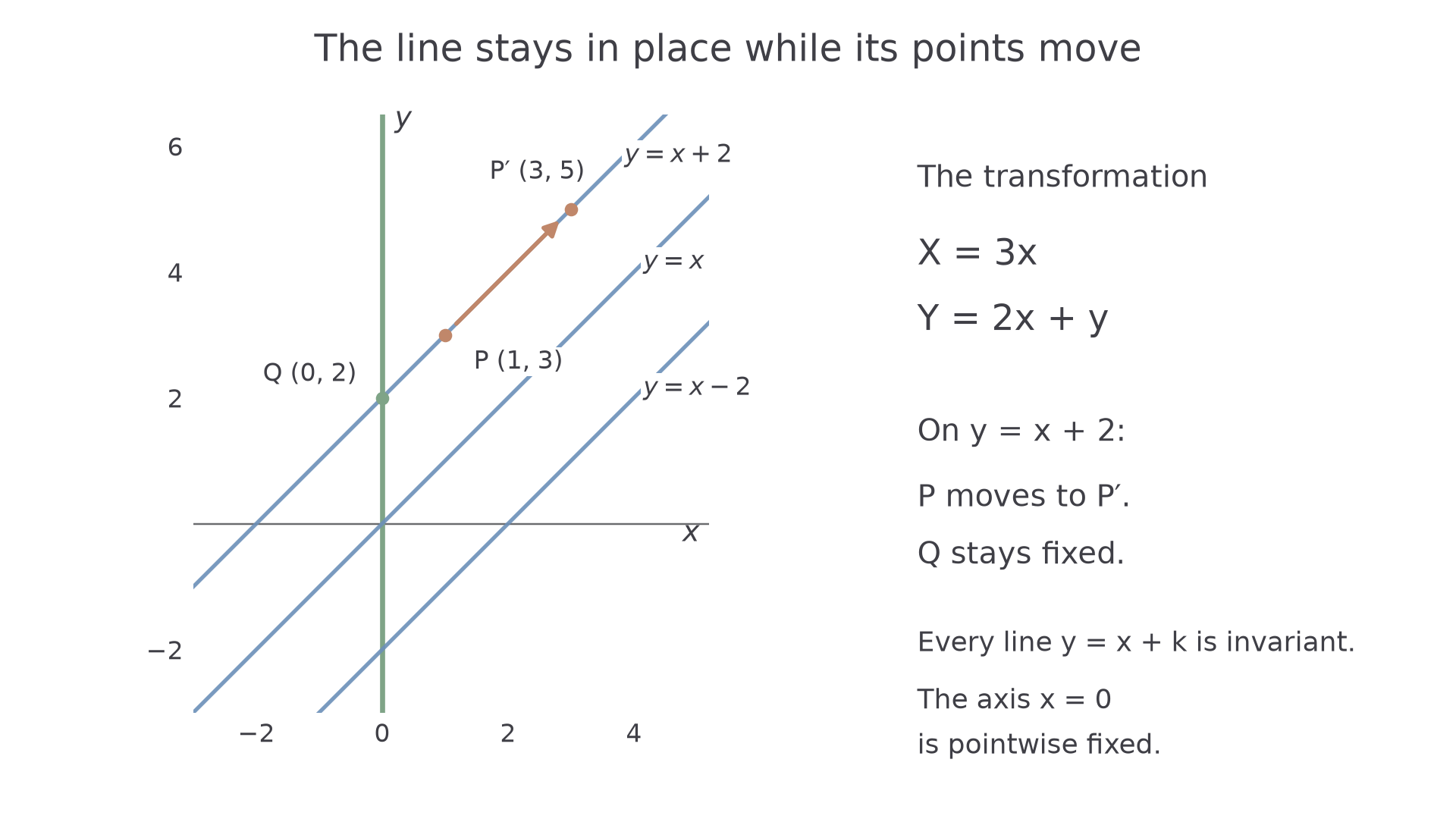
For a general nonvertical line , substitute before comparing with its own equation:
The image lies on the same line when for every . This requires both the coefficient of and the constant term to match.
Invariant lines away from the origin
For , solve
Also require to avoid collapse. The first equation preserves direction; the second preserves the line's position.
For a vertical line , the conditions are
These follow by substituting and requiring for every , with a nonconstant image. Not in the formula booklet: learn it.
The second equation may force , allowing only a line through the origin. If its other factor is zero, every intercept is allowed for that direction.
Worked example 5: a whole family of parallel lines
Question. Find all invariant lines of , and identify which are pointwise fixed.
Plan. Compare both coefficients for , then check vertical lines and fixed points separately.
Here . On ,
Requiring gives , so , with no restriction on . The multiplier of is , so each whole line is obtained.
For a vertical line , the image has . It is the same vertical line only when , hence . On this axis .
Answer. All lines , for real , and the vertical line are invariant. Only is pointwise fixed.
Check. Solving the fixed-point equations gives and , both requiring . On , ; every point is reached, but a point is fixed only when .
Change only the bottom-right entry from to . This changes the constant-term condition as well as the invariant direction.
Worked example 6: the intercept is forced to zero
Question. Find all invariant lines of , and identify any pointwise-fixed lines.
Plan. Impose the same equation on the image of , retaining the constant term.
The image has
For , compare
Thus and . For a vertical line , the same-line condition is , so ; it maps onto itself because there.
Answer. The invariant lines are and . Neither is pointwise fixed.
Check. On the first line, ; on the second, . Nonzero points move in both cases. The fixed-point equations give , so only the origin is fixed.
A negative multiplier along a line still maps the whole line onto itself: it reverses which direction points travel. A zero multiplier collapses the line to a point, so merely satisfying its equation is insufficient to show that its whole image is the same line.
Problem-solving
To find all invariant lines, compare both the gradient and the intercept, then check vertical lines. To decide whether one is pointwise fixed, test for a general point on that line.
The opening question now has a clear answer: a line can stay put as a set while points move along it. An invariant point, in contrast, must keep its exact position.
Quick Recap
- Fixed points solve .
- For an invariant line, points may move to other points on that same line.
- Test finite gradients and vertical lines separately; retain horizontal solutions.
- For , match the coefficient and constant term, and exclude collapse to a point when requiring the same whole line.
A line can be invariant while its points move. “Pointwise fixed” identifies the stronger condition that every point stays exactly where it was.