1.2 - Modulus graphs and inequalities
Moving the modulus signs changes the transformation: changes outputs, while changes inputs. You will sketch both, preserve the correct domains, and read equations and inequalities from the resulting curves.
Reflecting negative outputs
Do and mean the same thing? Take . At , the first gives , while the second gives . The position of the modulus signs matters.
An output modulus replaces a negative height by its positive opposite without moving its input. For example, becomes .
Output modulus
The graph keeps the parts of on or above the -axis and reflects the parts below it in that axis. The domain is unchanged.
Find the sign intervals before reflecting. A zero where the original curve crosses with nonzero gradient becomes a corner. A zero where a smooth curve merely touches the axis need not become a corner.
Worked example 1: reflecting one negative interval
Question. Describe the graph of .
Plan. Use the zero and pole to identify the negative interval, then reflect it.
The original function is positive for , negative for , and positive for . Therefore
The zero remains , and becomes . At , both branches now tend to . The horizontal asymptote remains . Since the original derivative at is , reflection reverses the left gradient, creating a corner.
Answer. Reflect only the interval . The resulting graph is nonnegative, has a corner at , asymptotes , , and intercept .
Check. At , the original height is , so the new one is . At , the original height is , so it stays .
Square only the numerator factor. This changes the zero from a crossing to a touch, so modulus no longer creates a corner there.
Worked example 2: a repeated zero stays smooth
Question. Which part of is reflected in ? Does a corner appear at ?
Plan. Use the nonnegative squared numerator to find signs, then inspect the curve near its zero.
For , the denominator is negative and the numerator is positive, so . For , . Thus reflect the left branch only. Near , the denominator is positive on both sides, so the graph is unchanged there.
More explicitly,
Answer. Reflect ; retain . The point is a smooth minimum, with no corner.
Check. At , , which is nonnegative for sufficiently small positive or negative . Taking its modulus makes no local change.
Reflection preserves holes as well as ordinary domain restrictions: a missing original input is still missing.
Watch out
Modulus does not automatically create a corner at every zero. Check whether the original graph crosses or merely touches, and whether its gradient is nonzero there.
Find the negative interval rather than reflecting an entire side of the -axis.
Reflecting the right-hand graph
An input modulus uses the original function at a nonnegative input, so only the right-hand half of its graph supplies the new values.
For , . The point at input is therefore copied to input . The old left-hand graph is discarded.
Input modulus
To sketch , keep the original graph for , then reflect that retained graph in the -axis. The result is even: .
Its domain consists of inputs for which belongs to the original domain.
A positive excluded input gives exclusions . A negative excluded input is never fed into , so it need not exclude any new input. If was excluded, it stays excluded. These are consequences of the domain rule, not extra exceptions.
Worked example 3: a negative pole disappears
Question. Describe , where .
Plan. Keep the original graph for nonnegative inputs and reflect it in the -axis.
The denominator is at least , so the domain is all real inputs and there are no vertical asymptotes. The zeros satisfy , giving . At , the output is . As , and the output tends to from below.
Answer. An even graph with zeros , minimum , horizontal asymptote , and no vertical asymptote. There is a corner at , since the reflected one-sided gradients are and .
Check. Both and give . The original exclusion does not survive: at new input , the function uses original input , giving .
Change only the denominator from to . The original pole is now on the retained side, so reflection produces two poles.
Worked example 4: a positive pole is copied
Question. Describe , where .
Plan. Apply the original restriction to , then copy the right-hand features.
Thus . The original positive zero gives zeros , and the original -intercept is . The horizontal asymptote is at both ends. At , the limits are from the left and from the right; symmetry determines those at .
Answer. An even graph with vertical asymptotes , horizontal asymptote , zeros , and intercept .
Check. At , the output is ; at , it is . These agree with a positive central region and reflected negative regions just outside the poles.
The two modulus operations applied to the opening function now look very different. The output modulus has only nonnegative heights; the input modulus is symmetric about the -axis and still has negative heights.
[DIAGRAM: asset_name: Where the modulus signs act; asset_slug: cam9231-modulus-comparison; caption: Output reflection and input reflection produce different graphs; description: Three coordinate panels show f(x) equals (x minus 2)/(x plus 1), absolute f(x), and f(absolute x). The original negative section is distinguished from its reflected positive section in the second panel. The third retains and mirrors the right half, showing zeros at plus and minus 2, minimum (0,-2), and no vertical asymptote. Dashed asymptotes and changed intercepts are labelled.]
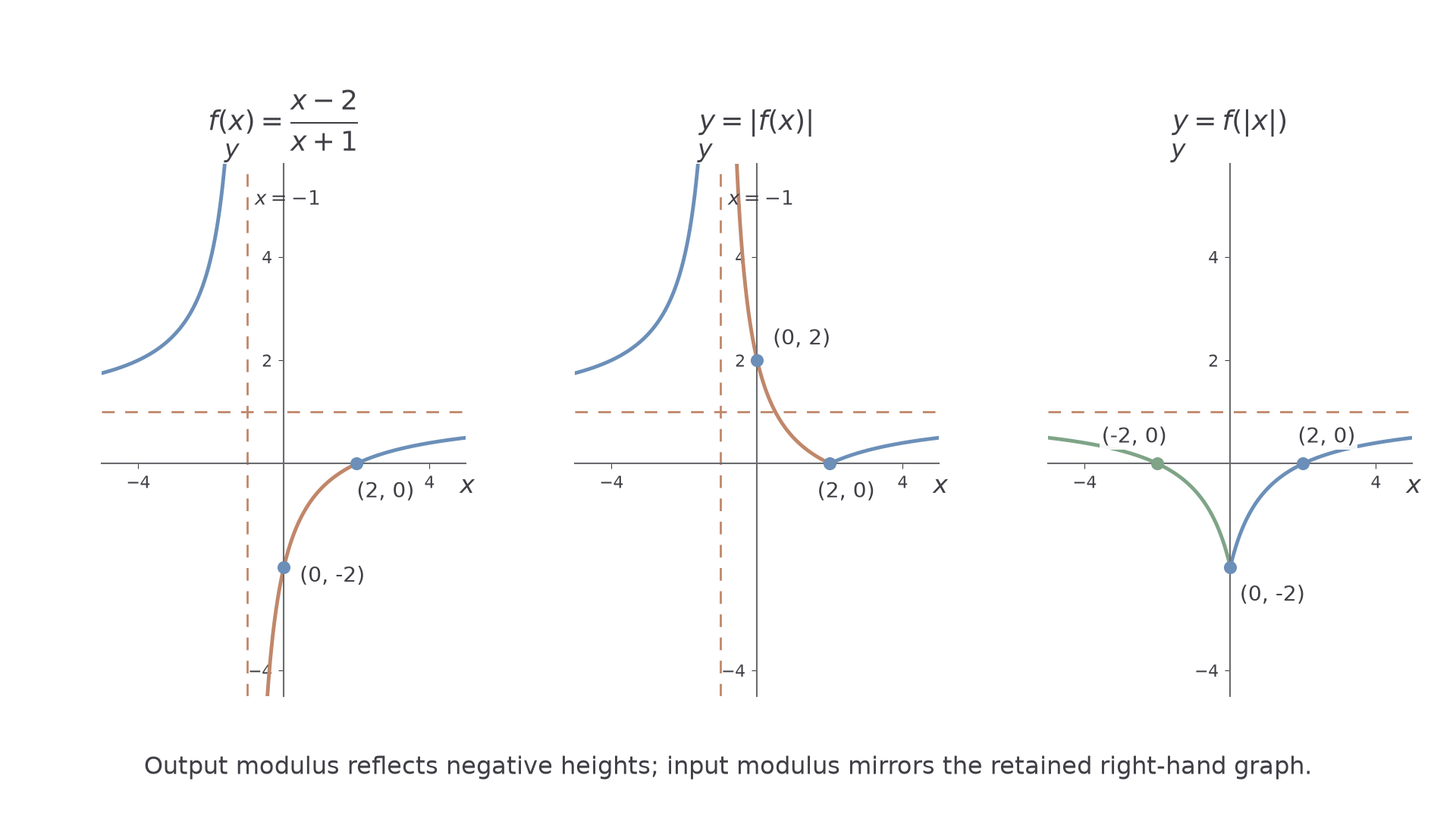
Apply the original restriction to the new input explicitly in this check.
Reading solutions
A modulus inequality asks where the transformed curve lies above or below a line; find the crossing inputs exactly, then read the intervals from the sketch.
For , is equivalent to . It can also be written . Squaring is safe here because both sides of the modulus inequality are nonnegative. For a rational function, multiplying by the square of its nonzero denominator is safe, but the original denominator zeros remain excluded.
Worked example 5: one finite crossing
Question. Solve .
Plan. Find where the modulus curve meets , then use an equivalent squared inequality to confirm the interval.
For ,
The boundary has original height . The original height is never attained, so there is only one finite crossing. The excluded input is outside the proposed interval.
Answer. .
Check. At , the modulus is ; at , it is ; at , it is . At large positive inputs the curve stays below , consistently approaching its asymptote.
Raise only the comparison line from height to height . It now cuts both outer parts of the modulus graph, producing two solution intervals.
Worked example 6: two crossings and a pole between them
Question. Solve .
Plan. Find the two crossing inputs and use the sign of the squared comparison.
For ,
The product is nonnegative for or . At , the original height is ; at , it is . The modulus graph lies above height between those crossings, with its pole inside that gap.
Answer. or .
Check. At , the modulus is ; at , it is ; at , it is . Equality holds at both stated boundaries.
For an input-modulus sketch, read solutions from its mirrored right-hand curve. For example, with means . Its denominator is positive, so , giving . This differs from the output-modulus condition because negative heights are retained.
The opening values and now have a visual explanation: one operation reflects a height, while the other selects an input.
Watch out
Strict inequalities exclude crossing points; poles are excluded in both strict and non-strict inequalities. A hole inside a selected interval must also be removed.
Use a strict inequality and new boundary inputs here.
Quick Recap
- For , reflect negative heights in the -axis and keep the domain.
- For , retain the right-hand graph and reflect it in the -axis; recompute the domain using .
- Find comparison-line crossings exactly, then select intervals from signs or the sketch.
- Keep domain exclusions and distinguish strict from non-strict boundaries.