2.3 - Differentiating inverse and hyperbolic functions
Hyperbolic and inverse functions have useful derivative patterns, but their signs and domains matter. You will derive the patterns, apply the chain rule and distinguish a function's domain from the interval on which its derivative formula is valid.
Derivatives of six hyperbolic functions
Does replacing tanh by its reciprocal merely turn its derivative upside down? It does not: a reciprocal changes both the derivative's sign and its factors.
Start with the exponential definitions you already know. Differentiating each term gives
The positive derivative of sinh agrees with its increasing graph. Cosh has negative gradient for negative arguments, zero gradient at zero and positive gradient for positive arguments.
Use the quotient rule for tanh:
The numerator is , by the hyperbolic identity. The other three derivatives come from differentiating reciprocals. For example,
Similarly, differentiating gives . The quotient rule for gives , since its numerator is .
Hyperbolic derivatives
For a differentiable inner function , multiply each derivative below by :
Sinh, cosh, tanh and sech are defined for every real . Cosech and coth require .
The first three derivative results are in the formula booklet. The last three are not listed there: learn them or derive them from reciprocals.
The factor from the inner function is essential even when several terms share the same argument.
Worked example 1: a common inner function
Question. Differentiate .
Plan. Differentiate each hyperbolic function, then multiply by the derivative of .
Both inner derivatives are , so
The minus sign belongs to the derivative of sech, not to its argument.
Answer. , for every real .
Check. Set . The original function becomes . Direct rational differentiation, using , gives gradient at . The answer gives the same value from and .
Change the pair of functions to coth and cosech, keeping the argument . Both new terms are undefined at zero, and both derivatives now carry a minus sign.
Worked example 2: changing to coth and cosech
Question. Differentiate , stating where the result applies.
Plan. Use the two reciprocal-function derivatives and retain their common chain-rule factor.
For ,
There is no derivative at , because the original function is not defined there.
Answer. , for .
Check. With , the original expression simplifies to . Its derivative is . At , this is . The hyperbolic answer gives .
A reciprocal must be differentiated as a reciprocal; it cannot be handled by reciprocating an existing derivative.
Watch out
The claim is false. Since , the reciprocal rule gives .
Apply the same pair of rules with a different inner scale.
Inverse sine and cosine
An inverse derivative comes from undoing the original function locally. The principal branch determines the square root's sign.
Let , so and . Implicit differentiation gives
For , the chosen branch has . Thus , giving the positive derivative.
For , the branch is . Now , and in the interior. The derivative is negative because the inverse cosine is decreasing.
Inverse sine and cosine derivatives
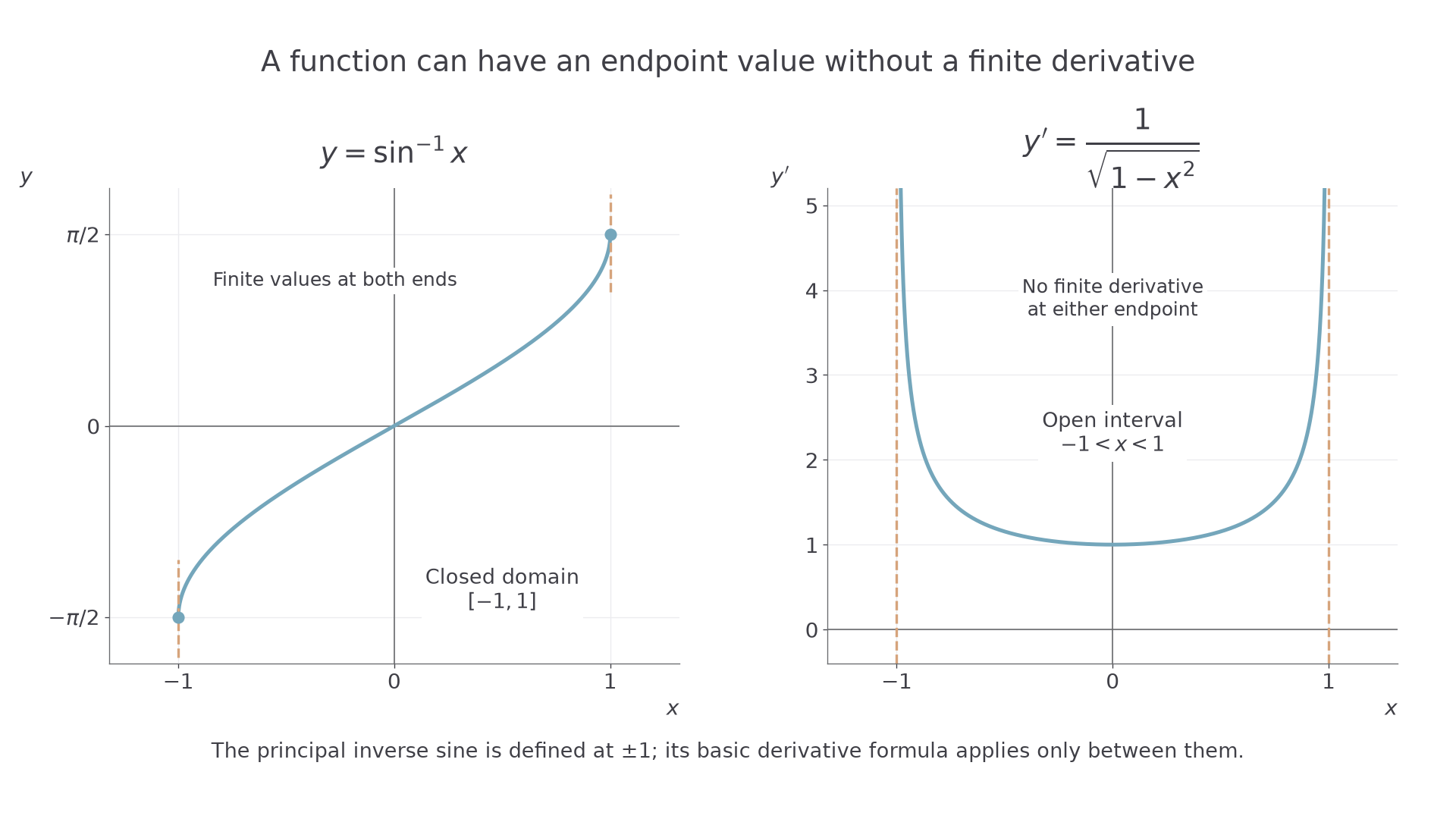
The inverse functions themselves accept . Their basic derivatives have no finite value at inputs . For a composition, the displayed chain-rule formula applies only where ; analyse an endpoint separately if required.
Both basic inverse derivative results are in the formula booklet.
The graphs show why a function can have an endpoint value even when its derivative formula excludes that endpoint.
[DIAGRAM: asset_name: Inverse values and derivative endpoints; asset_slug: cam9231-inverse-derivative-domains; caption: Inverse sine has finite endpoint values, while its gradient becomes unbounded near either endpoint; description: Two exact panels show inverse sine on the closed interval minus one to one, with finite endpoint dots and near-vertical endpoint tangents, and its positive derivative one over the square root of one minus x squared on the open interval. Dashed vertical lines mark the excluded derivative inputs minus one and one.]
Continue this lesson.
You’re previewing NovaLearn without an account. Create a free account to read the rest.
Create free account