3.6 - Oblique impact with a fixed surface
A smooth wall changes the velocity towards it but leaves motion along it untouched. In this part of 3.6, you will resolve an oblique velocity, apply restitution only in the normal direction, then find the rebound speed and angle.
Normal and tangential velocities
Why does a sphere hitting a wall diagonally usually leave at a different angle from the one at which it arrived? The answer starts by splitting its velocity into two perpendicular components.
The normal direction is perpendicular to the wall; the tangential direction is parallel to it. For a vertical wall on the right, choose positive normal towards the wall and positive tangent upwards. Write the incident components as , so a sphere approaching the wall has .
[DIAGRAM: asset_name: Resolving velocity at a smooth wall; asset_slug: cam9231-wall-normal-tangent; caption: The angle to the normal and the angle to the wall use different component ratios; description: A velocity triangle at a vertical wall has an incident vector with normal component 6 to the right and tangential component 8 upwards. The incident vector makes angle alpha to the positive normal. A second panel shows the final components minus 3 normal and 8 tangential when e is one half, with angle beta to the outward normal. Tangential arrows are unchanged, and the reversed normal arrow is half as long.]
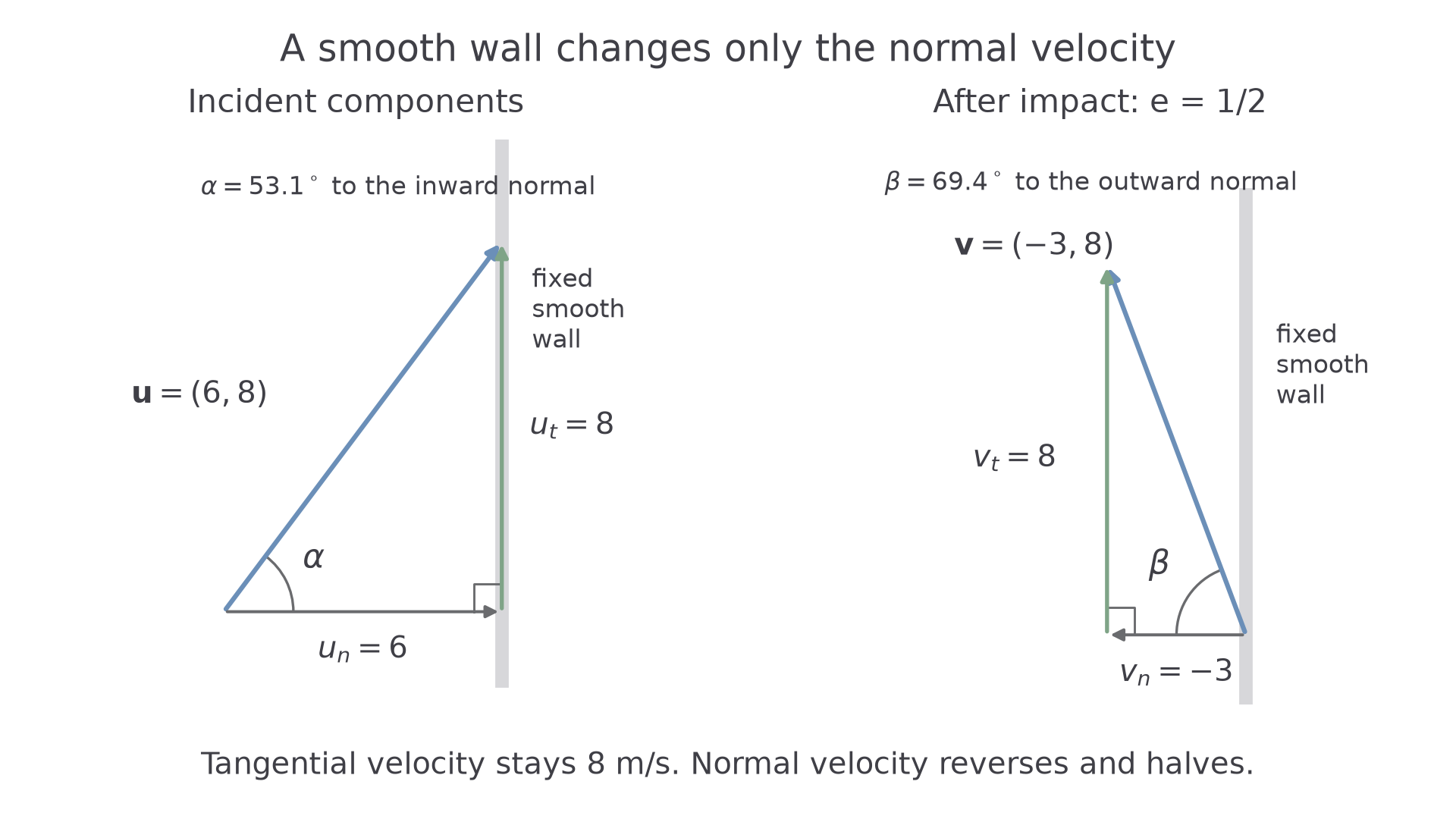
If an incident speed makes an acute angle with the normal, and its tangential motion is upwards, then
If the stated angle is instead measured from the wall, the roles swap:
Attach signs from the chosen directions. The speed satisfies .
Worked example 1: angle measured from the wall
Question. A sphere approaches a vertical wall on its right at , moving upwards at to the wall. Find its signed normal and tangential velocity components, taking normal towards the wall and tangent upwards.
Plan. Draw the angle next to the wall; the normal component is opposite that angle.
Answer. and , both positive.
Check. The normal component is smaller because the path is closer to the wall than to its normal. Also .
Keep the speed and numerical angle, but measure that angle from the normal. This changes the geometry.
Worked example 2: angle measured from the normal
Question. A sphere approaches the same wall at , now moving upwards at to the normal. Find its signed components in the same directions.
Plan. The normal component is now adjacent to the stated angle.
Answer. and .
Check. , so the reconstructed velocity has the required angle to the normal.
Always identify the line from which an angle is measured before choosing sine or cosine. The word “smooth” will now tell us which component the impact can change.
The normal restitution law
A smooth wall exerts no tangential contact force. Its impulse is perpendicular to the surface, so the sphere's tangential momentum, and therefore tangential velocity, stays unchanged. Restitution acts along this normal line only.
Oblique impact with a fixed smooth wall
Use the same signed normal and tangential axes before and after impact. Then
The surface is fixed, the contact is smooth, and other impulses during the short impact are neglected.
Not in the formula booklet: learn it.
This is the direct wall law applied to one component. Do not reverse or multiply the whole velocity vector by : that would invent a tangential impulse.
Worked example 3: changing the normal component
Question. A sphere reaches a fixed smooth wall with components , , taking normal towards the wall and tangent upwards. The coefficient of restitution is . Find its final components.
Plan. Reverse and scale the normal component, and retain the tangent.
Answer. The final components are : away from the wall and upwards.
Check. The velocity change is , entirely normal to the wall. The separation-to-approach ratio is .
Continue this lesson.
You’re previewing NovaLearn without an account. Create a free account to read the rest.
Create free account