1.5 - Polar and Cartesian coordinates
A point can be located by a distance and a direction instead of two perpendicular distances. You will use this polar description, convert points without losing their quadrant, and recognise the same curve in polar and Cartesian equations.
Locating a point
How can the same point have direction angles of and ? A complete turn changes the angle but leaves the point where it was.
Start at a fixed point , choose a horizontal ray pointing right, turn through the angle, then travel the stated distance from . An anticlockwise turn is positive; a clockwise turn is negative. We use radians throughout.
Polar coordinates
The pole is the fixed point , and the initial line is the fixed ray from which angles are measured. A point has polar coordinates , where and is its directed angle from the initial line.
We use nonnegative radii. A negative value of a formula for gives no point for that angle under this convention.
At a nonzero radius, angles differing by , for an integer , describe the same point. An angle interval selects one representative, commonly or . At the pole, , every angle gives the same point; the angle is not uniquely determined.
Worked example 1: removing a complete turn
Question. Express with , and describe its position.
Plan. Subtract complete turns until the angle lies in the interval.
Answer. : four units from the pole, at angle anticlockwise from the initial line.
Check. The angle difference is exactly one full turn. Both rays point into the first quadrant, and the distance remains .
Now use a clockwise angle. The radius stays positive; it is the direction angle that changes.
Worked example 2: a clockwise direction
Question. Express with , and identify its quadrant.
Plan. Add one complete turn to the negative angle.
Since , the ray is in the third quadrant.
Answer. , in the third quadrant.
Check. A clockwise turn of ends below the negative horizontal axis, just as an anticlockwise turn of does.
A coordinate pair is incomplete if the angle convention matters and you have not stated it. The two usual intervals place their cut on different rays but describe the same plane.
Watch out
Changing to moves a nonzero point to the opposite ray. Only complete turns leave the point fixed when remains nonnegative.
Try switching to the interval that allows clockwise angles.
Converting points
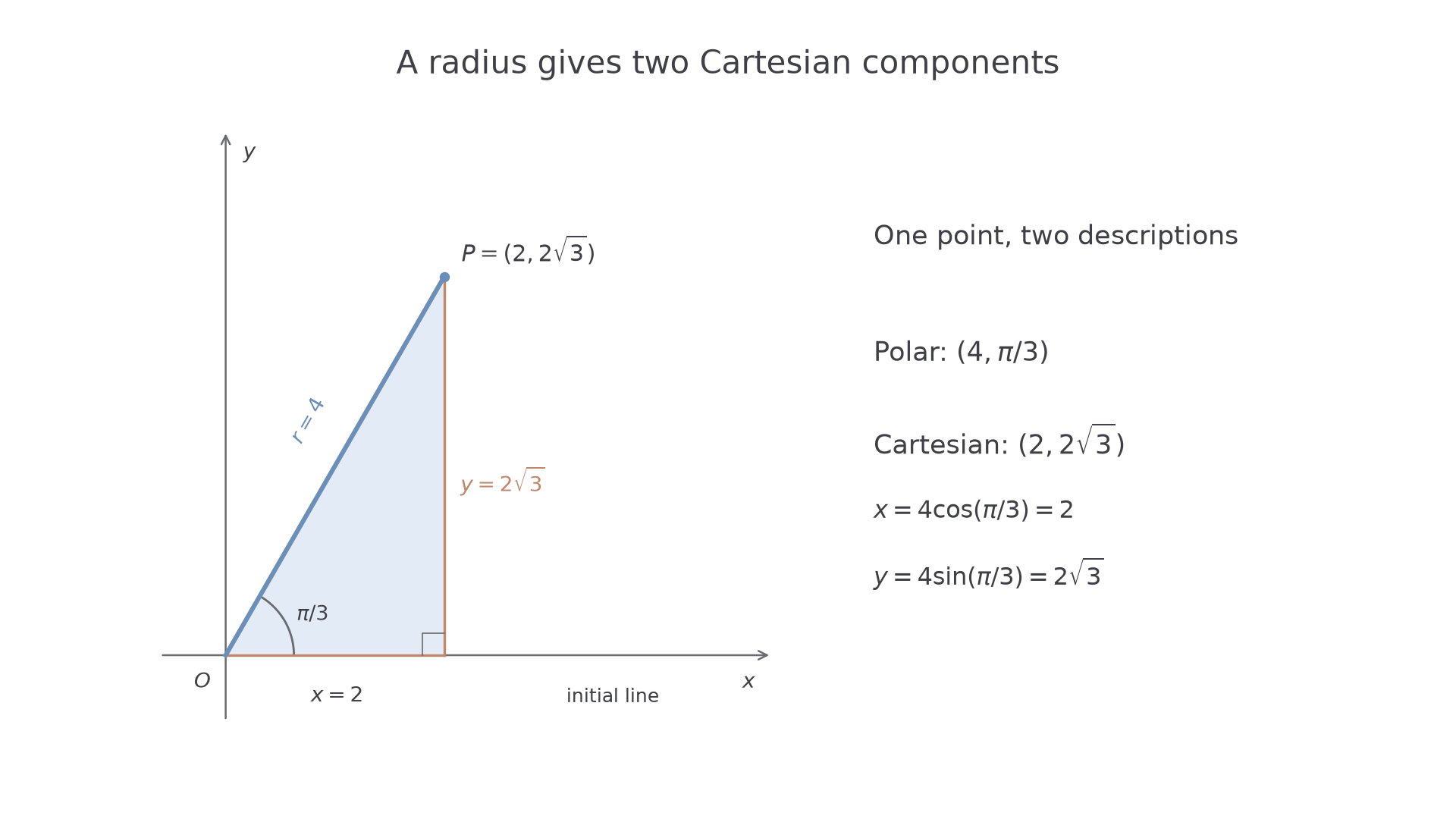
The horizontal and vertical components of a radius connect the two coordinate systems.
For example, gives horizontal component and vertical component . The same component formulae work outside the first quadrant because the trigonometric functions carry the signs.
[DIAGRAM: asset_name: A radius gives two Cartesian components; asset_slug: cam9231-polar-components; caption: The radius and its angle determine the signed horizontal and vertical components; description: Equal-scale Cartesian axes with pole O and initial line along positive x. The point P has polar coordinates (4, pi over 3) and Cartesian coordinates (2, 2 root 3). A pale right triangle shows radius 4, horizontal component 2, vertical component 2 root 3 and the angle pi over 3.]
Coordinate conversion
With the pole at the Cartesian origin and the initial line along the positive -axis:
For , , but the signs of must also fix the quadrant. These conversion relations are not in the formula booklet: learn them.
The inverse tangent on a calculator returns only . It cannot distinguish two opposite rays with the same gradient. Sketch the point first, then choose the angle in the required interval. If , use the vertical direction directly rather than divide by zero.
Worked example 3: a point in the second quadrant
Question. Find polar coordinates of , using .
Plan. Find the nonnegative distance, then use the signs to select the angle.
The reference angle is . Since , , the point is in quadrant two, so .
Answer. .
Check. Converting back gives and , exactly the given point.
Change only the sign of the vertical coordinate. The distance and reference angle stay the same, but the quadrant changes.
Worked example 4: the reflected point
Question. Find polar coordinates of , using .
Plan. Retain distance , and choose the third-quadrant angle.
Answer. .
Check. and . The alternative angle would give two positive coordinates, so the tangent value alone is insufficient.
On the axes, use for , for , above the pole and below it in this interval. For the origin, state and leave its angle arbitrary.
Watch out
The line can put a point in the wrong quadrant. Check the signs of both Cartesian components before giving the angle.
Use the same quadrant decision with a different reference angle.
Converting curve equations
A curve equation describes a set of points, so a conversion must preserve both its algebra and its allowed points.
From , , we obtain . Thus becomes . Away from the pole, division by gives . The pole must be checked separately after division; here it is included when .
Problem-solving
Use , and . Multiply before substituting when a polar equation contains a lone trigonometric function, and check any points affected by division or squaring.
For instance, is simply . In contrast, describes the ray , , because the radius cannot be negative. Giving just would add the opposite ray.
Worked example 5: a cosine circle
Question. Convert , , into Cartesian form and identify the curve.
Plan. Multiply by , use the conversion relations, then complete the square.
The given interval has , so all radii are allowed. Every point of the circle is represented, with the pole occurring at both endpoints.
Answer. A circle with centre and radius .
Check. Its horizontal intercepts are and . They correspond to at and at .
Replace cosine by sine. This turns the same circle through a right angle, so the Cartesian centre should move onto the positive vertical axis.
Worked example 6: a sine circle
Question. Convert , , into Cartesian form and identify the curve.
Plan. Multiply by , replacing by .
All radii are nonnegative on the given interval. The pole is retained at its endpoints.
Answer. A circle with centre and radius .
Check. The top point has , which satisfies the original polar equation. The centre and radius agree with the predicted rotation.
When converting the other way, retain the nonnegative-radius restriction. If you square an equation containing , retain its original sign condition as well: squaring can introduce extra points. Always test the pole in the original equation if an intermediate step multiplied or divided by .
The opening point has two angle descriptions because its ray repeats after a full turn. A whole curve needs the same care over angle intervals, especially before sketching it.
Quick Recap
- A polar point uses a nonnegative distance and an angle in a stated interval.
- Use , and .
- A tangent value gives a line direction; the coordinate signs fix the quadrant.
- Curve conversions must retain domain restrictions and any pole or sign checks.