1.4 - Matrices for plane transformations
A two-by-two matrix can transform an entire plane, yet two carefully chosen images determine the whole transformation. Construct these matrices, recognise rotations, reflections, enlargements, stretches and shears, and use the determinant to calculate how areas change.
Images of basis vectors
How can knowing where just two arrows go tell you where every point goes? The key is to choose the unit arrows along the coordinate axes.
Write
For example, . Matrix multiplication respects this combination: if the images of are , the image of that point is .
Matrix transformation
The matrix represents the transformation taking a point with position vector to the point with position vector .
For , writing the image as gives and .
The first column is , and the second is . This explains both their positions and their order.
[DIAGRAM: asset_name: Basis vectors determine the transformed square; asset_slug: cam9231-transformed-basis; caption: The columns are the images of the unit arrows and the square becomes a parallelogram; description: Two exact coordinate plots show the unit square with basis vectors (1,0) and (0,1), then its image under the matrix with columns (2,1) and (-1,3). The image vertices are (0,0), (2,1), (1,4), (-1,3). Blue and clay consistently identify the first and second basis images, and the far corner is their sum.]
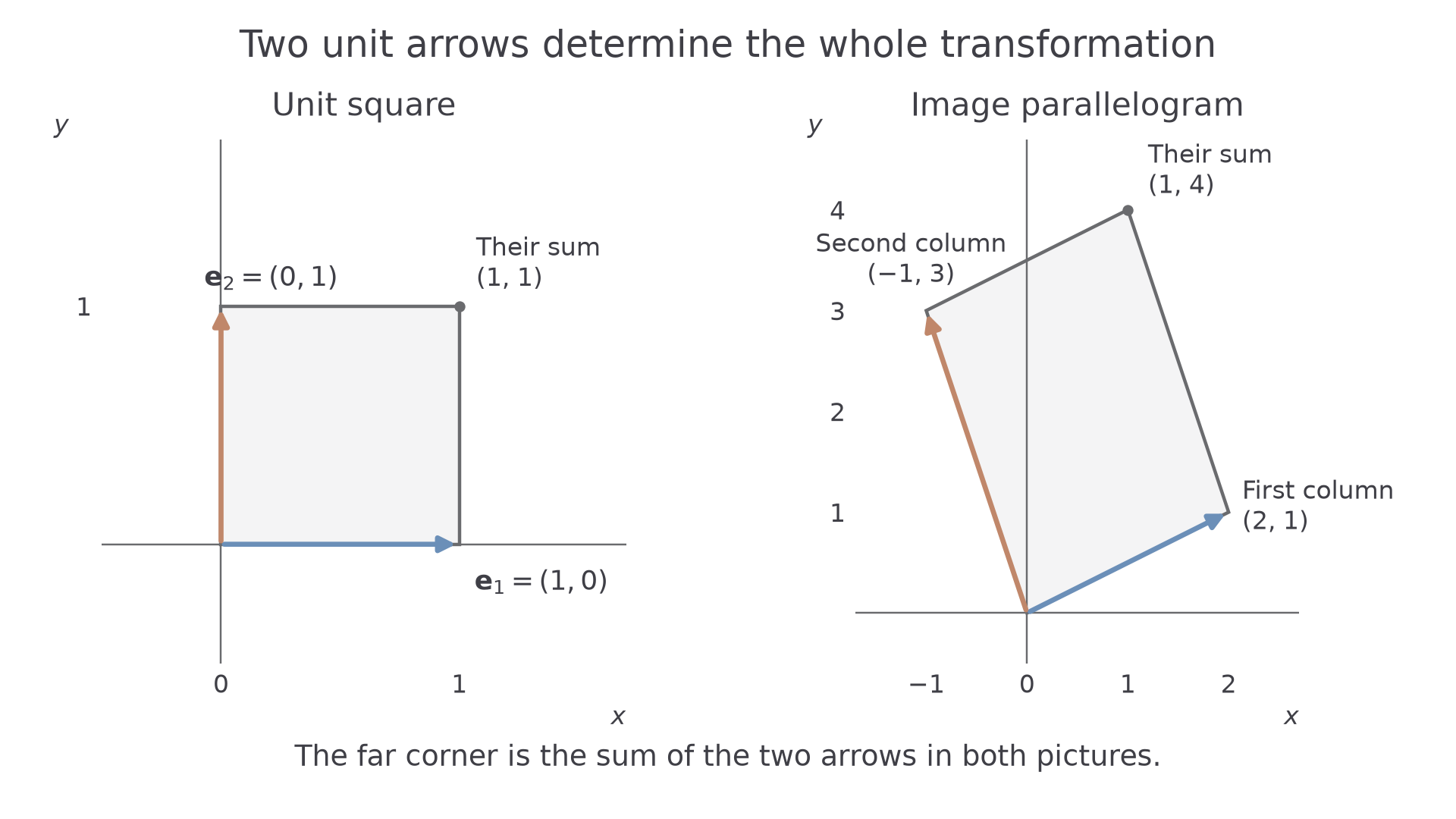
Every matrix transformation of this form fixes the origin, since . A translation by a nonzero vector cannot be represented by a two-by-two matrix acting on these position vectors.
Constructing the matrix from two images
If
then
Put the images in columns, in the order . Not in the formula booklet: learn it.
You can use the same idea when information is supplied in a less familiar form: first recover the two unit-arrow images by adding or subtracting the given vectors.
Worked example 1: constructing the columns
Question. A transformation sends to and to . Find its matrix and the image of .
Plan. Put the given images into the two columns, then multiply the position vector of .
Answer. The matrix is , and maps to .
Check. The vector construction gives , using the given arrows rather than the matrix entries.
Keep the transformation unchanged, but replace the unit arrows by two diagonal arrows. The extra decision is how to reconstruct the unit arrows.
Worked example 2: recovering the unit arrows
Question. A matrix transformation sends to and to . Find its matrix.
Plan. Add and subtract the given input vectors, doing the same to their images.
Adding the inputs gives . Subtracting the second from the first gives . Hence
Answer. .
Check. Its column sum is and its first column minus its second is . Both supplied images are recovered.
Two input vectors determine the matrix uniquely when neither is a multiple of the other. Two arrows along the same line do not generally determine what happens away from that line.
Watch out
The images are columns, not rows. If , the first column must be ; its two coordinates do not form the first row.
Recover the columns before finding another point image.
Rotations, reflections and stretches
Recognising a matrix means describing its geometry completely, including its centre, axis or direction.
Start with a rotation anticlockwise through about the origin. The first unit arrow turns to ; the second starts a right angle further round, so it turns to . Those two images give the rotation matrix.
A reflection in the line making angle with the positive -axis takes an arrow at angle to one at angle . Apply that to the two unit arrows to obtain its two columns. For instance, reflection in exchanges and .
Standard plane transformations
All centres and fixed axes below pass through the origin.
The reflection angle describes its mirror line, not the angle through which every point turns. Not in the formula booklet: learn it.
These arrays express simple coordinate rules. The stretch multiplies horizontal distances from the -axis by , leaving the -axis fixed point by point. The enlargement multiplies both coordinates; its centre is the origin. A negative enlargement factor also reverses every ray through the origin. Factor zero collapses the plane to the origin.
For the stretches in the table, a positive factor gives the usual one-direction stretch or compression. A negative factor additionally reverses that coordinate's sign, and zero collapses onto the fixed axis.
A horizontal shear has : the horizontal displacement is , so each point on the -axis stays fixed. A vertical shear instead has , fixing the -axis. A shear factor needs its sign and the direction of the shear to be meaningful.
Worked example 3: describing a positive shear
Question. Give full geometrical details of the transformation represented by , and find the image of .
Plan. Read the coordinate rule, identify the fixed axis, and use the image of a unit point to specify the shear.
Thus the motion is parallel to the -axis and its displacement is . When , the displacement is zero. Also .
For , .
Answer. A shear parallel to the -axis, with the -axis fixed and shear factor ; .
Check. The point keeps its height and moves horizontally by , twice its original height, as the description requires.
Change only the sign of the shear factor. The fixed axis stays the same; the displacement reverses.
Worked example 4: reversing the shear direction
Question. Describe fully , and find the image of .
Plan. Use the new coordinate rule to specify the signed shear and point image.
The -axis is still fixed, but now . For , the image is .
Answer. A shear parallel to the -axis, with the -axis fixed and shear factor ; .
Check. The displacement is horizontally. Applying the preceding factor- shear to the image gives , recovering the original point.
For rotations, state angle, direction and centre; for reflections, state the mirror line. Thus is a rotation through anticlockwise about the origin, whereas is reflection in . Both exchange the roles of the coordinates, but only the rotation negates the old -coordinate.
Exam tip
A complete shear description can state the fixed axis and a unit-point image, such as “-axis fixed and ”. Naming “shear” alone leaves its direction and size unspecified.
Use the sign and the fixed axis in your description.
Area scale factors
The determinant measures how a matrix changes area, while its sign records whether orientation is preserved or reversed.
The unit square is spanned by the two unit arrows. Its image is the parallelogram spanned by the two matrix columns and . The coordinate area formula gives this parallelogram area as . For the earlier picture, this is .
More generally, if two side vectors are the columns of a matrix , their signed parallelogram area is . Their image columns form . Expanding the two-by-two determinant gives
Taking absolute values establishes the same area ratio for every triangle, parallelogram and region built from them.
Area scale factor
For a plane matrix transformation,
If , orientation is preserved. If , orientation is reversed. If , the image has zero area: the plane collapses to a line or a point.
Area is nonnegative; the signed determinant is not itself an area. Not in the formula booklet: learn it.
Orientation refers to the order of vertices around a figure: a clockwise order becomes anticlockwise under a negative determinant. It does not say that the image lies on a particular side of an axis.
Worked example 5: preserving orientation
Question. A triangle of area is transformed by . Find the image area and state whether orientation is preserved.
Plan. Calculate the determinant, use its magnitude for area and its sign for orientation.
Answer. The area is , and orientation is preserved.
Check. Choose a representative triangle with vertices . Its images are , whose area is .
Negate the entire first row. This reflects the previous image in the -axis without changing its area.
Worked example 6: reversing orientation
Question. Transform a triangle of area by . Find the image area and describe the orientation change.
Plan. Keep the determinant sign separate from the positive area multiplier.
Answer. The area is , and orientation is reversed.
Check. The same representative triangle maps to . Its base and height still give area , but the order of these three vertices is opposite to the preceding image.
When the image area is given, divide by the nonzero area scale factor to recover the original area. If the determinant is zero, that reversal is impossible: different original areas all have zero image area.
A shear has determinant , so its slant can change while its area stays the same. An enlargement of factor has determinant , so its area factor is , even for a negative .
Watch out
“Area factor ” is incorrect. The area factor is ; the minus sign in the determinant describes reversed orientation. A negative enlargement factor, however, has a positive determinant in two dimensions.
The opening question now has a geometric answer too: the two unit-arrow images determine every point and the parallelogram that determines the area factor.
Quick Recap
- The first and second columns are the images of and .
- Describe a named transformation with its full centre, axis, direction and scale information.
- Multiply original area by ; use the determinant sign separately for orientation.
- A zero determinant collapses area and prevents an inverse.
Two independent arrows determine the whole matrix transformation, including what happens to every region's area.