1.2 - Sketching rational curves
A convincing sketch comes from a few exact features, rather than a table of plotted points. You will locate turning points, determine which way each branch approaches an asymptote, and combine that information with intercepts to sketch rational curves.
Turning points
Can two curves with the same vertical and oblique asymptotes have different numbers of turning points? The sign of one remainder will answer that question.
You already know how to differentiate from 9709. A stationary point has at an input in the domain. A turning point is a local maximum or minimum: check a change in the sign of , rather than assuming every stationary point turns.
Division can make differentiation shorter. For , differentiating the three terms gives . The quotient rule gives the same result.
Worked example 1: two stationary points
Question. Find and classify the stationary points of .
Plan. Divide first, solve , then check the derivative sign.
Thus , so . Writing , the height is . At these inputs, , so the heights are .
The derivative is positive when , and negative when . It changes from positive to negative at the left point, and from negative to positive at the right point.
Answer. A local maximum at ; a local minimum at .
Check. Differentiating by the quotient rule gives , confirming both roots and the sign test.
Change only the constant in the numerator from to . The remainder changes sign; the asymptotes stay and .
Worked example 2: proving that no stationary points exist
Question. Show that has no stationary points.
Plan. Express its derivative as a sum of positive terms.
Answer. The derivative never vanishes on the domain, so there are no stationary points. Each separate branch is increasing.
Check. The equation from the quotient rule would be . Its discriminant is , confirming that no real stationary input exists.
That answers the opening question: the same two asymptotes do not determine the turning points. The derivative supplies information the asymptotes cannot.
Watch out
Do not include a denominator root as a stationary point. For example, multiplying an equation by cannot make part of a graph whose original denominator is zero there.
Apply the same division and sign test with a new remainder.
Branches and limiting behaviour
An equation such as locates an asymptote but does not say whether a nearby branch rises or falls without bound.
Use a factor sign near the excluded input. The notation means approach from smaller inputs, and means approach from larger inputs. A numerator tending to a nonzero number divided by a small positive or negative denominator determines the direction.
At infinity, subtract the horizontal or oblique asymptote. A positive difference places the curve above the line; a negative difference places it below.
Worked example 3: a simple denominator factor
Question. Describe the branches of near its asymptotes.
Plan. Track the sign and size of the denominator on each side of , then at infinity.
As , from below. As , from above.
Answer. The left branch is below and falls towards ; the right branch is above and rises towards .
Check. , , and , confirming all four directions.
Square only the denominator factor. Its sign can no longer change across .
Worked example 4: a repeated denominator factor
Question. Describe the branches of near its asymptotes.
Plan. Use the positivity of a nonzero square.
Both one-sided limits at the pole are positive infinity, because a nonzero square is positive on both sides.
Answer. Both branches lie above the horizontal asymptote , and both rise without bound towards .
Check. Inputs and both give ; inputs and both give . The symmetry about is consistent with the squared denominator.
Repeated factors therefore matter for shape as well as for algebra. The numerator sign still matters: multiplying either example by reverses every vertical direction.
Key idea
Describe a branch with a sign and a limit. “There is an asymptote” alone does not determine its position.
Test both sides rather than extending the rule for a simple factor to a square.
Combining significant features
A complete sketch joins exact features with smooth branches that obey the derivative and limit information.
Start with the domain and any holes. Mark the axes and asymptotes, then intercepts and stationary points. Use signs and one-sided limits to connect them. Detailed plotting is unnecessary, but leaving out a branch changes the graph.
Worked example 5: a branch touching an axis
Question. Sketch , stating its significant features.
Plan. Rewrite the fraction to find its asymptotes, then differentiate to control the shape.
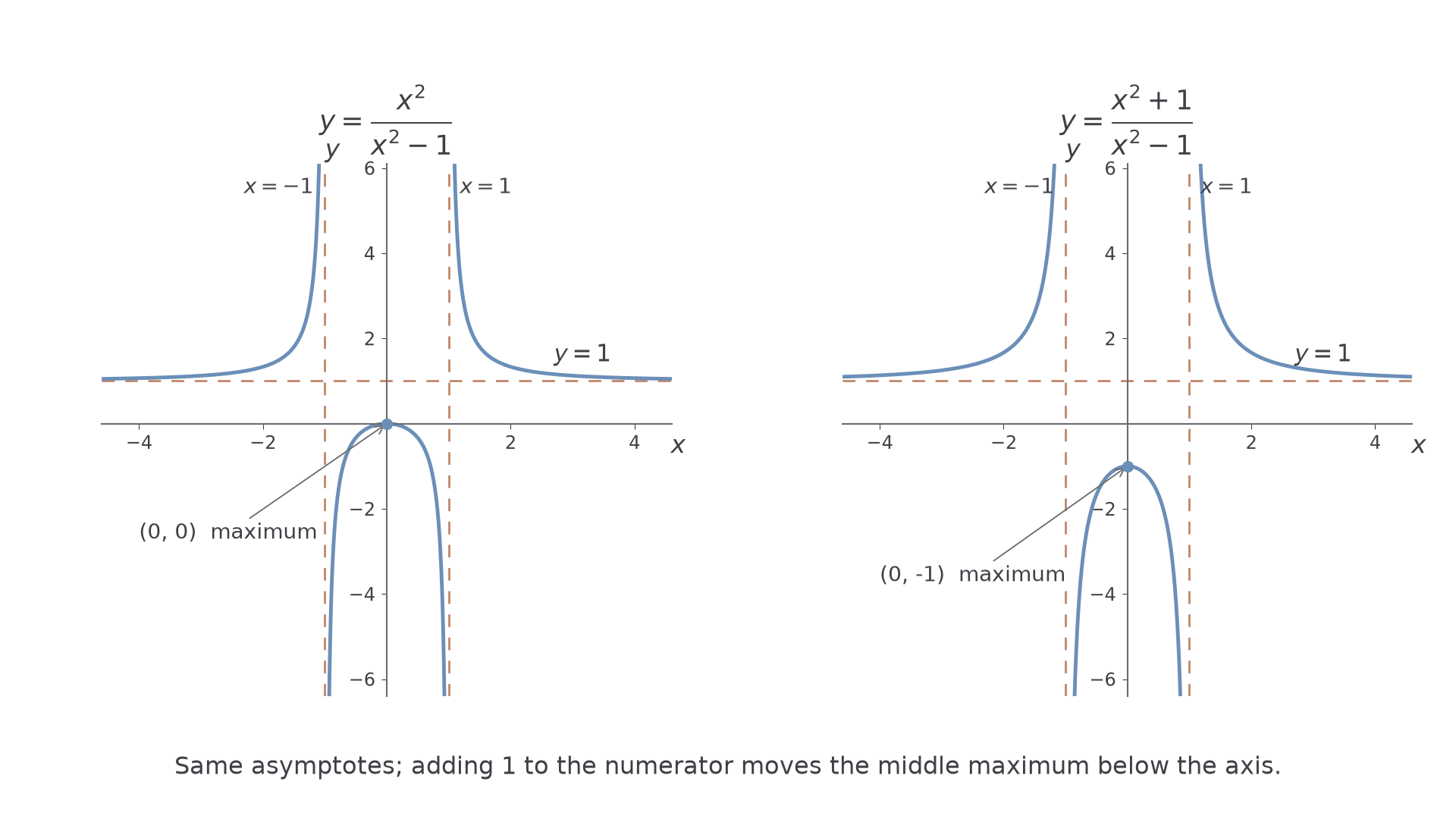
The domain excludes . The asymptotes are , and . Both axes meet the curve at . The derivative is positive for negative allowed inputs and negative for positive allowed inputs, giving a local maximum at .
For , : the outer branches lie above , tend to at the vertical asymptotes and approach at infinity. For , : the middle branch rises from , touches the axis at its maximum, then falls to .
Answer. Three branches with the labelled asymptotes and a middle maximum at , as in the left panel below.
Check. The function is even, so the sketch must be symmetric about the -axis. Also and , checking the outer and middle branch positions.
Add only to the numerator. The asymptotes stay fixed, but the middle branch no longer reaches the horizontal axis.
Worked example 6: a branch below the axis
Question. Sketch .
Plan. Compare its remainder and derivative with the previous curve.
The asymptotes remain , . The numerator is positive for every real input, so there are no -axis intersections. The -axis intersection and local maximum are . The derivative signs and all four one-sided infinite directions are as before. The two outer branches lie above ; the middle branch lies at or below .
Answer. Three branches, symmetric about the -axis, with the middle maximum , as in the right panel.
Check. Direct substitution gives , and . There can be no hidden crossing of an axis because the numerator has no real zero.
The graphs make the deliberate change visible: touching the axis becomes a maximum below it.
[DIAGRAM: asset_name: Building complete rational sketches; asset_slug: cam9231-rational-sketches; caption: Intercepts and derivative signs distinguish two curves with the same asymptotes; description: Side-by-side exact graphs of x squared/(x squared minus 1) and (x squared plus 1)/(x squared minus 1). Each has dashed vertical lines x equals plus or minus 1 and horizontal line y equals 1. The middle maxima (0,0) and (0,-1) are labelled. All six branches are visible with no segment joined through an asymptote.]
Cambridge sketch questions expect significant points and asymptotes to be labelled. A curve that turns where its derivative has one sign contradicts the algebra, even if its asymptotes are correct.
Quick Recap
- Solve only on the original domain, then classify stationary points.
- Determine the sign on each side of every vertical asymptote.
- Subtract the horizontal or oblique asymptote to place branches above or below it.
- Label significant points and connect them consistently with the derivative.
Curves can share their asymptotes and still have different turning points and intercepts.