3.3 - Vertical circular motion
A particle usually slows down as it rises around a vertical circle and speeds up as it falls. Use energy to find its speed, resolve the actual forces towards the centre, and decide whether a string or surface can maintain the assumed circular path. A zero-force calculation is useful only when the particle can physically reach that position.
Speed changes around a circle
Can a particle have enough energy to rise above the centre but still fail to stay on its circle? We need two different checks: energy determines its speed, while the forces determine whether the constraint can keep it on the path.
Start with energy. A light inextensible string has no elastic energy. Its tension is perpendicular to the particle's displacement while the string is taut, so tension does no work. The reaction from a smooth fixed circular track is also perpendicular to the motion. With no resistance, kinetic energy plus gravitational potential energy is conserved.
You already know
Kinetic energy is , and a rise through vertical height increases gravitational potential energy by . Choose one height datum and use the actual vertical rise, not the distance along the path.
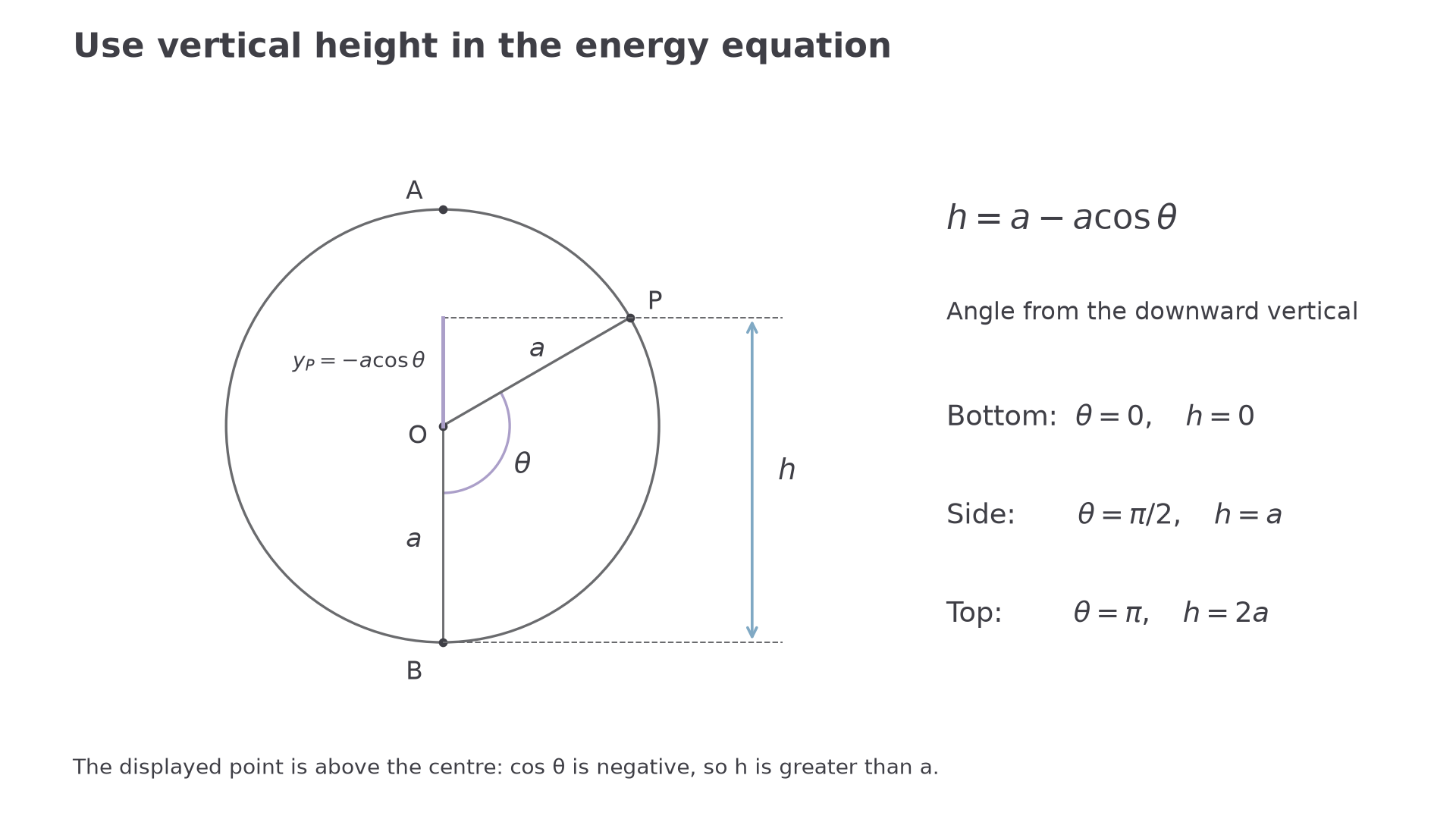
Let a circle have radius , and let be the angle from the downward vertical to the radius through the particle. At the bottom ; at the top . The downward projection of the radius is , so the height above the bottom is .
[DIAGRAM: asset_name: The height used in vertical-circle energy; asset_slug: cam9231-vertical-circle-height; caption: Measuring the angle from the downward vertical gives a rise of a times one minus cos theta; description: Exact vertical circle of radius a centred at O with bottom B, top A and a particle P in the upper right quadrant. The angle theta is measured from OB to OP. A horizontal level through P and a vertical height bracket from the bottom show h equals a minus a cos theta. The projection a cos theta is signed: it is negative at the displayed upper-half position. A side panel gives bottom, side and top heights zero, a and 2a.]
Energy from the bottom
If the speed at the bottom is , then, while the circular constraint remains valid,
so
This vertical-circle relation is not printed in the formula booklet: derive it from conservation of energy and the height geometry.
A negative value of means the particle cannot reach that position with the given energy. A nonnegative value alone does not guarantee that a string stays taut or that a one-sided track retains contact.
Worked example 1: rising from the bottom
Question. A bead threaded on a smooth fixed vertical circular wire of radius passes the bottom with speed . Find its speed when and at the top. Use .
Plan. Calculate each height above the bottom, then subtract the corresponding gain in potential energy.
At , the rise is :
At the top, the rise is :
Answer. The speeds are at and at the top.
Check. Per unit mass, the initial energy is . The two later totals are and , respectively. A threaded bead can be constrained from either side of the wire, so no one-sided contact condition has been assumed.
Now specify the speed at a higher point. The same energy principle works between any two positions, including on a descending arc.
Worked example 2: starting from a higher position
Question. A bead on the same smooth fixed circular wire has speed at . Find its speed at the bottom and when it next descends through . Use .
Plan. Find the initial height, then use the energy released in each fall.
The initial height is . Therefore the bottom speed satisfies
The position is above the bottom, so the fall from the given point is :
Answer. The bottom speed is , and the speed at is .
Check. Energy referred to the bottom is initially per unit mass. At it is . The direction of travel does not change this energy total.
The angle convention fixes the height formula. If an angle is instead measured from the upward vertical, the height above the bottom is . Draw the geometry before choosing either expression.
Watch out
Using for the gain in potential energy uses an arc length as a height. Use when is measured from the downward vertical.
Practise that height calculation without introducing a force equation yet.
Tension or normal reaction
Energy gives the speed, but it does not give the force maintaining the circle. At each position, resolve towards the centre and set that resultant equal to . Although the speed may be changing, this remains the radial component of Newton's second law.
For a string, tension points inwards. With measured from the downward vertical, the inward component of weight is . At the bottom weight points outwards; at the top it points inwards.
Radial force for a string or an inside track
While a string is taut,
For a particle in contact with the inside of a smooth circular track, replace by its inward normal reaction . These equations are not printed in the formula booklet: form them from the actual forces.
This sign convention produces the familiar extremes: at the bottom and at the top. It also gives at the side, where gravity is tangential.
[DIAGRAM: asset_name: Inward resolution depends on the side of the surface; asset_slug: cam9231-radial-force-signs; caption: Weight may help the inward resultant, while a surface reaction can point either inwards or outwards; description: Two exact force diagrams. The left shows a string particle in the upper right of a vertical circle with angle theta from the downward vertical, inward tension T and downward weight mg. The right shows a particle on the outside of a smooth dome at angle phi from the upward vertical, with outward normal reaction N and downward weight mg. Text below gives T minus mg cos theta equals mv squared over a on the left and mg cos phi minus N equals mv squared over a on the right.]
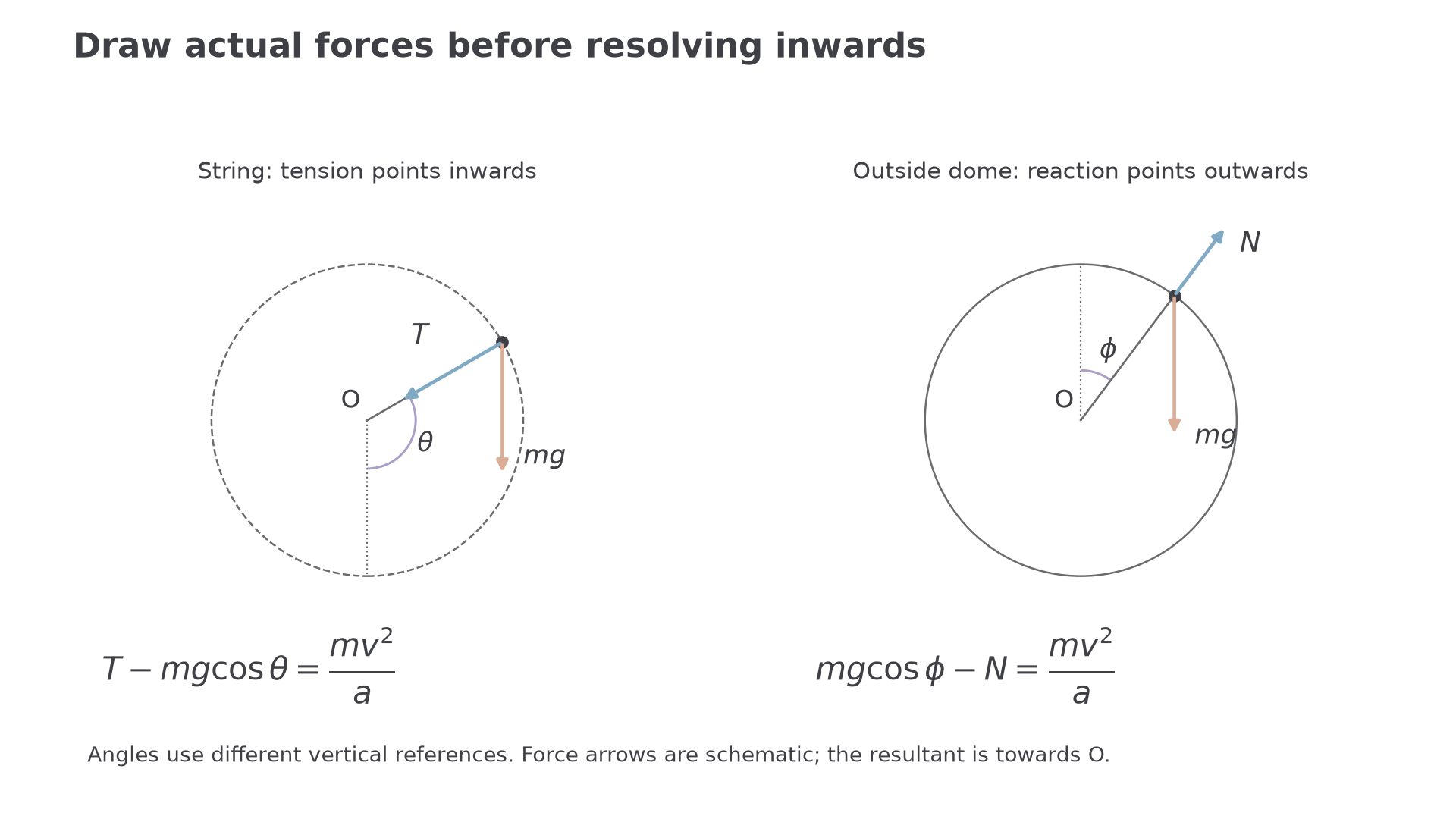
The force diagram changes for the outside of a convex circular surface. Its reaction pushes away from the centre. If is measured from the upward vertical, the inward equation is
Changing the angle convention does not change the forces; it changes which trigonometric component represents the weight.
Continue this lesson.
You’re previewing NovaLearn without an account. Create a free account to read the rest.
Create free account