2.4 - Surface areas of revolution
Rotating a curve sweeps out a surface, and the distance from the axis changes the area swept out by each small piece. You will combine radius with arc length to find curved surface areas about either coordinate axis, using Cartesian or parametric equations.
The surface element
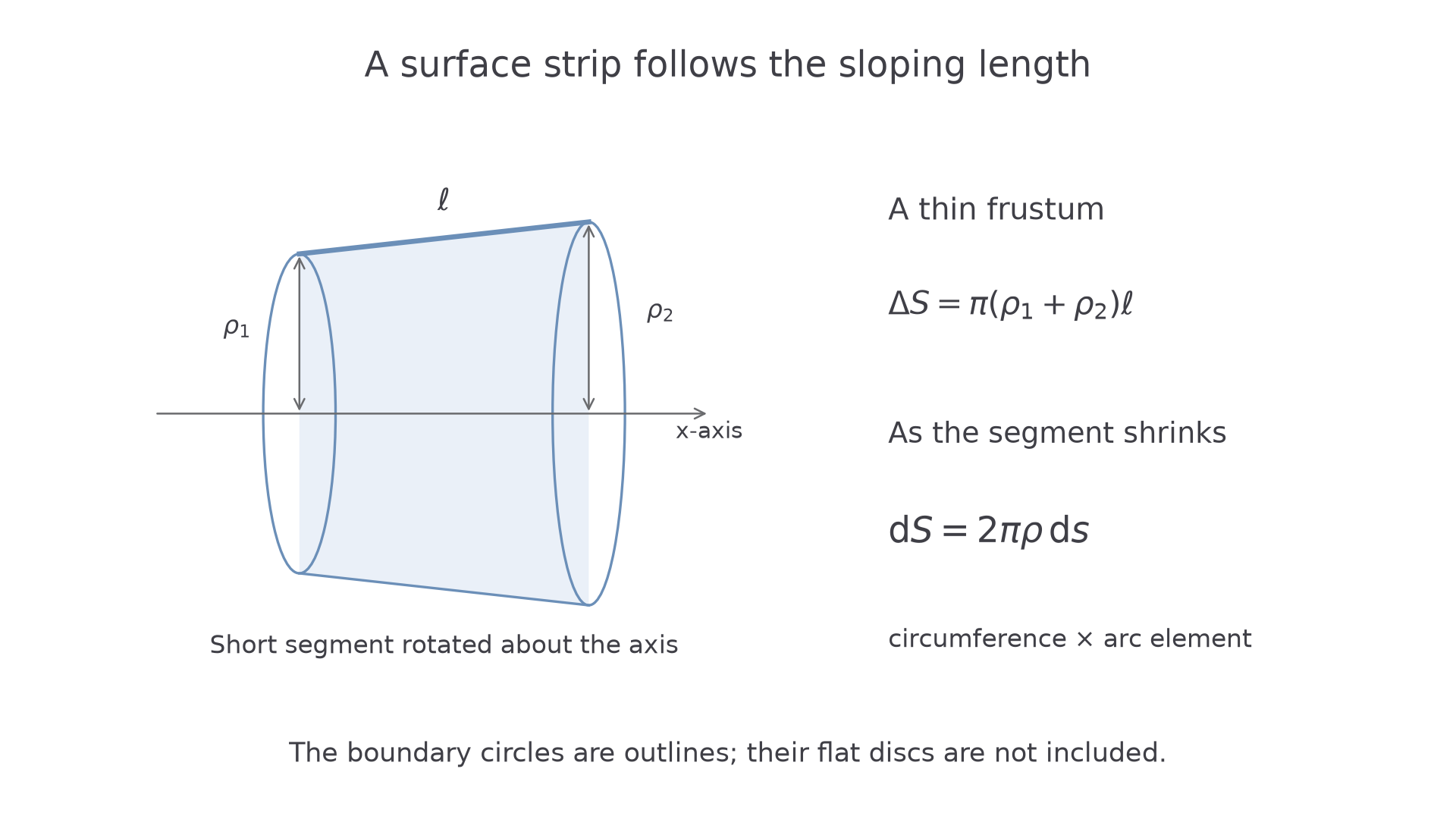
Why does a sloping line sweep out more area than a horizontal line with the same horizontal width and average distance from the axis? A surface strip depends on the actual sloping length, not just its horizontal projection.
Rotate a short straight piece about the horizontal axis. It makes a thin frustum, whose curved area is : the mean of its two circumferences multiplied by its slant length. As the piece becomes shorter, both radii approach , and the slant length becomes the arc element .
[DIAGRAM: asset_name: Radius and slant length determine the surface strip; asset_slug: cam9231-surface-strip; caption: A short curve element sweeps a frustum whose limiting area is circumference times arc length; description: A geometric side view shows the segment of y equals 1 plus x over two from x equals 1 to 1.6, its rotation about the horizontal x-axis, endpoint radii rho1 and rho2, and slant length ell. A separate clean formula panel shows frustum area pi times rho1 plus rho2 times ell approaching 2 pi rho ds. The end circles are outlines only; no end-disc area is included.]
Surface element of revolution
The curved area generated by a curve element is
where is its perpendicular distance from the axis of rotation. Integrate over a curve that sweeps the required surface once.
Not in the formula booklet: learn it.
This counts the swept curved surface. Flat closing discs are added only when the question separately asks for them as part of a total surface area.
Worked example 1: constant radius
Question. The line segment , , is rotated about the -axis. Find the area of the surface it generates.
Plan. Use radius and .
Every strip has the same circumference; no sloping correction is needed.
Answer. The generated curved surface area is .
Check. Unrolling the cylinder gives a rectangle of width and length , hence area . Its two end discs have not been swept by the line segment.
Change from constant radius to a steadily increasing radius. Both the circumference and the sloping element now enter.
Worked example 2: a sloping generator
Question. The segment , , is rotated about the -axis. Find its generated surface area.
Plan. Use radius , and calculate the length element from .
Answer. .
Check. This is a cone with base radius and slant length . The geometric curved-area formula gives independently.
The opening question is answered by the length factor: replacing the sloping element by its horizontal projection would make each strip too small.
Watch out
uses horizontal width rather than arc length. In general use .
Use a steeper generator to form the surface integral.
Revolving about either axis
The radius is always a distance from the chosen axis. For rotation about the -axis it is ; for rotation about the -axis it is .
Cartesian surface areas
For a curve , with , its swept curved area is
provided the chosen curve sweeps the required surface once. If , use instead, keeping the same radius rule. Split at sign changes to evaluate absolute values.
Not in the formula booklet: learn it.
The integration variable does not determine the axis. You can integrate with respect to when rotating about the -axis. Choose the variable that makes the curve and its limits easiest.
Worked example 3: a curve below the axis
Question. Find the area generated by rotating , , about the -axis.
Plan. Use the positive radius , then simplify the length element with the hyperbolic identity.
Since , . Thus
The endpoint values are and .
Answer. .
Check. Reflecting the curve in the -axis produces and exactly the same swept surface. A negative coordinate therefore cannot make the area negative. Also the arc length is , and ; hence , which contains the result.
Change only the axis. The length element remains the same, but the radius is now .
Continue this lesson.
You’re previewing NovaLearn without an account. Create a free account to read the rest.
Create free account