3.3 - Completing a vertical circle
Reaching the height of a circle's top is only part of the problem. Find the energy needed to keep a string taut or a particle against the inside of a track, compare those conditions with a rigid rod, and check force limits over the whole motion. The limiting point depends on what the constraint can do.
The taut-string condition
How fast must a particle leave the bottom to loop on a string? Energy alone suggests enough speed to gain height , but the string must also be able to supply the inward force at every point.
Let be the bottom speed and the angle from the downward vertical. While the string is taut, energy and inward resolution give
Both are smallest at the top, where . Thus
If the top tension is nonnegative, tension is nonnegative everywhere. The same inequality also gives , so there is enough energy to pass through the top.
A complete loop on a string
For a particle projected tangentially from the bottom on a light inextensible string of length , with no resistance,
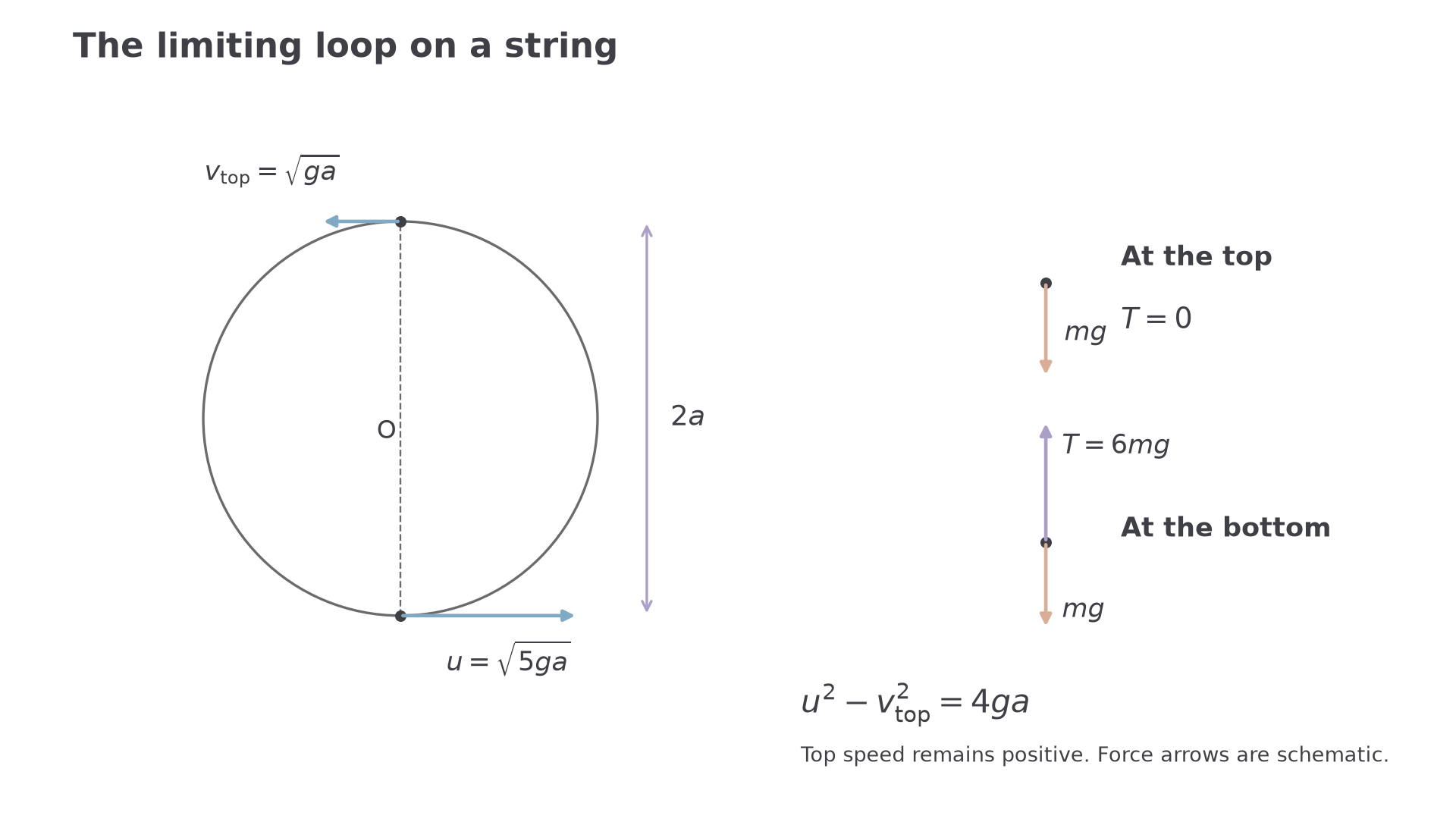
is the limiting condition for a complete circular path. At the limiting speed, and . Strictly positive tension at every point requires .
This result is not in the formula booklet: derive it from energy and the top force equation.
At equality the string is still fully extended at the top, with zero tension at that instant. Gravity alone supplies exactly the required inward acceleration. The speed is positive, and tension increases again as the particle descends. This is different from a zero-tension point below the top after which the circular formula would require negative tension.
[DIAGRAM: asset_name: The limiting string loop; asset_slug: cam9231-limiting-loop; caption: At the limiting loop speed the top tension is zero, but the top speed is positive; description: Exact vertical circle with bottom and top particle positions. The bottom has upward tension 6mg, downward weight mg and tangential speed square root of 5ga. The top has downward weight mg, zero tension and tangential speed square root of ga. A vertical bracket shows the height rise 2a. A side panel separates the energy loss 4ga in speed squared from the remaining top speed squared ga.]
Worked example 1: the limiting bottom launch
Question. A particle of mass is attached to a light inextensible string of length . Find the least bottom speed for a complete circle, the top speed at this limit, and the tension at the bottom. Use .
Plan. Set the top tension to zero, use energy to obtain the bottom speed, then resolve at the bottom.
At the top, gravity alone supplies the inward force:
The height gain is , so
At the bottom,
Answer. The least bottom speed is , the limiting top speed is , and the bottom tension is .
Check. Substituting into the full expression gives . It is nonnegative all around the circle, zero only at the top and at the bottom.
Now keep the string and mass, but launch from partway up the circle. The limiting top condition is unchanged; only the height still to climb changes.
Worked example 2: launching above the bottom
Question. The same particle and string are used. The particle is launched tangentially upwards when the string makes with the downward vertical. Find the least launch speed for a complete circle and the tension at the launch point. Use .
Plan. Retain the limiting top speed, then use the height from the launch point to the top.
The launch height above the bottom is . The remaining rise to the top is . If the launch speed is ,
Answer. The least launch speed is , with tension at launch.
Check. The equivalent bottom speed squared is . This is the same limiting loop as Worked example 1, so the force condition holds on the full path, including the later descent and bottom passage.
More generally, a launch at angle with speed has equivalent bottom speed squared . The complete-loop condition becomes . Derive it from the height rather than memorising an extra formula.
Watch out
The condition supplies enough energy to reach the top height, but it is insufficient for a string. At the top, must be at least so that no outward push is demanded from the string.
Use a side launch to check the difference between starting height and circle radius.
Track and rod constraints
The same radius and energy can produce different motions when the constraint changes. A one-sided track can push the particle away from its surface but cannot pull it back. A rigid rod can both pull and push.
For the inside of a smooth circular track, reaction points towards the centre. Its equation and nonnegativity condition are the same as those of string tension. A bead threaded on a smooth circular wire is different: the wire can exert a radial force in either direction.
| Constraint | Radial force it can supply | Condition needed in addition to energy |
|---|---|---|
| Light inextensible string | Inward pull | |
| Inside of a smooth one-sided circular track | Inward push | |
| Outside of a smooth convex circular surface | Outward push | Outward reaction , using its own force equation |
| Light rigid rod, or bead threaded on a smooth wire | Inward or outward force | A signed radial force is allowed; no one-sided nonnegativity condition |
Use tension for a pulling rod force and compression for a pushing rod force. If denotes its signed inward force, then
A negative means compression of magnitude , not a broken rod model. The rod is assumed light, rigid and able to sustain the required forces.
Worked example 3: one energy, two constraints
Question. A particle of mass has bottom speed in a vertical circle of radius . Compare whether a full circular path is possible (i) on the inside of a smooth one-sided track and (ii) attached to a light rigid rod pivoted at the centre. Use .
Plan. Find the top speed predicted by energy, then ask what radial force each constraint would have to provide there.
Energy predicts
The signed inward force at the top would satisfy
An inside track cannot provide this outward force: its reaction would have to be negative, so contact is lost before the top. The rod can push outwards with . Its minimum speed squared, at the top, is positive, and there is no one-sided force restriction.
Answer. A complete circle is impossible on the inside track but possible with the rigid rod, which is in compression at the top.
Check. For the rod, weight inwards minus compression outwards leaves . This is exactly . For the track, , confirming failure of its complete-loop condition.
Continue this lesson.
You’re previewing NovaLearn without an account. Create a free account to read the rest.
Create free account