1.6 - The vector product
The vector product turns two directions into a vector perpendicular to both. You will learn its direction and component form, then use its magnitude to find areas, calculate point-to-line distances and recognise parallel vectors.
A perpendicular vector
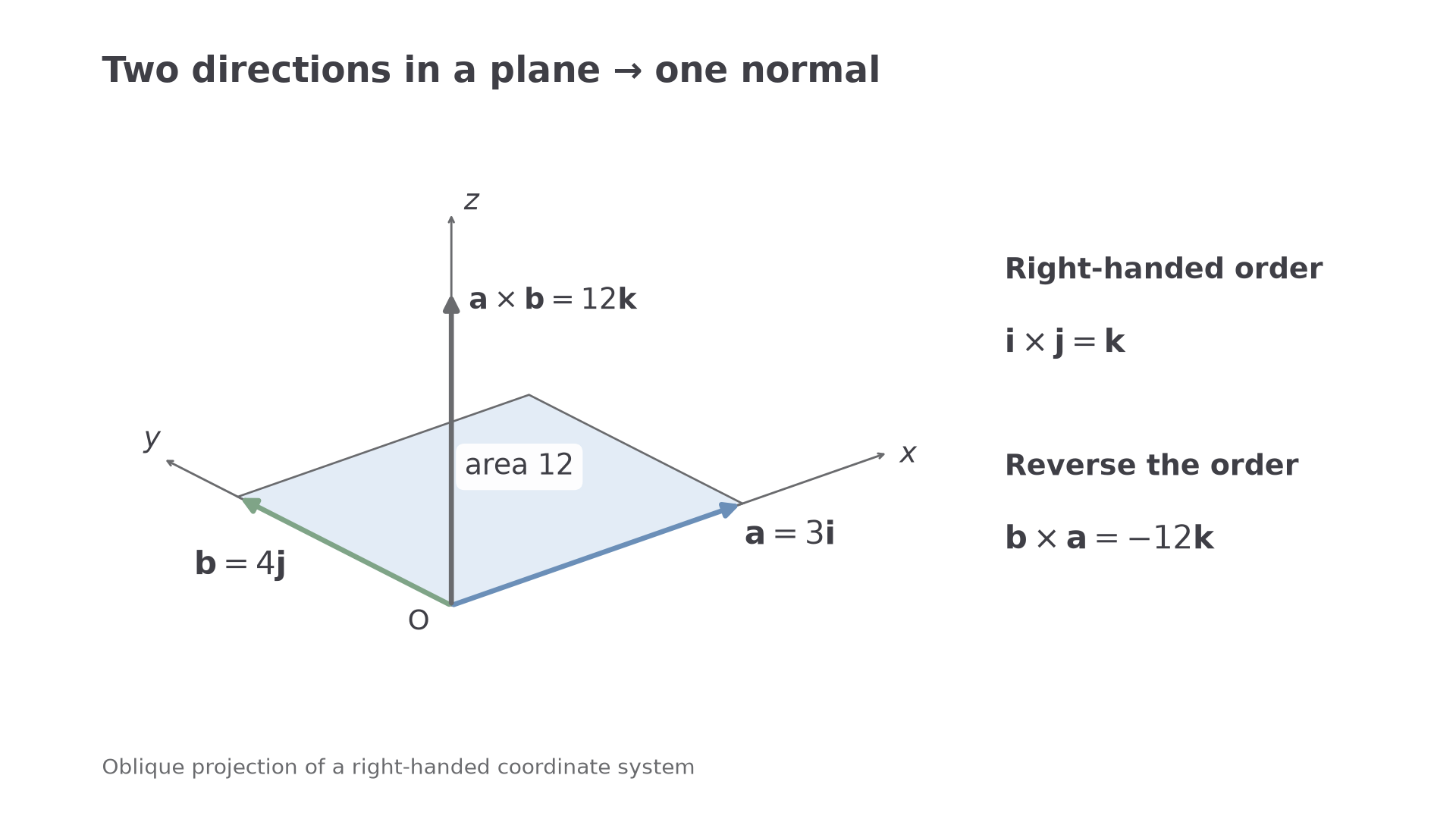
Two arrows lie on a flat board: one points three units east and the other four units north. Can we combine them to produce an arrow pointing out of the board? The scalar product cannot do this because its answer is a number. The vector product, also called the cross product, produces a vector.
Use the standard right-handed unit vectors . Turning from towards through the smaller angle gives the positive direction. Consequently,
The magnitude is the product of the two lengths because these particular arrows are perpendicular.
[DIAGRAM: asset_name: Cross product orientation; asset_slug: cam9231-cross-orientation; caption: A right-handed turn from a to b fixes the direction of their cross product; description: Exact oblique projection of positive x, y and z axes. A blue vector a of length 3 lies along positive x, a sage vector b of length 4 lies along positive y, and their cross product points along positive z. A pale parallelogram in the xy plane has area 12. A separate note states that reversing the order reverses the perpendicular vector.]
Vector product
For nonzero, nonparallel vectors and , let be their angle, with . The vector is perpendicular to both. Its direction follows the right-hand rule: curl the fingers of your right hand from towards through ; your thumb gives the direction.
The perpendicular has two possible senses. The order of the vectors chooses one of them. In particular, , and . Reversing any pair changes the sign.
Geometric vector product
where is the right-hand unit normal. If either vector is zero, or the vectors are parallel or antiparallel, their cross product is ; there is then no distinguished normal direction.
Not in the formula booklet: learn it.
For example, vectors of lengths and separated by have cross-product magnitude . Changing the angle to leaves the magnitude , but the actual direction still depends on the ordered vectors in space. A magnitude alone never identifies a vector.
Watch out
The cross product is not commutative: . The scalar product is commutative and produces a number; these are different operations.
Check both the operation and its orientation.
Calculating a cross product
Components let you find a normal without having to visualise a turn in space. The cyclic unit-vector products above, together with distributivity, give a formula whose signs you can check using scalar products.
Component vector product
For and ,
A determinant layout with first row is a useful mnemonic; its middle cofactor has a minus sign.
Not in the formula booklet: learn it.
The output must have zero scalar product with each input. Expanding, for example, gives six terms that cancel in pairs. This explains perpendicularity and provides a quick numerical check.
Worked example 1: calculating and checking a normal
Question. Find for and .
Plan. Calculate the three components, then check both scalar products.
Each component uses the other two coordinate positions in cyclic order.
Answer. .
Check. , and . The result is perpendicular to both inputs.
Now reverse only the order. This checks the sign rule as well as your component arithmetic.
Worked example 2: reversing the inputs
Question. For the same vectors, calculate .
Plan. Apply the component formula with first, then compare with the previous answer.
Answer. .
Check. This is the negative of , as the geometric definition requires. Both lengths are , and both scalar-product checks are still zero.
Perpendicularity detects many arithmetic errors, but it cannot distinguish a correct cross product from its negative. Keep the input order when checking orientation.
Watch out
The middle component is . Writing reverses only that component and usually destroys perpendicularity.
Try a pair with no zero component in the first vector.
Area, distance and parallelism
The cross product measures the area swept out by two adjacent sides. A parallelogram with side lengths has height , so its area is exactly . A triangle on the same sides has half that area.
Areas from side vectors
The vectors must represent two sides from the same vertex, rather than arbitrary position vectors.
Not in the formula booklet: learn it.
This also explains the zero case. For two nonzero vectors, if and only if , so they are parallel or antiparallel. If one vector is zero, the cross product is still zero, but it has no direction; do not describe the zero vector as defining a line.
The same area gives a perpendicular distance. Take a line through , with position vector , in a nonzero direction . For a point with position vector , the parallelogram with sides and has base length . Its height is the perpendicular distance to the line. Divide its cross-product area by that base length.
Distance from a point to a line
For the infinite line , where and , the distance from the point with position vector is
Not in the formula booklet: learn it.
The foot can lie anywhere on the infinite line. For the distance to a finite segment, first check whether the foot lies within the segment; otherwise the nearest point is an endpoint. A point already on the line gives cross product zero and distance zero.
Worked example 3: a parallelogram area
Question. A parallelogram has adjacent side vectors and . Find its exact area.
Plan. Find the cross product and then its magnitude.
Answer. The area is square units.
Check. Independently, and . Thus , using .
Change the shape to a triangle, keeping exactly the same side vectors but moving their shared vertex away from the origin. Its height will also give a point-to-line distance.
Worked example 4: position vectors are not side vectors
Question. Points , and are given. Find the area of triangle and the perpendicular distance from to the line through .
Plan. Form two side vectors from ; use their cross-product magnitude for the area and divide it by the base length for the distance.
These are the vectors in Worked example 3, so
The base has length , giving the perpendicular distance
Answer. The area is square units and the distance from to line is units.
Check. Its base has length . The component of along the base has length , giving height . Hence .
If the two side vectors had instead been and , their cross product would be zero: the three vertices would be collinear and the triangle degenerate. A nonzero cross product proves both non-collinearity and the existence of a plane normal. This is how the arrow pointing out of our opening board will help describe planes.
Problem-solving
For three points, form two joining vectors from a common point. Their cross product gives a normal; its magnitude gives twice the triangle's area. Dividing that magnitude by one side length gives the distance to the line along that side.
Use the same cross product for two geometric measurements.