2.2 - Singular systems and three planes
A zero determinant does not tell you whether equations contradict one another or leave a choice of solutions. You will reduce singular systems, distinguish these outcomes, and express a whole line or plane of common solutions using parameters.
Reducing a system
If an inverse does not exist, can the equations still have solutions? Compare , , . The third equation is the sum of the first two, including its constant. It supplies no new restriction.
Elimination makes this dependence visible. An augmented matrix places the constant column beside the coefficient matrix, separated by a vertical line. Each row represents one complete equation.
Equivalent row operations
You may swap two rows, multiply one row by a nonzero scalar, or add a multiple of one row to another. Apply the operation to the constants as well as the coefficients. Each operation is reversible, so it preserves the complete solution set.
The notation means replace row 2 by row 2 minus row 1. Not in the formula booklet: learn it.
A zero row must be read as an equation. Its right-hand entry makes the decisive difference.
Worked example 1: a redundant equation
Question. Reduce , , , and find its solutions.
Plan. Subtract row 1 from row 2, then subtract twice row 1 from row 3.
Now gives . Row 2 gives , and row 1 gives . Choose .
Answer. , for every real ; there are infinitely many solutions.
Check. Substitution gives , , and for every . All three original equations hold.
Change only the third constant from to . The coefficient matrix remains singular, but agreement of the constants can change.
Worked example 2: a contradiction after elimination
Question. Reduce , , , and state the number of solutions.
Plan. Apply the same reversible operations as in Worked example 1.
The last row says , which no coordinates can satisfy.
Answer. There is no solution.
Check. Adding the first two original equations requires . The third requires the same expression to equal , independently confirming the contradiction.
You need not always reduce to a diagonal array. Stop once the remaining equations show a contradiction or show which coordinates are free.
Watch out
The row adds no condition. The row , with , makes the system impossible.
Track the constants through this elimination.
Consistency and inconsistency
A system is consistent if it has at least one solution and inconsistent if it has none. A nonzero determinant guarantees consistency and uniqueness. A zero determinant requires you to inspect the constants as well as the coefficient rows.
For three unknowns with a singular coefficient matrix, a consistent system has infinitely many solutions: elimination leaves at least one free variable. A singular system cannot have exactly one solution.
[DIAGRAM: asset_name: Three different intersections of planes; asset_slug: cam9231-three-plane-cases; caption: Three planes can meet at one point, share a line, or have no common point; description: Three exact coordinate constructions compare x equals 0 and y equals 0 with a third plane. With z equals 0 the common set is the origin. With x plus y equals 0 the common set is the whole z-axis. With x plus y equals 1 the three planes have no common point although each pair intersects in a line. The planes are pale blue, sage and lavender, with the common point or line highlighted where present.]
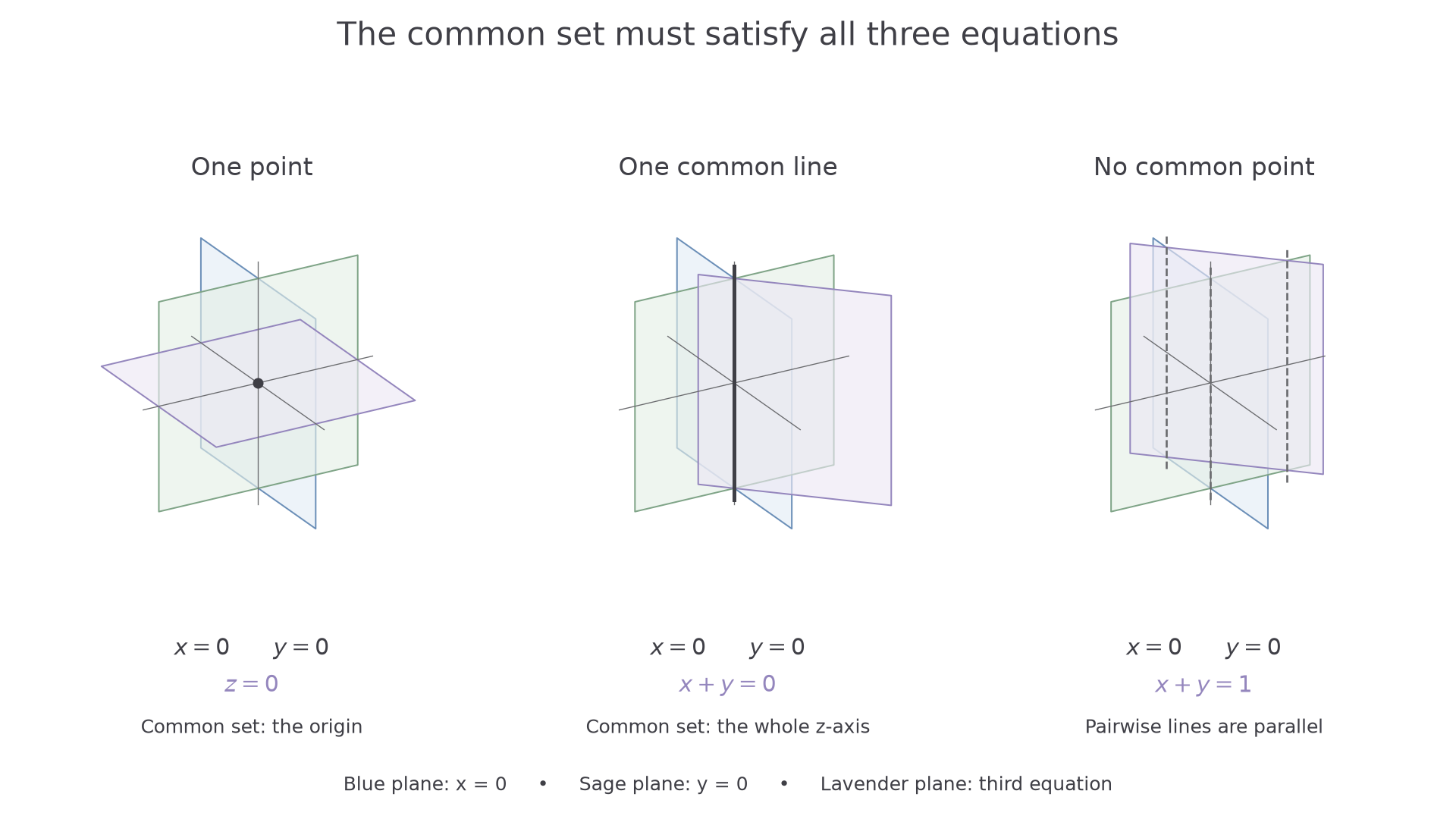
Each panel concerns the intersection of all three planes. Three pairwise intersections need not share a point.
Worked example 3: a singular case that stays consistent
Question. Investigate the consistency of , , for all real .
Plan. Locate the singular value, then inspect it without dividing by a possibly zero expression.
The coefficient determinant is
For , there is a unique solution. Eliminate using and . The third equation gives
For , this gives . For , it is , leaving free.
Answer. The system is consistent for every . Its unique solution is for ; at , its solutions are for real .
Check. The point satisfies the original equations for every , immediately confirming consistency. Substituting the whole family at verifies the free parameter.
Continue this lesson.
You’re previewing NovaLearn without an account. Create a free account to read the rest.
Create free account