1.5 - Sketching polar curves
A polar sketch comes from watching a radius change as its direction turns. You will use the allowed angle interval, symmetry, extreme radii and behaviour at the pole to draw the significant features without a long table of plotted points.
Symmetry and angle intervals
Does an equation symmetric in its angle always give a symmetric sketch? The angle interval can remove half of an otherwise symmetric curve.
Consider . The radii at and are both . These directions are reflections in the initial line, so their points form a reflected pair, provided both angles are allowed.
Symmetry of a polar curve
A polar curve is symmetric about a line when reflection in that line preserves its set of points. For an equation , compare the radii at reflected angles and check that the angle domain contains the corresponding directions, allowing complete turns.
Three useful angle changes are:
| Geometric change | Angle of the new ray |
|---|---|
| Reflection in the horizontal axis | , equivalently |
| Reflection in the vertical axis | , adjusted by a complete turn if needed |
| Half-turn about the pole | , adjusted by a complete turn if needed |
These are tests of the complete point set, not permission to extend the stated domain. First remove any angles that would require a negative radius.
Worked example 1: a full angle interval
Question. State the symmetry of , , and locate the points on the horizontal axis.
Plan. Compare reflected directions, then use angles and .
Since , reflection in the horizontal axis preserves the radius and domain. But , so the vertical reflection generally changes it.
Answer. Symmetric about the horizontal axis, with horizontal-axis points . It is not symmetric about the vertical axis or under a half-turn.
Check. The corresponding Cartesian points are and . Their unequal distances from the pole rule out the latter two symmetries.
Keep the equation but restrict the angle to the upper half-plane. This changes the point set and therefore its symmetry.
Worked example 2: a restricted angle interval
Question. Describe which part of is traced for . Is this restricted curve symmetric about the horizontal axis?
Plan. Use the signs of and , then test a reflected interior point.
Here , and , so . As the ray turns, the curve goes from , through , to , in Cartesian coordinates.
Answer. Only the upper half of the full curve is traced. It is not symmetric about the horizontal axis.
Check. The point occurs at , but its reflection would require , outside the interval.
The two pictures have the same radial rule but different permitted directions. In both, stays positive, so the curve never reaches the pole.
[DIAGRAM: asset_name: The angle interval changes the polar curve; asset_slug: cam9231-polar-angle-domain; caption: A full curve has reflected pairs that a restricted upper half no longer contains; description: Two equal-scale panels show r equals 3 plus cos theta. Left uses 0 at most theta less than 2 pi and shows a closed curve symmetric about the horizontal axis, with Cartesian labels (4,0), (-2,0), (0,3), (0,-3). Right uses 0 at most theta at most pi and shows only the upper half with the two axis endpoints and (0,3).]
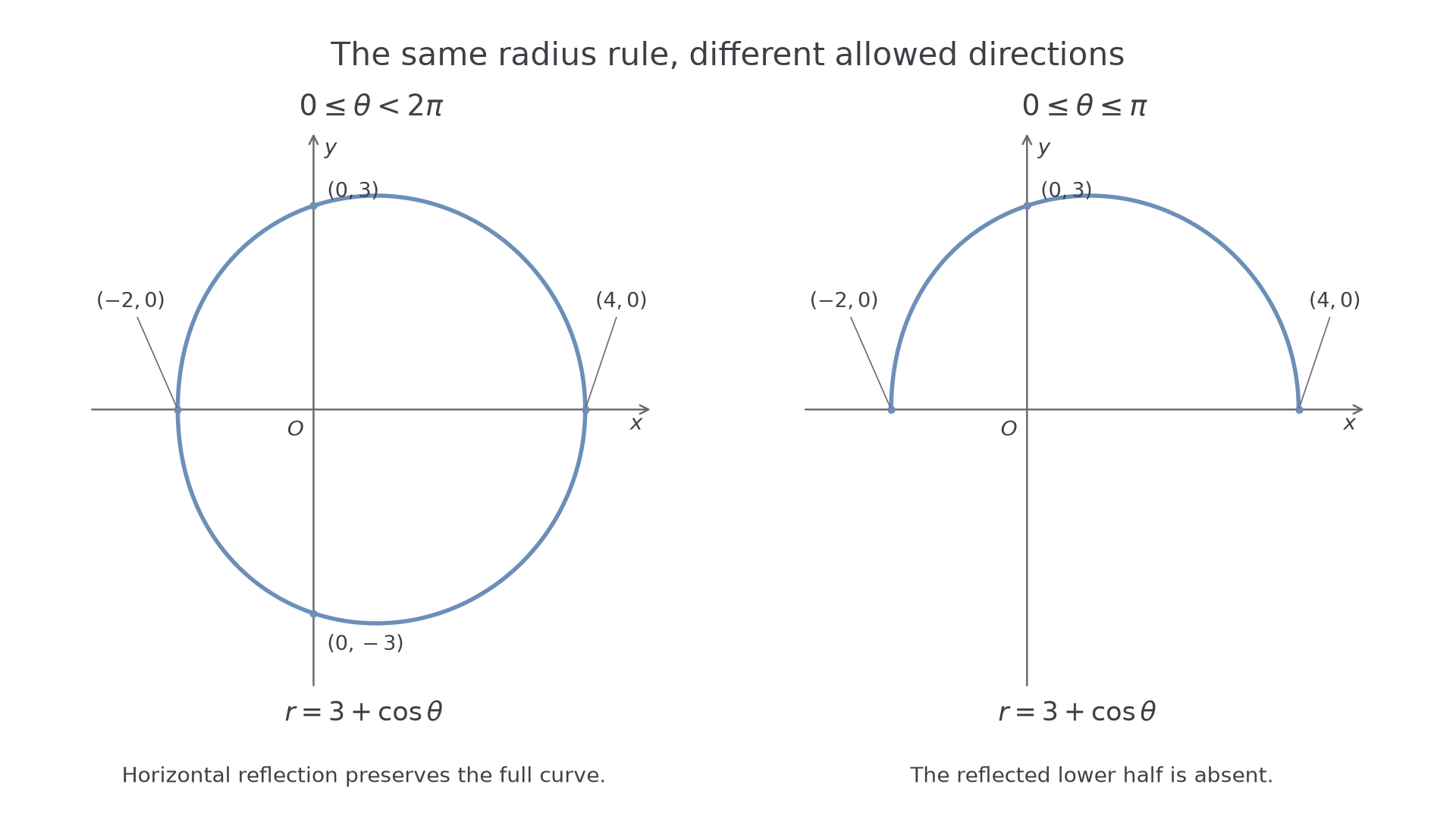
An exact identity such as is useful evidence only after the domain has been checked.
The pole and extreme radii
The greatest radius locates a point furthest from the pole; it need not locate the highest point or the point furthest from the initial line.
For , the bound immediately gives . The greatest distance occurs on the initial line. A point's height is instead , so a greatest-height question would require a different calculation.
Problem-solving
Find where , and find the least and greatest permitted values of . If the equation gives , take its nonnegative square root before stating a radius.
At a pole point, inspect nearby directions as well as the value zero. If points approach the pole with , the line through each point and the pole has that limiting direction. This gives a tangent line through the pole when the limit exists. Two branches may have the same tangent but form a cusp, or approach along different tangents. A zero radius alone does not settle the shape.
Worked example 3: a cusp at the pole
Question. For , , find the extreme radii and describe how the curve meets the pole.
Plan. Use the cosine bounds, then follow the curve on either side of its zero radius, identifying and as the same ray.
Near either end of the interval, is small and positive, , and has opposite signs on the two branches. Also .
Answer. The furthest point is in polar coordinates. The curve has a cusp at the pole, with both branches on its left and tangent line .
Check. Writing gives for small positive . Thus the upper branch approaches from the left; its reflection supplies the lower branch on the same side, confirming a cusp rather than a crossing.
Change the left side of the equation from to , keeping its right side. The same angle maximises it, but the maximum distance changes.
Worked example 4: an equation for the squared radius
Question. For , , find the extreme radii and the tangent at the pole.
Plan. Bound , take the nonnegative square root, then use the limiting direction.
The maximum is at , and the minimum zero at . Near the pole, on both branches and .
Answer. The furthest point is in polar coordinates, and the pole tangent is . The branches again approach on the left with a common tangent.
Check. At , the radius is . Substituting the claimed maximum into the equation gives ; radius would fail it.
Neither example has its greatest height at its greatest radius: both maximum-radius points have height zero. Keep these geometric questions separate.
Watch out
If , the distance bound is , not . Give the furthest point as a polar pair, with its angle, when asked for polar coordinates.
The same reasoning applies to a rotated curve.
Putting a sketch together
A complete sketch joins permitted points in increasing angle order, showing which branches meet and how they meet.
Use a small set of significant directions: interval endpoints, zero radii, extreme radii and axis directions. Join them consistently with symmetry and the changing radius. In particular, the initial line is the positive horizontal ray; a point at lies on the opposite ray, although it is still a horizontal-axis intersection.
Worked example 5: two horizontal lobes
Question. Sketch , , stating its allowed angle intervals and significant features.
Plan. Require the squared radius to be nonnegative, then locate its zeros, maxima and symmetries.
On these intervals, . The largest radius is , at , and the radius is zero at . Reflection in either axis preserves the equation and allowed directions.
Answer. Two equal lobes lie to the right and left of the pole, symmetric about both axes. Their tips are Cartesian points , ; the positive tip is the nonzero initial-line intersection. The lobes meet at the pole with tangent lines and .
Check. At , the right side is , so no vertical-axis point is allowed except the pole represented at other angles. At , , placing the upper right branch strictly between its tip and its pole endpoint.
The first and last intervals are two halves of the same right-hand lobe, separated only by the choice to cut the angle interval at zero. There is no extra lobe at that cut.
[DIAGRAM: asset_name: Allowed directions build two-lobed polar sketches; asset_slug: cam9231-polar-lobes; caption: Changing cosine to sine rotates the two lobes through pi over four; description: Two equal-scale panels show r squared equals 16 cos 2 theta and r squared equals 16 sin 2 theta with nonnegative r only. The left panel has horizontal lobes, tips (4,0) and (-4,0), and dashed pole tangent lines y equals plus or minus x. The right panel has lobes on the north-east and south-west diagonal with polar tips (4, pi over 4), (4, 5 pi over 4), and dashed horizontal and vertical pole tangents. No negative-radius intervals are drawn.]
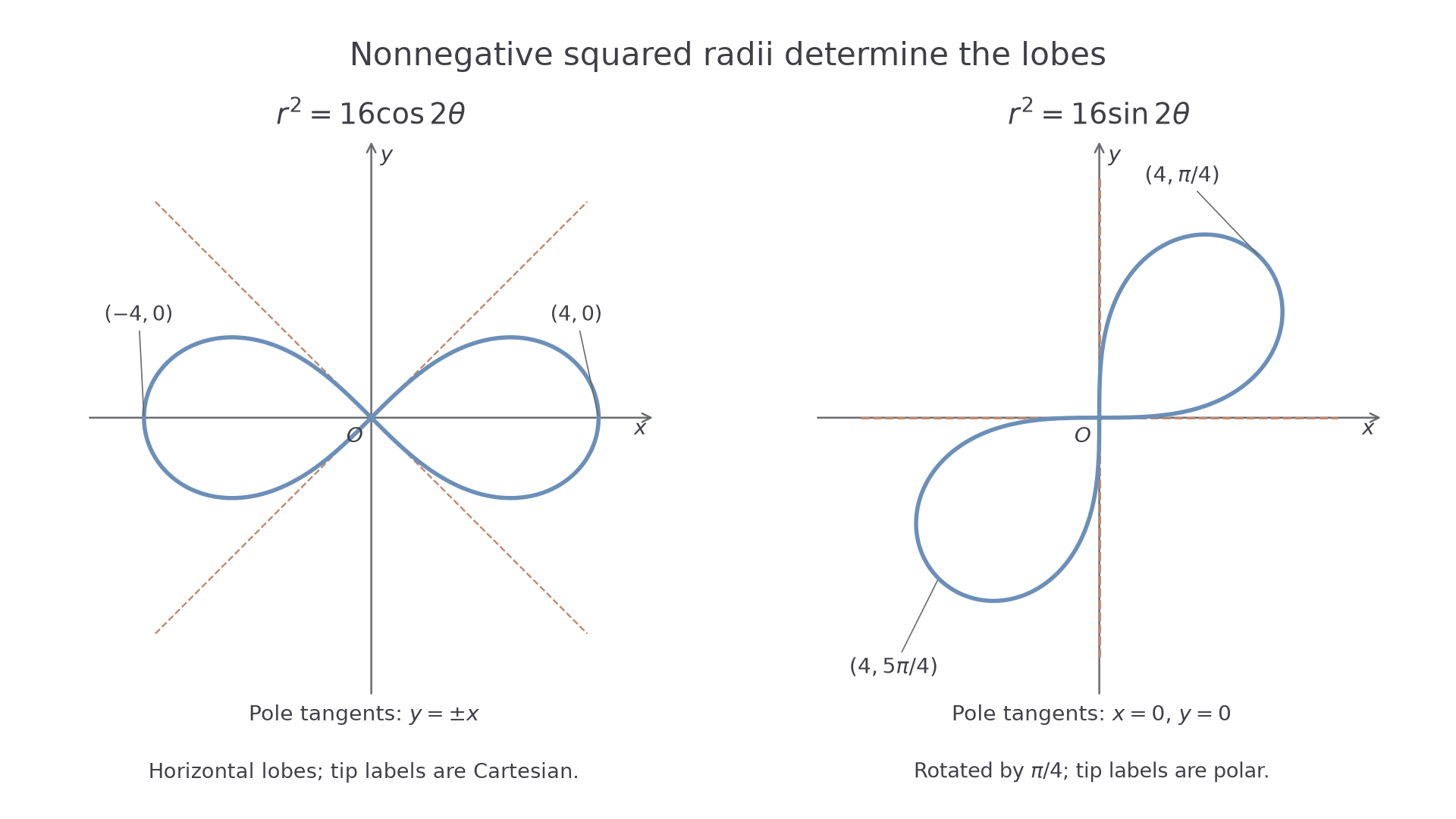
Replacing cosine by sine changes the directions of the lobes. The same radius bounds and nonnegativity test still work.
Worked example 6: rotated lobes
Question. Sketch , , stating its significant features.
Plan. Solve , and use its zero and maximum values.
The allowed intervals are . The radius is zero at . Its maximum occurs at .
The identity shows that this is the preceding sketch rotated anticlockwise through .
Answer. Two equal lobes lie in the first and third quadrants, symmetric about and , with a half-turn symmetry. Their polar tips are , ; their pole tangents are the two coordinate axes. The initial line contains only the pole.
Check. Converting the first tip gives , which lies on the stated diagonal. At , the squared-radius expression is negative, confirming that no lobe belongs in quadrant two.
The opening symmetry question now has a precise answer: both the radial equation and the permitted directions must preserve reflected points. A full sketch also needs its zeros, extreme distances and local pole shape.
Watch out
Do not plot a negative radius on the opposite ray. Under our convention, exclude that angle. For , retain only and use the nonnegative square root.
Describe the important features of the same lobe pattern at a new scale.
Quick Recap
- Check the domain as well as the equation before claiming symmetry.
- Zero radii, extreme radii and initial-line intersections guide the sketch.
- A limiting ray gives a pole tangent; inspect nearby branches to determine the local shape.
- Nonnegative-radius restrictions decide which lobes exist and which directions are absent.