3.2 - Toppling and sliding
A block can lose equilibrium because friction is insufficient or because its support can no longer balance its turning effect. In this final part of 3.2, you will identify each limiting condition, take moments about a toppling edge and compare the thresholds to find which motion begins first.
Impending motion
If you push harder and harder on a tall box, will it slide or tip first? Solving the force equations gives the friction required, but that is only part of the answer. The floor's normal force must also act somewhere within the base.
Limiting equilibrium
A body is in limiting equilibrium when it is just at the boundary of a possible equilibrium configuration. For impending sliding, friction reaches . For impending toppling, the resultant normal contact force reaches an edge of the supporting base.
Before either limit, friction can be less than , and the normal contact force can act inside the base. For two separate supports, loss of contact occurs when one reaction falls to zero; at a toppling edge, the contact on the far side has just disappeared.
Consider a block on a horizontal floor with weight , a centred centre of mass, base half-width , and a rightward horizontal push at height . Let the normal reaction act a distance to the right of the base centre. Force and moment balance give
The friction acts left. Both floor forces act on the base line, so friction has zero moment about its centre. Possible equilibrium requires
These conditions apply to this horizontal-push model. An angled pull changes , so you must resolve forces again rather than reuse .
Worked example 1: below both limits
Question. A block of weight has a horizontal base wide and its centre of mass above the base's midpoint. It rests on a floor with coefficient of friction . A horizontal force of acts to the right at height . Determine whether equilibrium is possible.
Plan. Find the required friction and the normal reaction's position, then check both constraints.
The half-width is . Thus and .
Answer. Equilibrium is possible; neither sliding nor toppling is impending.
Check. The normal reaction's moment about the base centre is , balancing the push's moment .
Increase only the push until friction reaches its maximum. You still need to check the reaction's position.
Worked example 2: a sliding boundary
Question. For the same block and force height, the push is increased to . Identify the limiting condition.
Plan. Recalculate the two requirements and see which constraint has become an equality.
Answer. Sliding is impending. Toppling is not impending because the normal force still acts strictly inside the base.
Check. The push needed to move the normal force to would satisfy , giving , well above the sliding boundary.
Equality should describe the specified impending motion, rather than being assumed for every contact force in a stationary problem.
Watch out
“Limiting equilibrium” does not automatically mean . A body may be about to topple with friction still below its maximum. Identify the boundary from the physical motion.
Test both inequalities in a fresh configuration.
The pivot at toppling
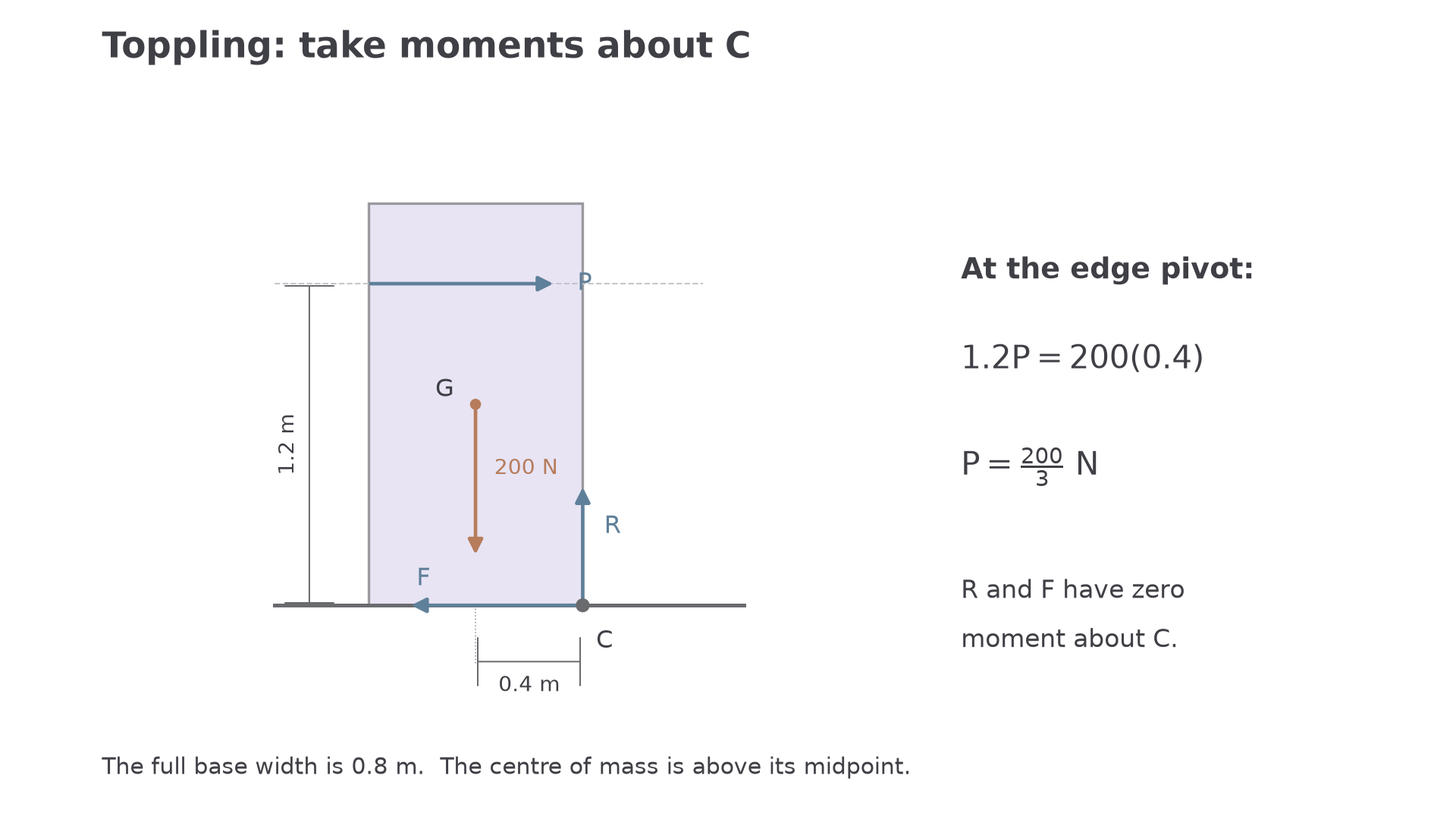
At impending clockwise toppling, the floor contact has reduced to the right-hand edge. Take moments about that edge: the normal force and friction both disappear from the equation because their lines of action pass through it.
The opposing weight moment uses the horizontal distance from the pivot to the vertical line through . For a centred block this is . If is shifted towards the pivot, use the smaller distance. A composite body's centre of mass can therefore change its stability even when its outer dimensions stay fixed.
[DIAGRAM: asset_name: The limiting pivot of a pushed block; asset_slug: cam9231-toppling-pivot; caption: At impending toppling the contact forces act at the edge; description: A block of base width 0.8 metres on a horizontal rough floor has a horizontal rightward push P at height 1.2 metres and vertical weight 200 newtons through its central vertical line. The right base corner C is the limiting pivot. Normal reaction R points up at C and friction F points left at C. The weight's perpendicular distance from C is 0.4 metres. A faint dashed line marks the push height.]
Worked example 3: pushing at a greater height
Question. A block has weight , base width , and its centre of mass above the base midpoint. A rightward horizontal push acts at height . Assuming the floor is sufficiently rough to prevent earlier sliding, find the push at impending toppling.
Plan. Take moments about the right-hand base edge.
The push turns clockwise and the weight turns anticlockwise. At the boundary,
Answer. Toppling is impending at , or .
Check. The base-centre method gives , exactly the edge. Friction requires ; this states precisely how rough the floor must be.
Keep the weight and outside dimensions fixed, but shift only the centre of mass towards the right edge. The restoring moment is smaller.
Continue this lesson.
You’re previewing NovaLearn without an account. Create a free account to read the rest.
Create free account