3.2 - Equilibrium of a rigid body
Balanced forces can still turn a body. In this part of 3.2, you will combine force and moment balance, draw the forces permitted by each support and solve coplanar equilibrium problems. You will also check that the resulting contact forces are physically possible.
Force and moment balance
Can two equal and opposite forces fail to keep a body in equilibrium? Hold a book at opposite edges and push one edge up and the other down: the resultant force can be zero while the book still turns.
A particle model has no size, so force balance is enough. A rigid body has spatially separated forces, and their turning effects must balance too. The body is rigid when distances between its points are treated as fixed.
Coplanar rigid-body equilibrium
For coplanar forces, the conditions are
These conditions are necessary and sufficient for equilibrium of a body initially at rest, provided its forces satisfy the support and contact constraints. One reference point is enough once the resultant force is zero; the total moment is then zero about every point.
Not in the formula booklet: learn it.
The converse matters: if the resultant force and total moment are both zero, there is no tendency to accelerate or start rotating. These equations do not by themselves stop a body that is already moving; equilibrium problems here specify a body at rest.
Worked example 1: force balance without moment balance
Question. An upward force of acts at the left end of a horizontal bar of length . A downward force of acts at its right end . No other forces act. Determine whether the bar can remain at rest.
Plan. Check the resultant force and then the total moment about .
The separated forces form a couple: zero resultant force but a nonzero turning effect.
Answer. The bar is not in equilibrium; there is a clockwise turning effect.
Check. Taking moments about the midpoint gives again. Changing the reference point cannot remove this turning effect.
Move only the downward force's line of action until it coincides with the upward force's line. Force balance stays unchanged, but moment balance changes.
Worked example 2: both conditions satisfied
Question. Both forces in Worked example 1 now act at , along the same vertical line. Determine whether the bar, initially at rest, is in equilibrium.
Plan. Test the force sum and moment sum again.
Answer. Yes. The two forces cancel and have no resultant moment.
Check. About , the moments are . Both tests agree.
A zero total moment about one point alone is also insufficient: a single force through that point has zero moment there but can accelerate the body. Use all three scalar equations when independent horizontal, vertical and turning effects are present.
Watch out
“Upward forces equal downward forces, so equilibrium” omits a condition for a rigid body. Check horizontal balance and moment balance as well.
Separate the force calculation from the turning calculation.
Contact forces and constraints
A support does not provide an arbitrary force. A smooth surface pushes normal to itself; a rough surface can also exert friction. The force diagram must reflect what the support can actually do.
| Model | Forces exerted on the body |
|---|---|
| Smooth surface | A normal reaction , perpendicular to the surface, pushing away from it |
| Rough surface | Normal reaction plus tangential friction , opposing actual or impending relative motion |
| Smooth hinge in a plane | Two force components through the hinge; no resisting moment |
| Taut light string | Tension along the string, pulling away from the body |
A contact reaction must satisfy ; an ordinary surface cannot pull a body towards itself. Tension must satisfy . If a solved value is negative, the assumed contact or taut-string model is not possible.
Static friction constraint
For a body at rest on a rough surface with coefficient of friction ,
At impending sliding, . In ordinary equilibrium the friction takes the value needed, up to that maximum.
Not in the formula booklet: learn it.
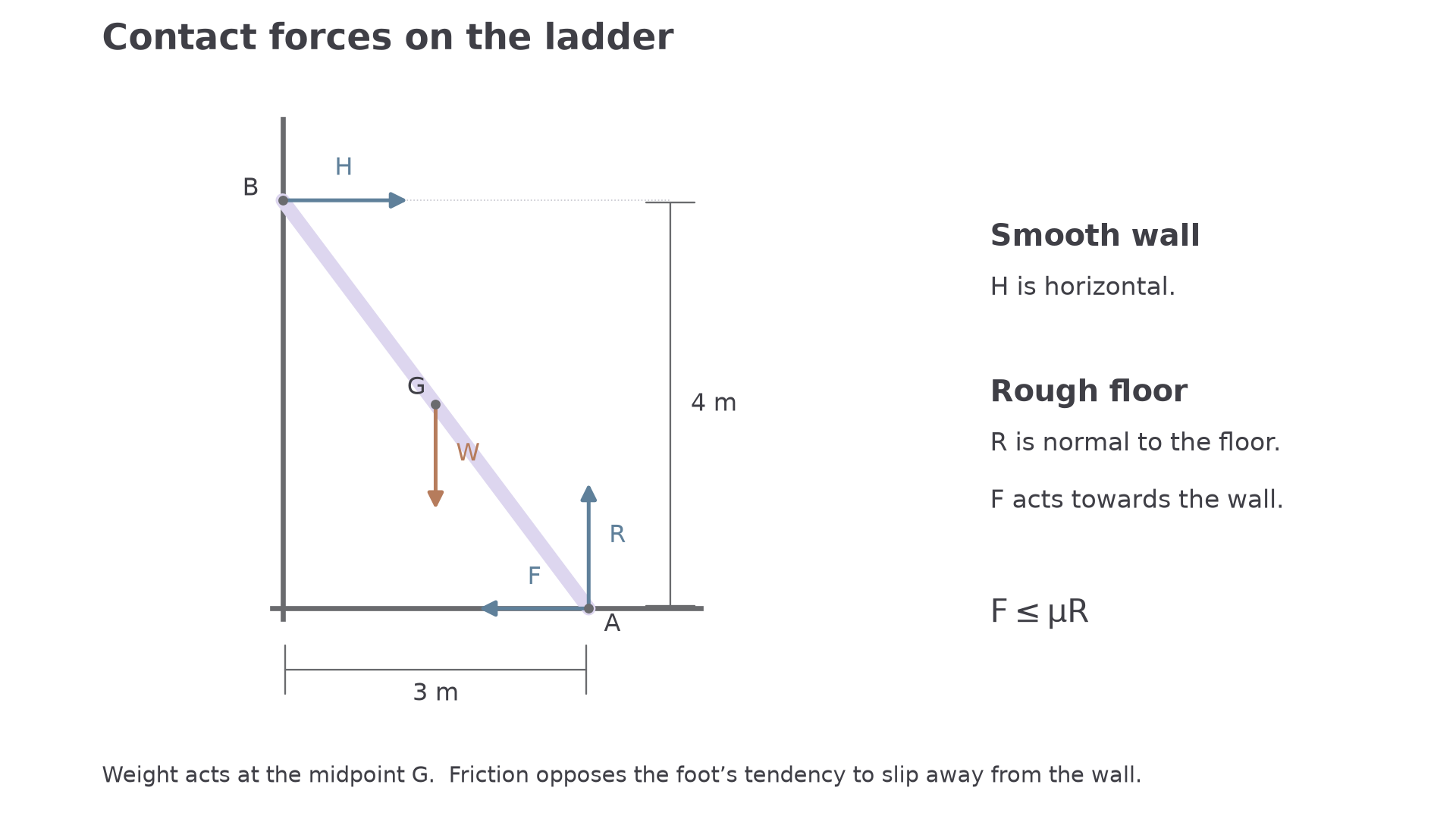
The next diagram shows a ladder tending to slip with its foot moving right and its top moving down. Floor friction acts left, towards the wall; the wall is smooth, so it exerts only a horizontal normal reaction.
[DIAGRAM: asset_name: Forces on a ladder against a smooth wall; asset_slug: cam9231-ladder-forces; caption: The smooth wall has no friction force; floor friction opposes the foot's tendency to move away; description: A ladder runs from A at (3,0) to B at (0,4), against a wall on the left. Its weight acts vertically downwards at the midpoint (1.5,2). The wall reaction H at B points right. The floor normal reaction R at A points up, and floor friction F points left. Horizontal and vertical separations are labelled 3 metres and 4 metres.]
Worked example 3: checking available friction
Question. A uniform ladder of weight rests with its foot from a smooth vertical wall and its top above a rough horizontal floor. The coefficient of friction at the floor is . Determine whether equilibrium is possible.
Plan. Take moments about the foot, resolve forces, then compare the required friction with its maximum.
Let be the wall reaction, the floor normal reaction and the friction towards the wall. The weight line is horizontally from the foot. Moments about the foot give
Horizontal balance requires , while vertical balance gives . The maximum friction is .
Answer. Equilibrium is possible because , and both normal reactions are positive.
Check. The required ratio is . Friction is below its limiting value, so setting at the start would have been wrong.
Continue this lesson.
You’re previewing NovaLearn without an account. Create a free account to read the rest.
Create free account