3.1 - Modelling projectile motion
A moving projectile curves even though its acceleration keeps the same direction. You will build a model using horizontal and vertical motion, then find the projectile’s position, speed and direction at a specified time or position.
The projectile model
If one ball is dropped and another is thrown horizontally from the same height at the same instant, which reaches level ground first? In the model we will use, they arrive together. Their horizontal motions differ, but their vertical motions start with the same vertical velocity and have the same acceleration.
Once a ball has left the hand, there is no continuing “throwing force”. Neglecting air resistance, its only force is its weight. Newton’s second law gives downward acceleration of magnitude , independent of the ball’s mass. A downward acceleration does not mean downward velocity: the ball may still be moving upwards while its upward velocity decreases.
Projectile model
A projectile is modelled as a particle moving freely under gravity, with constant downward acceleration. Its size and rotation are ignored, air resistance is neglected, and is taken as constant over its flight.
The model begins after release and ends at the first relevant impact. It does not describe the force exerted by the hand or the contact force during a bounce. Treating the body as a particle is useful when its dimensions are small compared with the distances involved. Neglecting air resistance is less suitable for a feather, a parachute or a rapidly moving light ball. Wind and spin can also make a real flight depart from this model.
Choose a horizontal axis and a vertical axis before calculating. With rightwards and upwards positive, the acceleration components are and . At the greatest height the vertical velocity is zero for an instant, but the acceleration is still . Unless another value is specified, use in the numerical work in these lessons.
[DIAGRAM: asset_name: Projectile velocity and acceleration; asset_slug: cam9231-projectile-components; caption: Horizontal velocity stays constant while vertical velocity changes sign; description: Exact trajectory x equals 20t and y equals 15t minus 5t squared from launch until t equals 3 seconds. Tangent arrows at t equals 1 and 2 show equal rightward components and opposite vertical components. A downward acceleration arrow at the highest point shows that gravity continues to act there.]
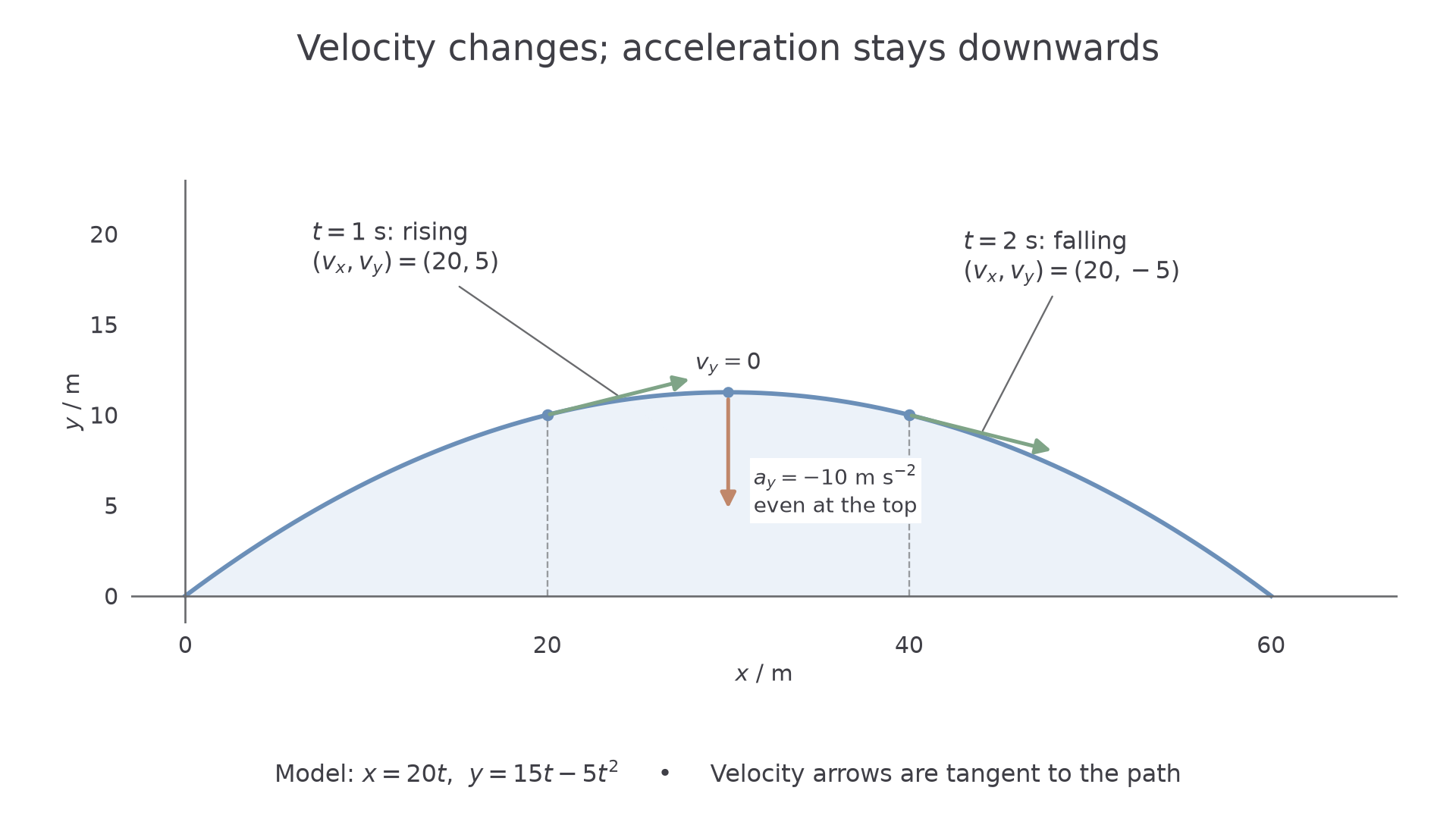
The two motions share the same clock. A horizontal launch has zero initial vertical velocity, just like a drop; adding a horizontal component cannot change the vertical arrival time.
Key idea
The trajectory curves because the velocity changes. The acceleration itself remains vertically downwards throughout free flight.
Apply the model at its most easily misread instant.
Horizontal and vertical equations
Resolve the launch velocity first, then apply the constant-acceleration equations separately in the two directions.
A speed of at an angle above the horizontal, where and , gives initial components rightwards and upwards, in . After seconds, the horizontal displacement is ; the vertical displacement is . The negative term represents the effect of downward acceleration, not a negative initial speed.
You already know
For constant acceleration, and . Use a component of velocity and the acceleration in that same direction. These constant-acceleration formulae are in MF19.
In general, take the launch point as the origin, with horizontal and vertically upwards. For initial speed at angle above the positive horizontal direction, resolving a right-angled triangle gives and .
Component equations
During free flight,
Here are displacements from launch. If a fixed vertical coordinate has launch height , use .
The underlying constant-acceleration formulae are in MF19; resolve and apply them in each direction.
The same must appear in both equations: the particle cannot have a different elapsed time horizontally and vertically.
Worked example 1: position after one second
Question. A particle is projected from at , with and . Find its horizontal and vertical displacements after second. Use .
Plan. Resolve the initial velocity and apply the displacement equation in each direction.
There is no horizontal acceleration term because the model has no horizontal force.
Answer. The particle is horizontally from and above .
Check. Its vertical velocity falls from to , so its average vertical velocity is . In one second that gives the same rise.
Change only the observation time. Doubling time doubles the horizontal displacement, but the vertical acceleration prevents the same rule vertically.
Continue this lesson.
You’re previewing NovaLearn without an account. Create a free account to read the rest.
Create free account