3.4 - Elastic systems in motion
When several forces act, geometry decides each extension and energy tracks the resulting motion. You will model two elastic elements, motion along inclined planes, and a conical pendulum whose string changes length as it rotates.
Two strings or springs
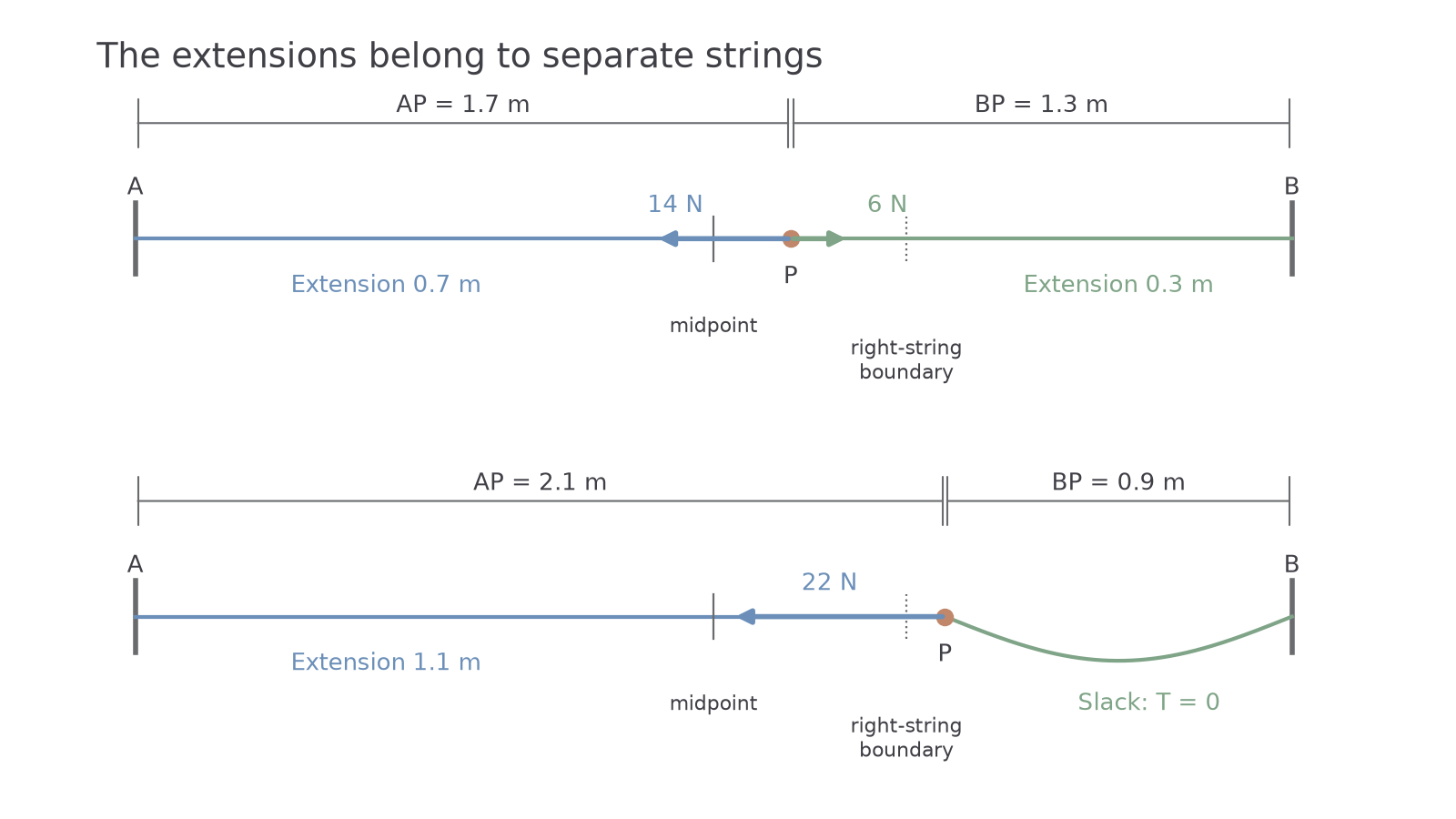
Can two elastic strings attached to the same particle have different tensions? Yes: each tension depends on that string's own extension, and one string can even be slack while the other pulls.
Put fixed points and apart on a smooth horizontal surface. A particle between them is attached to each by a string of natural length . If the particle is displaced metres right of the midpoint, the straight end separations are
The candidate extensions are therefore and . Both strings are stretched only when .
[DIAGRAM: asset_name: One particle with two elastic strings; asset_slug: cam9231-two-elastic-strings; caption: Each string uses its own length, and the right-hand string becomes slack beyond its natural-length boundary; description: Two exact horizontal constructions have anchors A at coordinate 0 and B at coordinate 3. In the upper construction P is at 1.7, so extensions are 0.7 and 0.3 metres and the left and right tension arrows have magnitudes 14 and 6 N. In the lower construction P is at 2.1, so the left extension is 1.1 metres with tension 22 N, while the right string is slack because its end separation is 0.9 metres. The midpoint and the right-string boundary at coordinate 2 are marked.]
Forces and energies of several elements
Calculate each elastic force separately, then add forces with their directions. Add stored energies as scalars:
For a string, include its term only in its stretched region; a slack string contributes zero. A spring's term remains valid in compression.
The individual Hooke's law and energy formulae are in the formula booklet.
There is no rule that the tensions on opposite sides of a particle must agree during motion. Equality follows only in a particular equilibrium. For two springs, signed extensions can be used throughout the permitted straight geometry; for two strings, check each region before writing their energies.
Worked example 1: both strings remain stretched
Question. In the horizontal arrangement above, both strings have modulus . A particle of mass is released from rest at . Find its initial acceleration, taking rightwards as positive, and its speed when it first reaches the midpoint.
Plan. Use the difference of the two tensions for acceleration, then the decrease in their combined energy for speed.
Initially the extensions are and . Thus
Both strings remain stretched between this position and the midpoint. There is no change in gravitational potential energy and no friction, so
Answer. The initial acceleration is , and the speed at the midpoint is .
Check. In the two-taut-string region, the leftward resultant is . It decreases linearly from to zero over the journey. Its work is , independently confirming the kinetic energy gained.
Move only the release position farther right, past the boundary where the right string loses tension. The force and energy models must now allow for a slack string.
Worked example 2: one string starts slack
Question. The same particle is instead released from rest at . Find its initial acceleration and its speed when it first reaches the midpoint.
Plan. Use zero tension and energy for the initially slack right string, then compare the total energies at release and the midpoint.
Initially and . The left string has extension , while the right string is slack. Hence
As the particle moves left, the right string reaches natural length at and then begins to stretch. Its energy is continuous at that boundary, so no extra energy-loss term is needed.
Answer. The initial acceleration is , and the speed at the midpoint is .
Check. From to , the leftward force decreases from to , doing work . From to zero, the two-string resultant decreases from to zero, doing another . Total work is .
These examples answer the opening question: different extensions give different tensions. In the second example, adding an energy term for a supposed right-string compression would give a wrong answer even though squaring the negative extension produces a positive number.
Problem-solving
Make a small table of each element's natural length, current length, extension and taut/slack state. Write the force equation with directions and the energy equation with scalar stored energies.
Use the relevant model at both endpoints in the next arrangement.
Motion on an inclined plane
For an elastic element parallel to an inclined plane, a displacement down the plane changes both its extension and the particle's height.
If a particle moves distance down a plane inclined at angle , its height decreases by . A string fixed farther up the plane gains extension . When no other force has a component normal to the plane, ; during sliding, the friction magnitude is .
Energy for travel down a plane
For a particle sliding distance down the plane with a parallel elastic element, from extension ,
This expression assumes the string remains taut, or that the element is a spring. Omit the friction term on a smooth plane. For a slack string use zero elastic energy in the slack region.
The elastic energy formula is in the formula booklet; the height and work terms follow from the geometry.
For travel up the plane, gravitational potential energy increases, while friction still removes energy. Rebuild the equation from the actual initial and final heights: changing one sign without checking the displacement can reverse the friction incorrectly.
Worked example 3: down a smooth plane
Question. A particle of mass rests on a smooth plane inclined at to the horizontal. It is attached to a point farther up the plane by a light elastic string parallel to the plane, with natural length and modulus . It is released from rest with the string at natural length. Find its speed after moving down the plane. Take .
Plan. Split the gravitational energy loss between kinetic energy and elastic energy.
The final extension is , and the vertical drop is .
Answer. The speed is .
Check. The down-plane resultant falls linearly from at release to at the final position. Its average work is , matching the final kinetic energy. The negative final resultant means deceleration, not that the position is unreachable.
Continue this lesson.
You’re previewing NovaLearn without an account. Create a free account to read the rest.
Create free account