2.5 - De Moivre's theorem
Powers of a complex number become much simpler when you track its modulus and argument. You will interpret multiplication and division on an Argand diagram, prove de Moivre's theorem for positive integer powers, and extend the result to zero and negative integer powers with the necessary nonzero condition.
Powers as rotations and scalings
Can you calculate without multiplying out twelve brackets? The number has modulus and argument . Each multiplication by it stretches lengths by and rotates anticlockwise through . Twelve multiplications give modulus and angle , so the answer is .
Here is why those geometric instructions work. If
then expanding and using the angle-addition formulae gives
The real part is ; the imaginary part is . Thus moduli multiply and arguments add, with arguments understood modulo .
[DIAGRAM: asset_name: Repeated multiplication by one plus i; asset_slug: cam9231-complex-powers; caption: Each multiplication by one plus i adds 45 degrees to the argument and multiplies the modulus by the square root of two; description: Exact Argand diagram showing z equals one plus i, z squared equals two i and z cubed equals minus two plus two i. Origin arrows and quarter-pi angle steps show the successive rotations, with lengths square root two, two and two square root two. A separate panel states the corresponding scaling and rotation rules.]
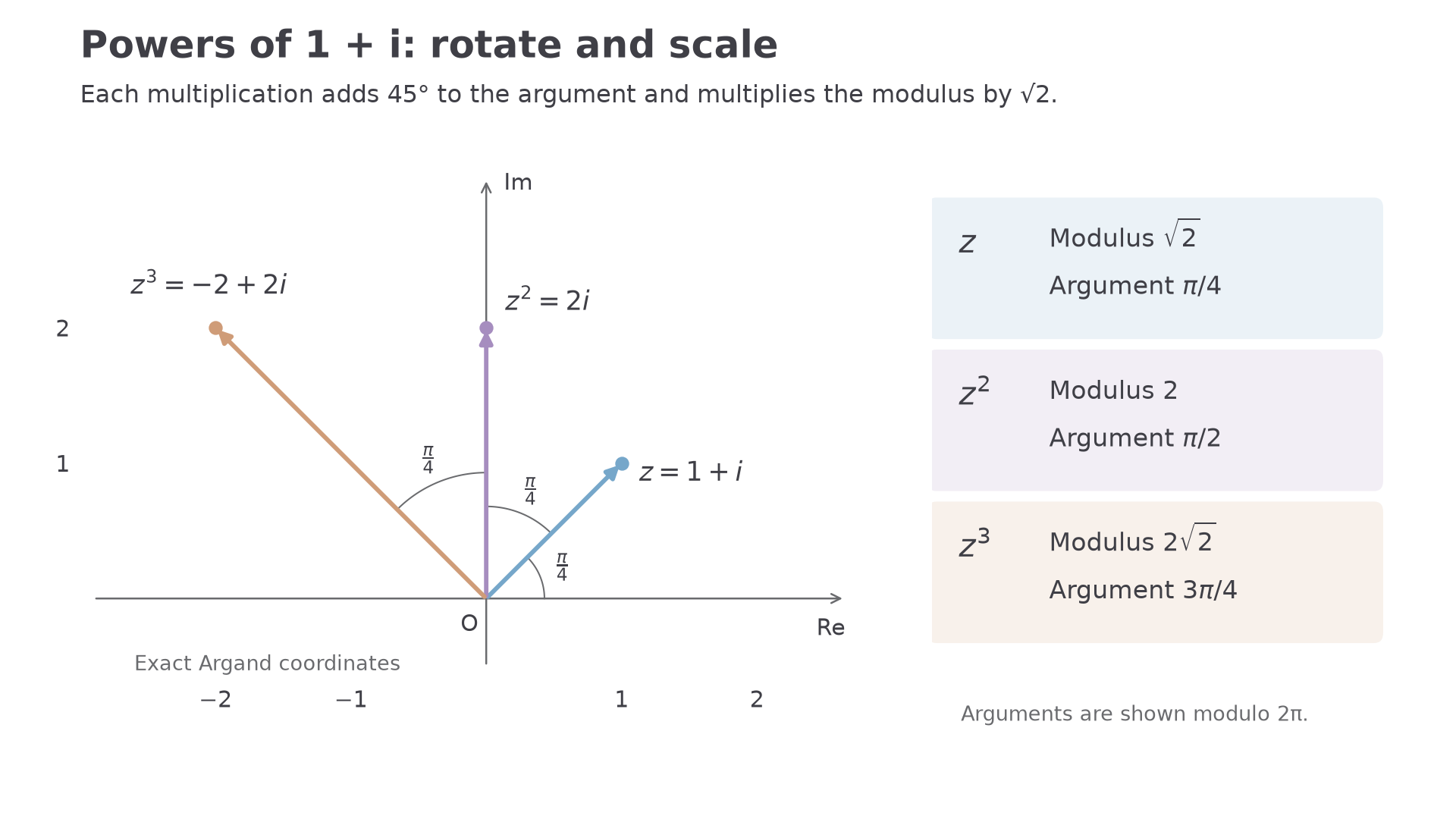
Division reverses the operation. For example, : equal moduli divide to , while the angle is .
Complex multiplication, division and powers
For nonzero and , with ,
Repeated multiplication gives de Moivre's theorem for positive integers :
These results are not in the formula booklet: learn them.
A nonzero complex number has many arguments, differing by . Multiplication by an integer changes those differences to whole turns again, so the power is a single well-defined number.
Worked example 1: a cube from its rotation
Question. Find in the form .
Plan. Cube the modulus and multiply the argument by , then convert back to Cartesian form.
Since ,
Answer. .
Check. Direct multiplication gives , then , independently of the polar calculation.
Change only the sign of the real component of the base. Its modulus stays the same, but its starting quadrant changes.
Worked example 2: keeping the correct starting quadrant
Question. Find in the form .
Plan. Use argument , rather than the acute angle suggested by a tangent ratio.
The modulus is still , so
Subtracting changes the argument but not the point.
Answer. .
Check. Cartesian multiplication gives and .
The modulus alone cannot distinguish these cubes: both have modulus . Their arguments carry the missing information.
Watch out
is an equality modulo . If a particular argument interval is requested, reduce the final angle into that interval after multiplying.
Now reflect the first base in the real axis and use the same method.
Positive integer proof
Repeated rotation suggests a result for every positive integer, but an induction proof establishes that the pattern cannot break at the next power.
Write . The multiplication calculation above establishes
This addition rule is the engine of the proof: it converts one extra factor into one extra angle.
You already know
Induction needs a verified base case, a hypothesis at an arbitrary allowed integer , and a justified implication to . State the final integer domain in the conclusion.
First hold the modulus at , so the proof can focus entirely on the angles.
Worked example 3: proving the unit-modulus case
Question. Prove by induction that
for every positive integer and every real .
Plan. Use the angle-addition formulae to multiply the assumed power at by one more factor.
Fix any real . At , both sides are . Assume, for an arbitrary positive integer , that
Then
The first line uses the hypothesis; the last uses the two addition formulae.
Answer. The base case and the implication from to prove the identity for every positive integer , by induction. Since was arbitrary, it holds for every real .
Check. At , squaring directly gives , the point with angle .
Continue this lesson.
You’re previewing NovaLearn without an account. Create a free account to read the rest.
Create free account