2.1 - Hyperbolic functions and graphs
A small change from adding exponentials to subtracting them produces two very different curves. You will define the six hyperbolic functions, build their graphs from their formulae, and solve equations while keeping track of the real values each function can take.
Exponential definitions
How can two functions made from the same exponentials behave so differently that one reaches every real height, while the other never falls below ? Start with and : their half-sum is , but their half-difference is .
The names hyperbolic sine and hyperbolic cosine refer to these half-difference and half-sum functions. The argument is a real number; the definitions use exponentials directly.
The six hyperbolic functions
For real ,
For real ,
The exponential definitions are not in the formula booklet: learn them.
The exclusions come from the denominators. The sum is always positive. The difference is zero exactly when , which means . Thus and , while and are undefined.
Worked example 1: exact values at a positive argument
Question. Find the exact values of all six hyperbolic functions at .
Plan. Find and from the exponentials, then take their ratios and reciprocals.
Since and ,
Therefore
Answer. In the order , the values are .
Check. Evaluate the last four directly from : for example, and . Their product is , as the reciprocal definitions require.
Change only the sign of the argument. This swaps and , so the sum stays the same and the difference changes sign.
Worked example 2: reversing the argument
Question. Find the exact values of all six hyperbolic functions at .
Plan. Substitute and , then form the same ratios.
Hence
Answer. The four functions change sign; and keep their values.
Check. Direct substitution into the exponential forms gives and , agreeing with the reciprocal calculation.
These sign rules hold for every allowed argument, not just logarithms. A function with is even; one with is odd. They will let us construct half a graph and reflect it.
Watch out
means . It does not mean . In particular, exists and equals .
Use the definitions with a different logarithm.
Shapes and domains
The exponential definitions determine each graph's symmetry, intercepts and behaviour far from the origin. Unlike their trigonometric namesakes, these six real functions are not periodic.
For , increasing increases both and , so the half-difference increases throughout the real line. It passes through the origin and is unbounded in both directions. For , write
Equality occurs only at . Its even graph therefore has a minimum at , with both ends rising without bound.
To see the limiting heights of , divide numerator and denominator by :
Odd symmetry gives the limit at the other end. Also, : as increases, the subtracted positive fraction decreases, so tanh increases. The graph never reaches either limiting height: the positive denominator is always larger than the magnitude of the numerator.
[DIAGRAM: asset_name: The three basic hyperbolic graphs; asset_slug: cam9231-hyperbolic-basic; caption: Sinh is unbounded, cosh has minimum 1, and tanh approaches two horizontal asymptotes; description: Three exact coordinate plots of sinh x, cosh x and tanh x. Sinh crosses the origin with odd symmetry. Cosh has even symmetry and a marked minimum at zero comma one. Tanh is odd and lies strictly between dashed horizontal lines y equals minus one and y equals one.]
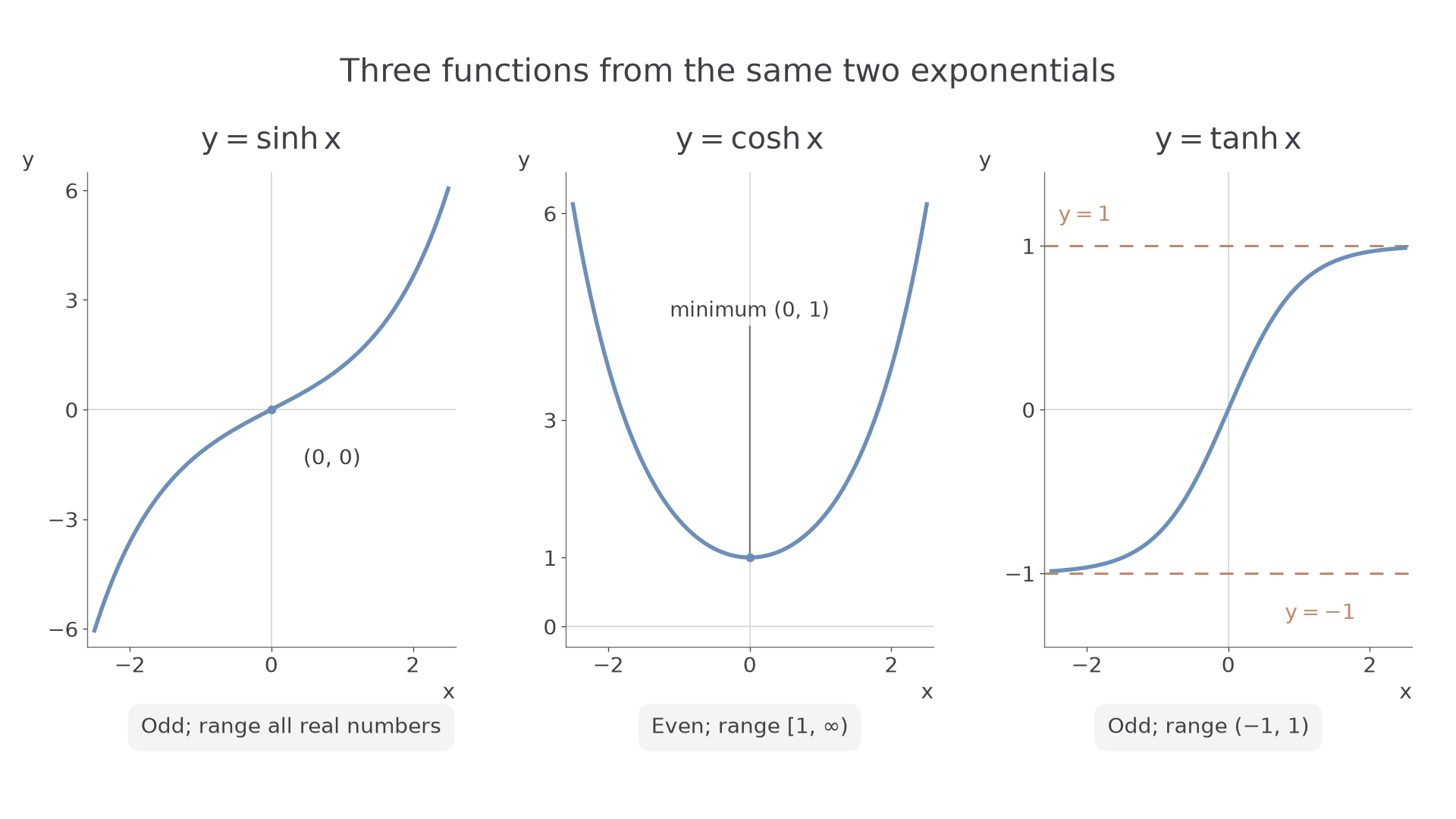
Taking reciprocals gives the remaining graphs. A positive quantity growing without bound has a reciprocal approaching zero. A quantity approaching zero from above or below has a reciprocal growing without bound with the same sign. In particular, the zero of creates a vertical asymptote for both and .
[DIAGRAM: asset_name: Reciprocal hyperbolic graphs; asset_slug: cam9231-hyperbolic-reciprocals; caption: Sech has maximum 1, while cosech and coth exclude zero and have two branches; description: Three exact coordinate plots of sech x, cosech x and coth x. Sech is even with maximum zero comma one and tends to zero at both ends. Cosech is odd with vertical asymptote x equals zero and horizontal asymptote y equals zero. Coth is odd with vertical asymptote x equals zero and horizontal asymptotes y equals minus one and y equals one.]
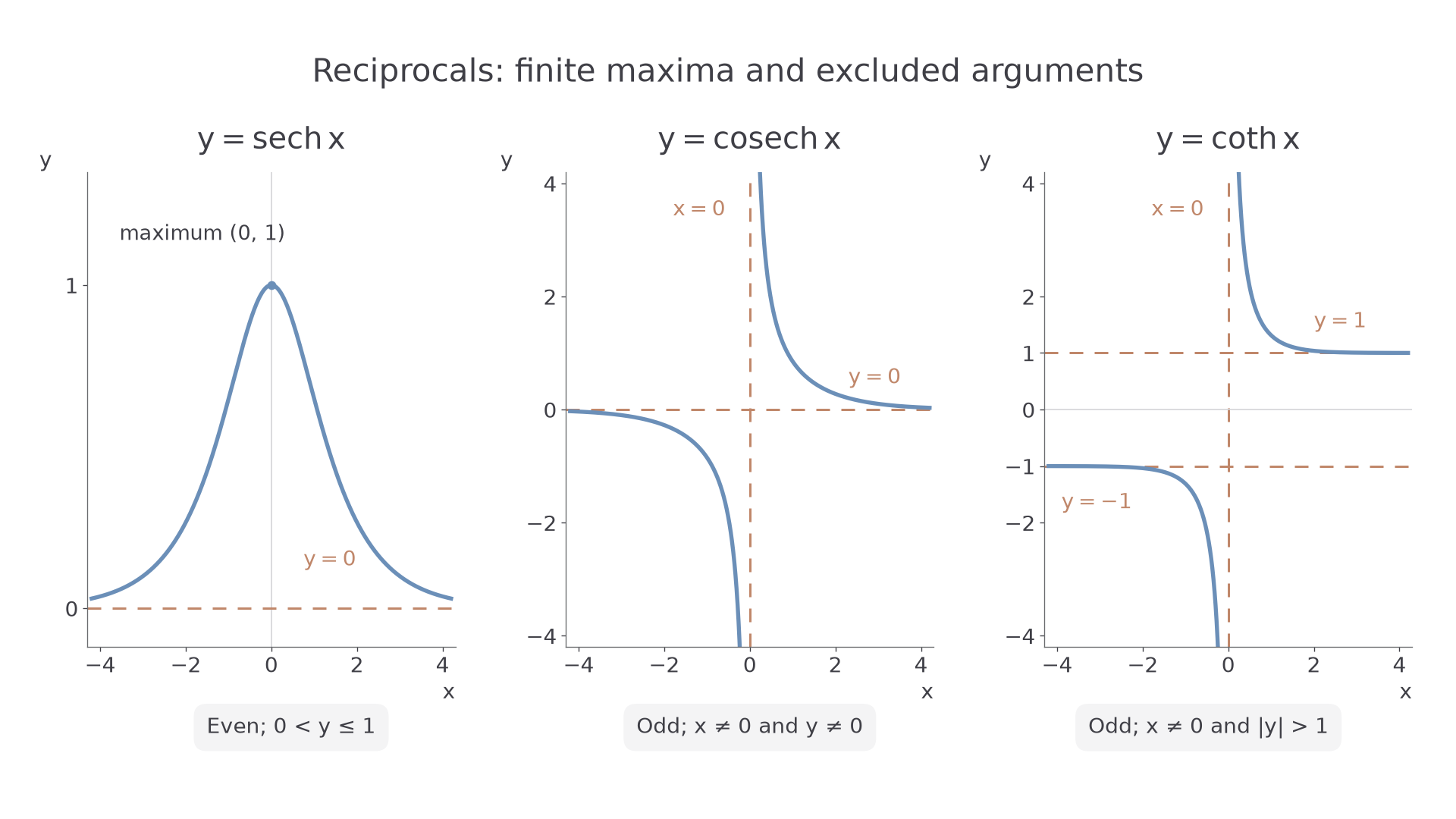
Here is the full set of features needed for sketches. A horizontal asymptote records a limit; it is not automatically part of the range.
Continue this lesson.
You’re previewing NovaLearn without an account. Create a free account to read the rest.
Create free account