2.6 - Differential equations in context
An algebraic solution becomes a model only when its constants, units and interval have a meaning. You will use values and rates as initial data, interpret transient and long-term behaviour, and check whether a solution remains physically valid.
Using initial data
Does changing an initial rate change just one constant in a second-order solution? Usually both constants must change, because the value and rate give two simultaneous constraints.
Suppose a device's signed displacement , in centimetres, is modelled by
where time is measured in seconds. Primes in this lesson denote derivatives with respect to the displayed independent variable, here . The numerical coefficients carry the units needed to make each term a displacement per second squared.
The auxiliary roots are , and the constant particular integral is . Therefore
Differentiate the whole solution before applying rate data. A constant in the particular integral contributes zero, but a nonconstant particular integral would contribute to the rate too.
Worked example 1: released with zero initial rate
Question. The displacement model is , with and . Find .
Plan. Substitute both data in the general solution and its derivative, then solve for .
The second equation gives , so , .
Answer. centimetres, for .
Check. At zero the value is and the rate is . The formula gives ; independently, the differential equation predicts .
Change only the initial rate from zero to . Both constants now respond.
Worked example 2: a different initial rate
Question. For the same displacement equation, find the solution with and .
Plan. Retain the value equation and replace the rate equation.
Adding gives , so and .
Answer. centimetres, for .
Check. The value and rate at zero are and . Also , agreeing with the independent equation prediction .
These signed displacements may be positive or negative according to the reference point; they are not automatically distances. In a model, first identify what the dependent variable measures.
Watch out
The coefficient of a sine or exponential term is not automatically the initial rate. Apply the data to the derivative of the complete solution.
Use a new initial value and rate in the same family.
Interpreting a solution
A solution can approach a fixed value while repeatedly crossing it: decay and oscillation describe different features of the same response.
For the model , with in centimetres and in seconds, a constant solution is . The general solution is
The constant is the equilibrium value. The exponential-trigonometric term is a transient: it tends to zero as time increases. The frequency of the trigonometric factor is ; that factor repeats after seconds, but the full response is not periodic because its size decays.
Decay envelope
If
where and , then with ,
The oscillatory factor has period . The parameter has units of reciprocal time and is an angular frequency. This combined result is not in the formula booklet: derive it from the sine-cosine amplitude and exponential decay.
The bound follows by writing . A larger positive makes the envelope shrink faster; it does not change the trigonometric period. With a nonzero oscillation persists, while a negative gives a growing envelope.
Worked example 3: crossing an equilibrium
Question. The model has and . Find its solution and describe its long-term behaviour.
Plan. Determine the constants, then bound the displacement from equilibrium.
The value gives . At zero the derivative is , so , giving .
Answer. , in centimetres. It oscillates about , with , and tends to as .
Check. The first equilibrium crossing is , where the cosine is zero. At , and the value is . These values confirm that approaching need not mean remaining above it.
The graph shows the response and its shrinking bounds. The bounds are envelopes, rather than horizontal asymptotes at every point.
[DIAGRAM: asset_name: A decaying response crosses its equilibrium; asset_slug: cam9231-decay-envelope; caption: The response stays between shrinking envelopes and repeatedly crosses the equilibrium value; description: Exact graph for nonnegative time of y equals 4 plus 2 exp minus t times cos 2t. A blue response curve lies between pale clay dashed envelopes y equals 4 plus or minus 2 exp minus t, with horizontal equilibrium y equals 4. The initial point (0,6) and first equilibrium crossing at t equals pi over 4 are labelled. The horizontal axis is time in seconds and the vertical axis is y in centimetres.]
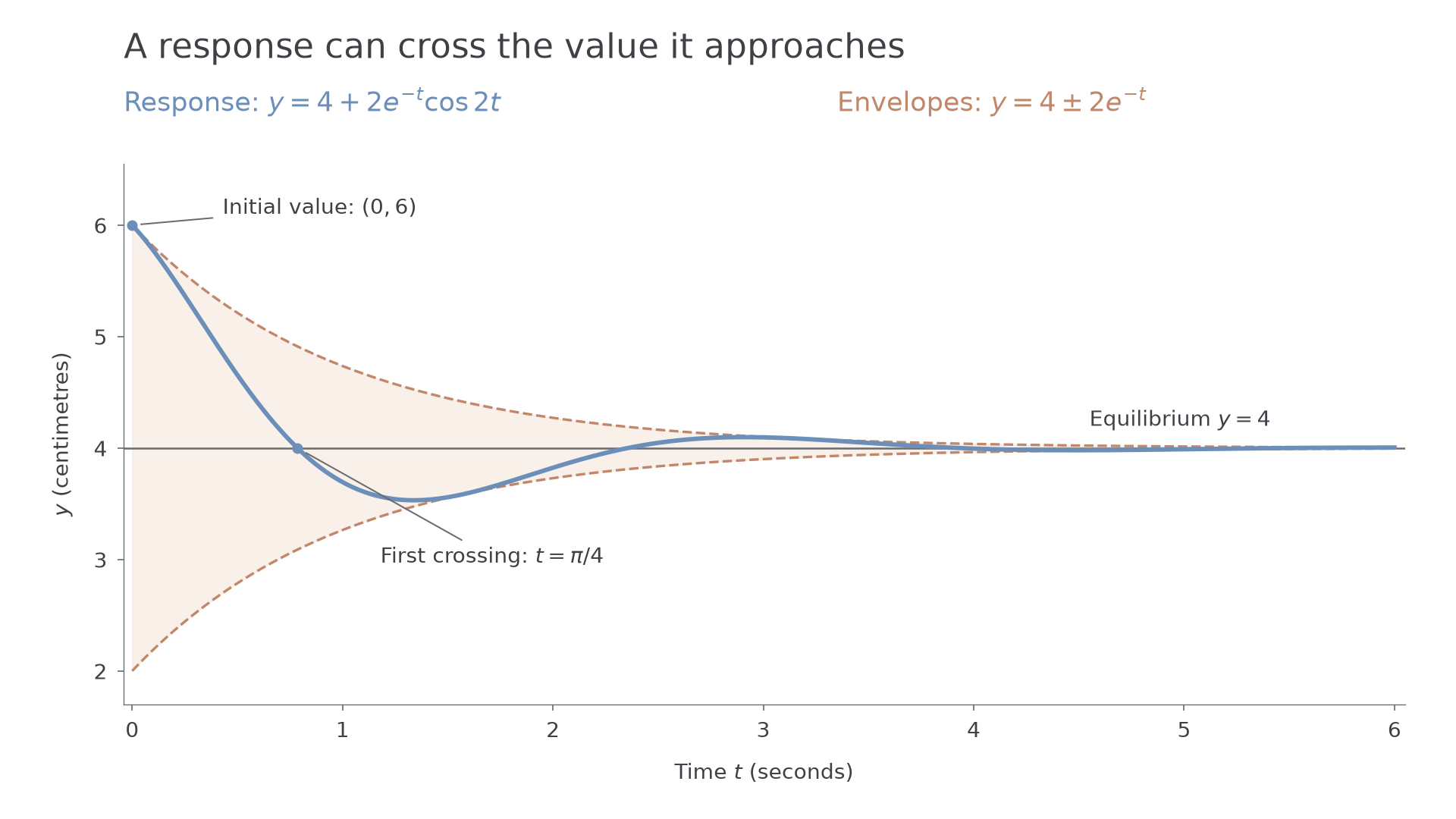
Change only the initial rate. This changes the phase and the envelope size, while the limiting value and frequencies stay fixed.
Continue this lesson.
You’re previewing NovaLearn without an account. Create a free account to read the rest.
Create free account