2.2 - Eigenvalues and eigenvectors
Most vectors change direction under a matrix transformation, but some special directions are preserved. You will identify these eigenvectors, find their scale factors from a characteristic equation, and solve for every corresponding eigendirection of a two-by-two matrix.
Unchanged directions
Which vectors can a matrix stretch without turning them away from their original line? For , the vector becomes . Its length changes but its direction line stays the same.
Eigenvalue and eigenvector
For a square matrix , a nonzero vector is an eigenvector with eigenvalue when
The scalar describes the action along that direction. Every nonzero multiple of is another eigenvector with the same eigenvalue.
If , the sense is preserved; if , it reverses. If , the vector is sent to zero. That is still an eigenvector, although its line collapses instead of being mapped onto itself. The zero vector itself is excluded: it would satisfy the equation for every and identify no direction.
[DIAGRAM: asset_name: Two special directions of a matrix; asset_slug: cam9231-eigendirections; caption: Along an eigendirection the image stays on the same line; description: Exact coordinate panels for the matrix with rows 4 1 and 2 3. A vector (1,1) and its image (5,5) lie on y equals x, while (1,minus 2) and its image (2,minus 4) lie on y equals minus 2x. A second panel compares (1,0) with its image (4,2), showing a direction that is not an eigendirection. Inputs and images are labelled with pale blue and sage accents.]
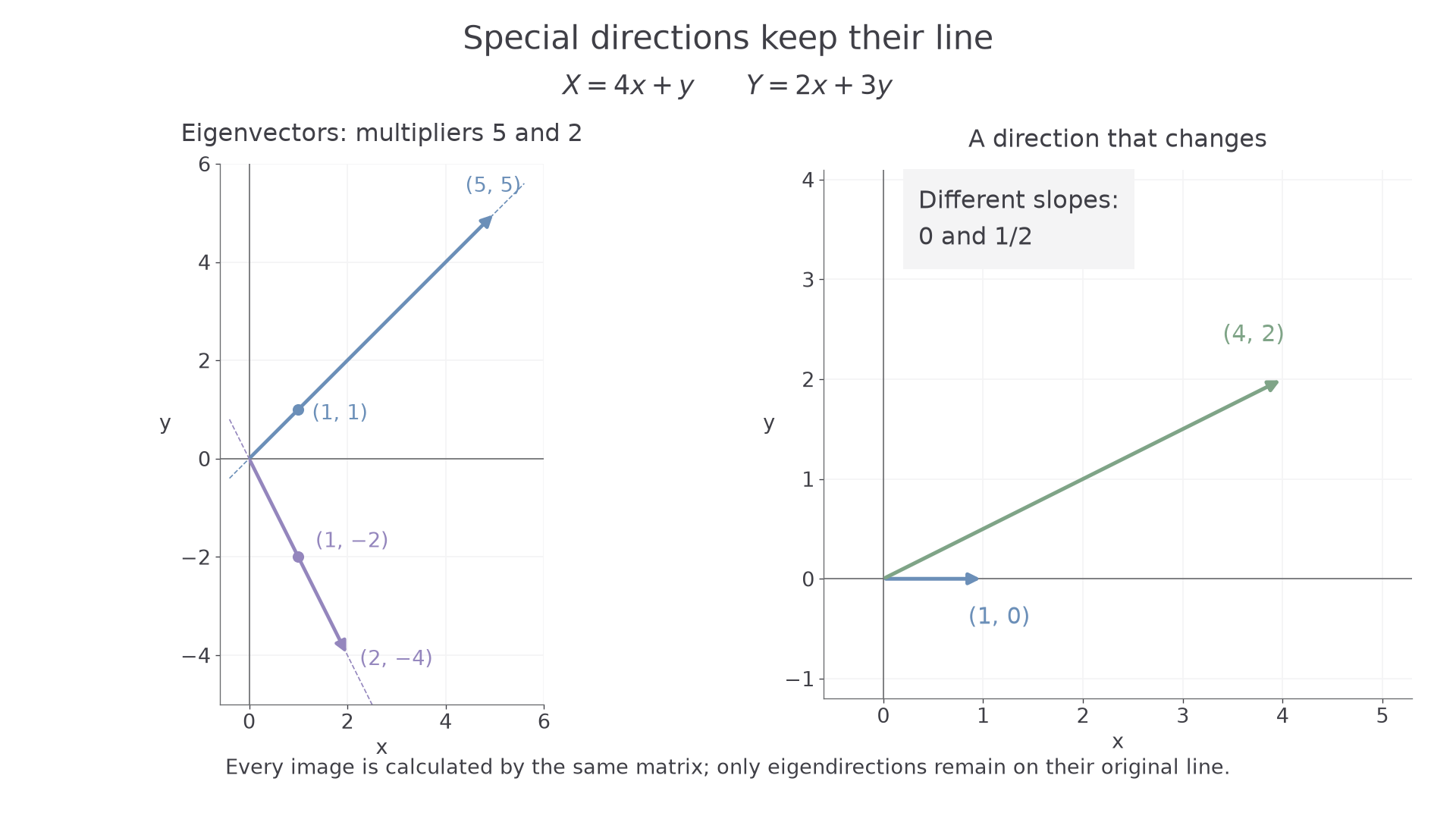
Check the whole vector equation, not just one coordinate ratio; a coordinate may be zero.
Worked example 1: verifying an eigenvector
Question. For , determine whether and are eigenvectors.
Plan. Multiply each vector and test whether the result is one scalar multiple of the original.
Every multiple of has second coordinate zero; its image does not.
Answer. is an eigenvector with eigenvalue . The vector is not an eigenvector.
Check. The coordinate rules give . Thus is an invariant line. On it, , confirming the multiplier . The horizontal direction of has slope zero, whereas its image has slope , so that direction changes.
Now subtract from the matrix. This changes a scale factor and can reverse its sign, without changing the direction vectors.
Worked example 2: a negative eigenvalue
Question. For , verify that is an eigenvector and find its eigenvalue.
Plan. Multiply first, then compare both coordinates with the original vector.
The multiplier is negative, so the vector reverses sense and doubles in length.
Answer. is an eigenvector with eigenvalue .
Check. Since and , subtracting gives , independently confirming the multiplier.
An eigenvector with eigenvalue is fixed. Other nonzero eigenvalues preserve its line while moving nonzero points on it. The methods in this sequence concern matrices whose eigenvalues are real and distinct.
Watch out
is a scalar and is a nonzero column vector. An answer such as “the eigenvector is ” confuses the multiplier with the direction.
Verify the multiplier directly.
The characteristic equation
To discover the possible scale factors, rearrange the defining equation as . A nonsingular coefficient matrix would force , which is forbidden. Therefore this matrix must be singular.
Characteristic equation
The characteristic equation of is
For , it becomes
Subtract from diagonal entries only. The roots are the eigenvalues. Not in the formula booklet: learn it.
Using instead gives the same roots. Keep one convention throughout an expansion.
Continue this lesson.
You’re previewing NovaLearn without an account. Create a free account to read the rest.
Create free account