3.3 - Horizontal circular motion
A particle can have constant speed and still accelerate. Learn how angular speed describes a turn, why circular motion needs an inward resultant force, and how friction or a sloping string can supply that force. You will use these ideas for horizontal circles and conical pendulums.
Speed and angular speed
Two points on the same rotating wheel finish each turn together. Why does the point nearer the rim travel faster? Both sweep out the same angle, but the outer point travels along a longer arc.
Recall that an arc of radius and angle radians has length . For steady rotation, divide by the elapsed time: distance per second is radius times radians per second.
Angular speed
The angular speed of a particle moving steadily around a circle is the angle swept out per unit time, measured in . A complete revolution sweeps out radians.
A period is the time for one complete turn. A frequency is the number of turns per second, so .
Linear and angular speed
For a circle of radius , with constant speed and angular speed ,
Convert revolutions per minute to revolutions per second before using the final expression. These relations are not printed in the formula booklet: learn them. The arc-length relation is printed there.
Here speed means the magnitude of the velocity. Its direction will be important in the next part.
Worked example 1: a point near the rim
Question. A wheel makes one revolution every . Find its angular speed and the speed of a point from its centre.
Plan. Convert one turn to radians, then use the point's radius.
Answer. The angular speed is , and the point's speed is .
Check. Its circumference is . Dividing by gives the same speed.
Keep the wheel's rotation unchanged and move the point closer to the centre. The angular speed stays fixed; the linear speed changes.
Worked example 2: a point nearer the centre
Question. The same wheel takes per revolution. A point is from its centre. Find its speed and the distance it travels in revolutions.
Plan. Use the same angular speed, then multiply the circumference by the number of turns.
Answer. Its speed is , and the distance is .
Check. The motion takes . Speed times time gives .
The two speeds are in the ratio , as the arc lengths suggest.
Watch out
Putting revolutions per minute straight into gives the wrong units. First convert to .
Apply that conversion to a different wheel.
Acceleration towards the centre
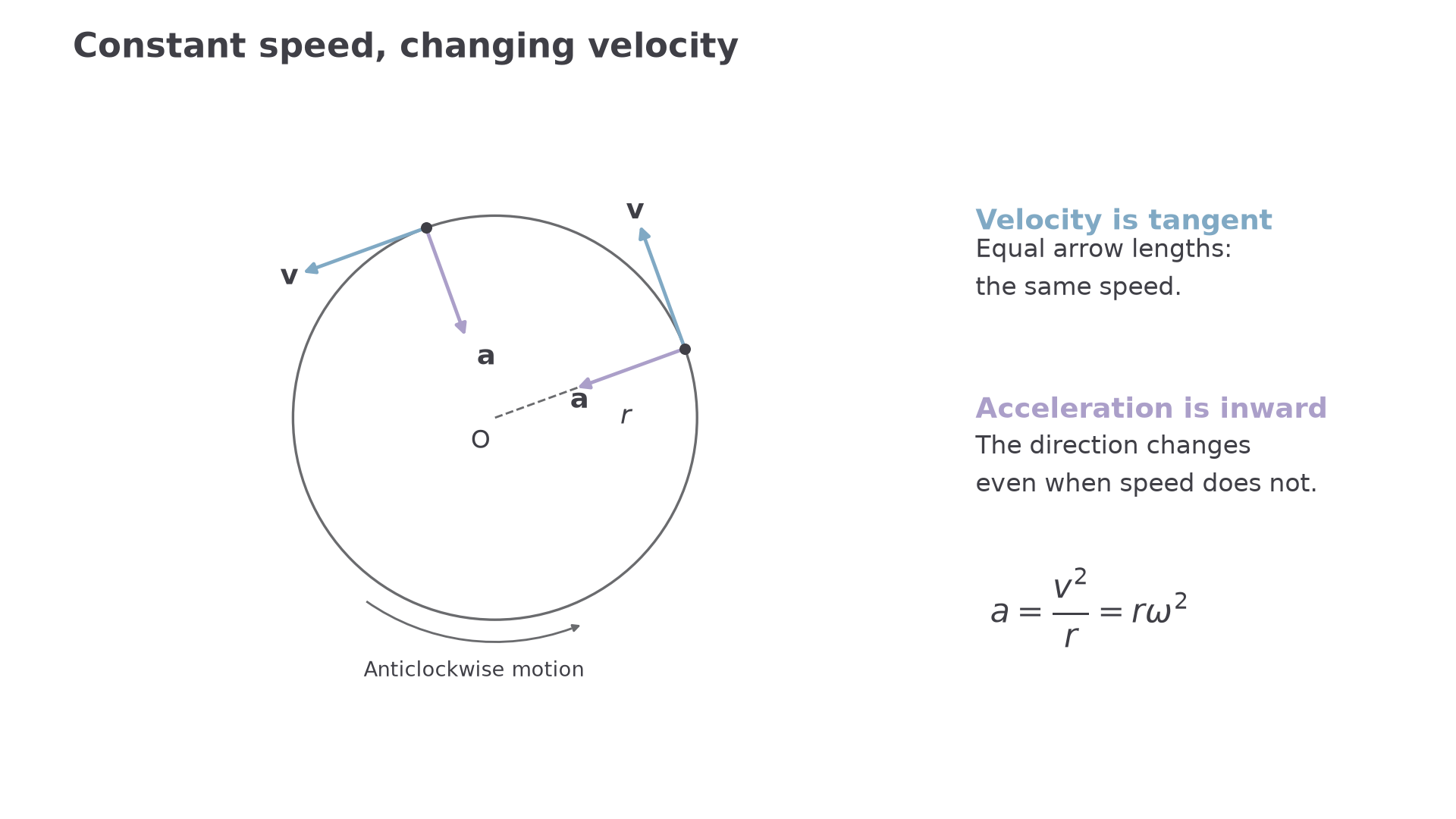
At any instant a particle's velocity is tangent to its circular path. A little later the tangent points in a different direction. Even if the speed is unchanged, that change in velocity means there is an acceleration.
For constant speed, this acceleration points towards the centre. There is no acceleration along the tangent because the speed is not changing. A proof of the circular-acceleration formula is not needed here, but its direction is essential to choosing a force equation.
[DIAGRAM: asset_name: Velocity turns while speed stays fixed; asset_slug: cam9231-circular-velocity; caption: Tangential velocity changes direction while the acceleration points towards the centre; description: Exact circle with two marked positions on an anticlockwise path. Equal-length blue velocity arrows are tangent at the two positions. Lavender acceleration arrows point from each position towards the centre O. A dashed radius r is shown and a side panel distinguishes constant speed from changing velocity.]
Centre-directed acceleration
For constant-speed circular motion of radius ,
The acceleration points towards the centre. Both expressions and this direction are in the formula booklet. They agree because .
If the speed varies around a circle, is still the inward radial component of acceleration; a tangential component may also be present. We will use that distinction for vertical circles.
Worked example 3: the two acceleration formulae agree
Question. A particle moves at constant speed around a circle of radius . Find its angular speed and acceleration.
Plan. Find from the speed, then calculate the inward acceleration.
Answer. The angular speed is , and the acceleration is towards the centre.
Check. The alternative formula gives . Also, has units , as an acceleration must.
Change only the radius while keeping the linear speed fixed. A gentler turn needs less acceleration.
Worked example 4: a larger circle at the same speed
Question. A second particle moves at constant speed around a circle of radius . Find its angular speed and acceleration, and compare its acceleration with Worked example 3.
Plan. Keep in ; do not keep the old angular speed.
The acceleration is of the earlier value.
Answer. , and the acceleration is inwards, two-thirds of the previous acceleration.
Check. The period is , so . Then .
Continue this lesson.
You’re previewing NovaLearn without an account. Create a free account to read the rest.
Create free account