3.6 - Direct impacts and restitution
A collision can send both spheres forwards while still making them separate. In this part of 3.6, you will use relative velocities to describe a direct impact, interpret the coefficient of restitution and predict how a sphere rebounds from a fixed surface.
Newton's experimental law
If a sphere moving at catches one moving at , how fast are they approaching each other? The gap closes at , not at . The difference between their velocities describes their relative motion.
A direct impact has both velocities along the line joining the centres. Label the spheres , then , from left to right, and choose rightwards as positive. Write for velocities just before impact and just afterwards. For an approaching pair, , so the approach speed is . After impact, the separation speed is .
Coefficient of restitution
The coefficient of restitution, , is the ratio of relative separation speed to relative approach speed, measured along the line of impact.
For initially to the left of , using one common positive direction from towards , Newton's experimental law is
The law compares the pair's motion, rather than each sphere's speed separately. This is an experimentally determined collision model; it does not follow from momentum conservation alone. A zero approach speed does not define a collision coefficient by this ratio.
[DIAGRAM: asset_name: Approach and separation of a pair; asset_slug: cam9231-direct-relative-velocities; caption: Subtract signed velocities to find how quickly the gap closes or opens; description: Two horizontal panels show A to the left of B. Before impact both move right, A at 8 and B at 2 metres per second, so the gap closes at 6 metres per second. After impact A moves right at 1 and B at 4 metres per second, so the gap opens at 3 metres per second. All velocity arrows use the same scale and the positive direction is rightwards.]
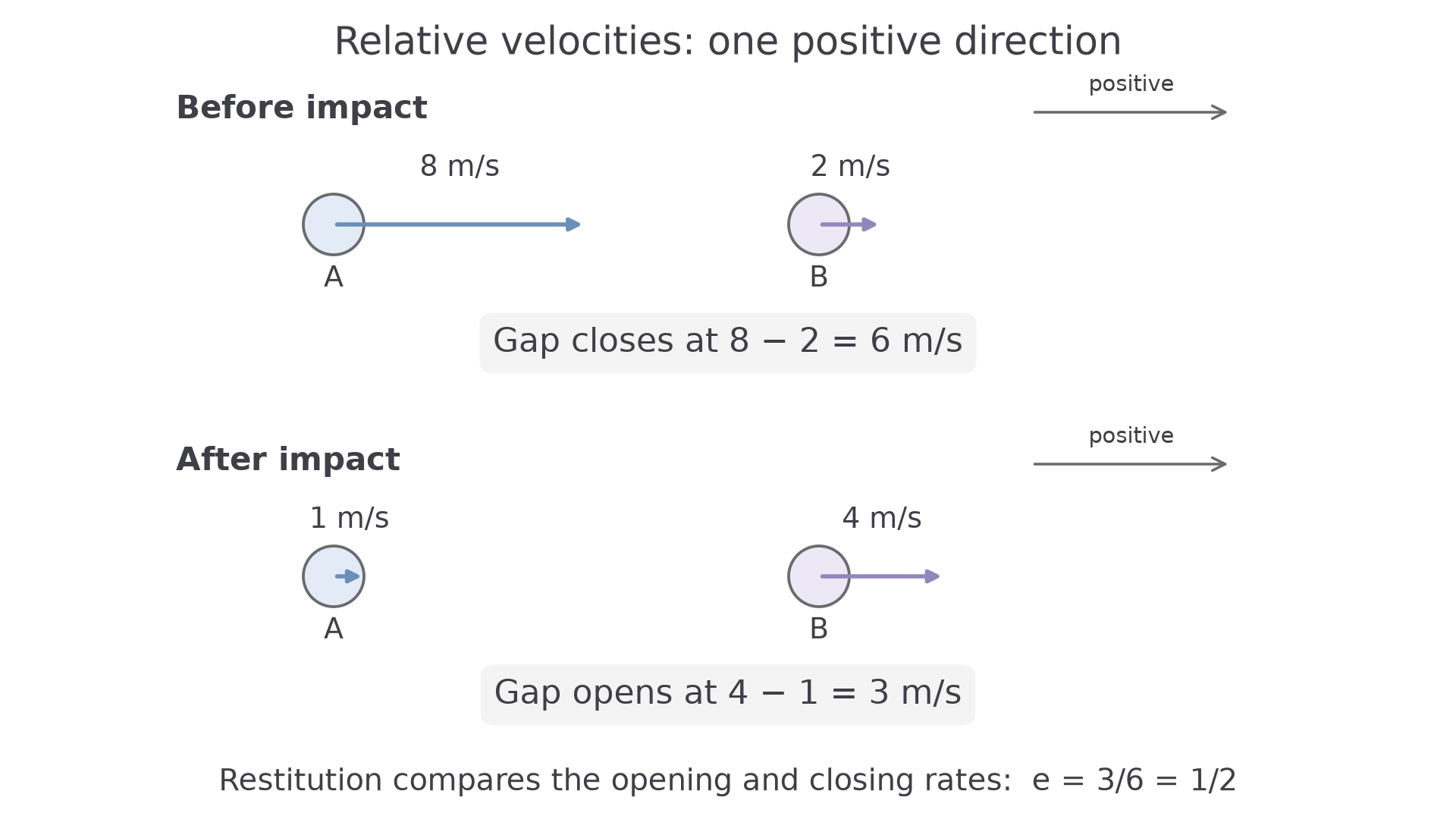
Worked example 1: both spheres move forwards
Question. Before a direct impact, moves right at and , ahead of it, moves right at . Afterwards their rightward speeds are and , respectively. Find .
Plan. Calculate the closing and opening speeds using the same rightward direction.
Answer. .
Check. In a short interval at the stated velocities, the gap would decrease by before impact but increase by afterwards. The opening rate is half the closing rate.
Now let the spheres approach head-on. The subtraction is unchanged; the sign of 's initial velocity changes.
Worked example 2: opposite directions
Question. , initially left of , moves right at , while moves left at . Afterwards moves left at and right at . Find .
Plan. Use signed rightward velocities before forming the relative speeds.
Answer. .
Check. An observer moving left at adds to every listed velocity. The initial pair becomes , and the final pair . The approach and separation speeds remain and .
A common change of observer changes individual velocities but leaves their differences unchanged. Keep signs until the relative speeds have been formed.
Perfectly elastic and inelastic impacts
A larger coefficient means a greater separation speed for the same approach speed. The standard impact model uses : the pair leaves contact separating or with zero relative normal velocity, without gaining kinetic energy from the impact.
The limiting impacts
A perfectly elastic impact has : separation speed equals approach speed and total kinetic energy is conserved in the smooth-sphere impact model.
This syllabus uses inelastic for : separation speed is zero. In a direct two-sphere impact the spheres then have the same velocity immediately afterwards. They need not be stationary.
You may meet the broader use of “inelastic” for any collision that loses kinetic energy. In this course, retain Cambridge's stated convention; describes a partially elastic impact. Zero relative speed at the instant after impact does not, by itself, mean that the spheres are permanently stuck together.
Continue this lesson.
You’re previewing NovaLearn without an account. Create a free account to read the rest.
Create free account