3.2.6.4 - Exchange rate systems
Learn how currency markets determine exchange rates, how authorities influence them, and why the effects of a currency change depend on firms, consumers and the exchange rate system.
Quoting and converting currencies
An exchange rate is the price of one currency in another currency, so its quotation must identify both currencies and their order.
If £1 buys US$1.25, the quotation is US dollars per pound. A rise to US$1.40 per pound is an appreciation of sterling: each pound buys more dollars. A fall to US$1.10 is a depreciation of sterling. The dollar moves in the opposite direction against sterling. Under a fixed system, an official reduction in a currency's fixed value is a devaluation; an official increase is a revaluation.
For an illustrative rate of US$1.25 per pound:
A £200 product costs US$250 if its sterling price is unchanged. A US$250 import costs £200. If sterling depreciates to US$1.00 per pound, the same sterling-priced export costs US$200 abroad, while the same dollar-priced import costs £250 in Britain. These are price conversions, before changes in quantities, profit margins or delivery costs.
The reverse quotation at the initial rate is £0.80 per dollar, because . Sterling depreciation makes this reverse quotation rise. Always write the unit before deciding whether a movement means appreciation or depreciation; an unlabelled number is ambiguous.
Floating currency equilibrium
In a freely floating system, the exchange rate adjusts to the demand for and supply of the currency without authorities targeting its value.
Consider the market for pounds, with US dollars per pound on the vertical axis and the quantity of pounds exchanged per period on the horizontal axis. Foreign buyers demand pounds to pay for UK exports or acquire sterling assets. UK buyers supply pounds when they exchange them to purchase imports or foreign assets. Capital transactions can be large, so the trade balance alone does not determine the rate.
The simplified demand curve slopes down: cheaper pounds make unchanged sterling-priced goods and assets cheaper in dollars. Supply slopes up here because stronger pounds make dollar-priced purchases cheaper for UK buyers, encouraging them to buy enough foreign goods or assets to offer more pounds. This assumes a sufficiently responsive demand for those purchases; an upward-sloping supply is not guaranteed for every currency market. These are movements along curves, holding other influences constant. Real currency trading also reflects expectations and portfolio decisions.
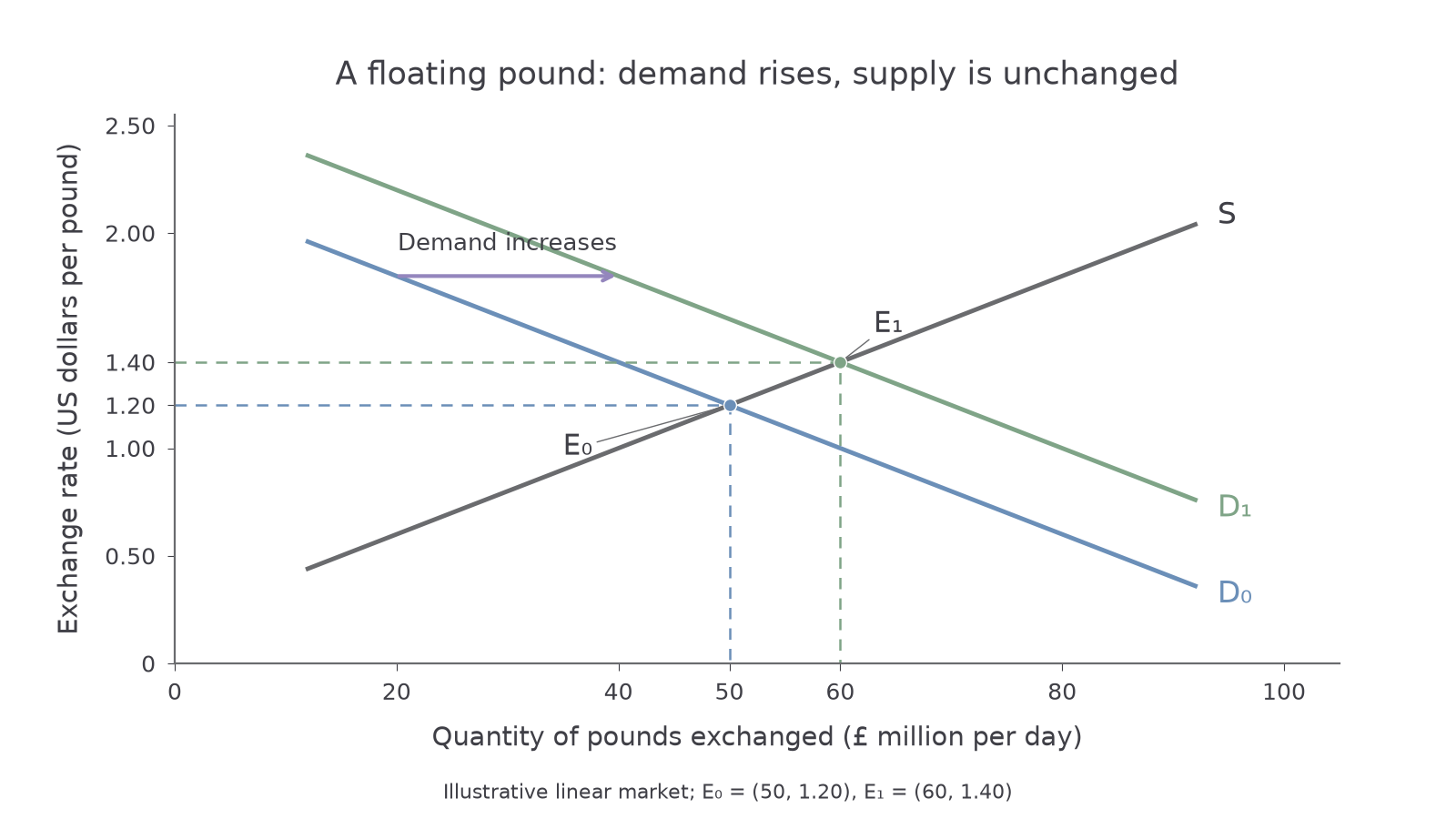
The illustrative graph starts at E₀: US$1.20 per pound and £50 million exchanged per day. Demand shifts from D₀ to D₁, while supply stays at S. At the old rate, demand is £70 million but supply is £50 million: excess demand bids up sterling. The new equilibrium E₁ is US$1.40 per pound and £60 million. The demand shift causes a movement along the unchanged supply curve.
Demand could rise because overseas incomes raise demand for UK exports, or because investors expect a better risk-adjusted sterling return. A higher UK interest rate relative to foreign rates may attract capital, other things equal, but an expected depreciation or higher perceived risk can outweigh the interest advantage. Higher UK demand for imports can shift the supply of pounds right, tending to depreciate sterling. Expectations can change either side rapidly.
To construct this graph in your notebook, label the quotation and quantity units, draw D₀ and S, mark their intersection and project dashed lines to both axes. Shift only demand right to D₁, mark E₁, and check that both the exchange rate and quantity rise. A diagram labelled pounds per dollar would describe a different currency market and require a different interpretation.
Intervention and fixed rates
Authorities can influence a currency market through foreign-exchange transactions, monetary policy or restrictions on capital flows.
To support sterling, a central bank can sell foreign-currency reserves and buy pounds, adding to demand for sterling. To weaken sterling, it can sell pounds and buy foreign currency, adding to sterling supply. This is direct intervention. A managed float allows market movements but uses occasional intervention; it differs from a freely floating system and from a promised fixed rate.
In a fixed exchange rate system, authorities commit to a rate against another currency or a basket, sometimes within a band. Suppose a fictional authority maintains US$1.40 per pound while private demand and supply would clear at US$1.20. At the higher fixed rate, pounds have excess supply. The authority must buy that surplus using foreign reserves, or change policies to reduce the pressure. It cannot merely announce that supply equals demand.
Higher domestic interest rates may attract capital and reduce spending on imports, supporting the currency. But they also raise borrowing costs, weaken investment and can worsen unemployment. Restricting capital outflows can reduce currency supply, but restricts choices and may damage confidence. Announcements work only if traders believe the commitment and the authority's capacity to fulfil it.
Reserves are finite. Persistent overvaluation, capital flight or a speculative attack can make defending a peg costly; the authorities may ultimately devalue or abandon it. Conversely, pressure to appreciate requires selling domestic currency and accumulating foreign reserves. Intervention's duration, scale and credibility matter; it does not guarantee a lasting outcome.
Continue this lesson.
You’re previewing NovaLearn without an account. Create a free account to read the rest.
Create free account