3.1.5.6 - Monopoly and monopoly power
Learn how a price maker chooses output and price, why monopoly profit may persist, and how market power affects consumers and producers. The monopoly model is a benchmark: judging a real firm also requires evidence about substitutes, entry, costs and investment.
Sources of market power
A firm has monopoly power when it can influence the price of its product rather than simply accept a market price.
Pure monopoly means one seller in the relevant market. Monopoly power is a matter of degree: an oligopolist or a differentiated café in monopolistic competition can also be a price maker. These firms face downward-sloping demand because some customers prefer their product, but raising price still loses sales. A price maker cannot choose any price and any quantity independently.
The relevant market matters. One cinema in a town may face competition from streaming, other entertainment or a cinema within travelling distance. Market share alone does not tell us how customers would respond to a price rise.
| Source of power | Mechanism | A condition that weakens it |
|---|---|---|
| Few close competitors | Customers have fewer practical alternatives, making the firm's demand less price elastic | Imports or a new substitute give customers another choice |
| Product differentiation | Quality, location or brand loyalty makes a rival's product an imperfect substitute | Customers regard brands as interchangeable |
| Advertising | Information can attract customers; persuasive advertising can strengthen loyalty and differentiation | Advertising makes price comparisons easier or rivals can advertise equally effectively |
| Barriers to entry | Patents, restricted access to a key input, network effects or high sunk costs prevent profitable entry | A new technology bypasses the protected input or network |
Barriers matter for the persistence of power. A large market share with easy entry may be less powerful than a smaller share protected by switching costs. Where scale economies are large relative to market demand, one network may supply the market at lower average cost than several competing networks: this is a natural monopoly. It is a cost condition, not a claim that the firm must behave well.
Monopoly equilibrium
A single-price profit-maximising monopolist chooses output where marginal revenue equals marginal cost, then reads the selling price from demand.
The model assumes a single seller, barriers to entry, a given demand curve and cost curves, and one price for all units. Average revenue (AR) is price, so AR is the firm's demand curve. Marginal revenue (MR) is the extra total revenue from one more unit. With downward-sloping demand, selling more requires a price cut on existing units as well as on the extra unit, so MR lies below AR. With a straight-line AR curve, MR has the same vertical intercept and twice its slope.
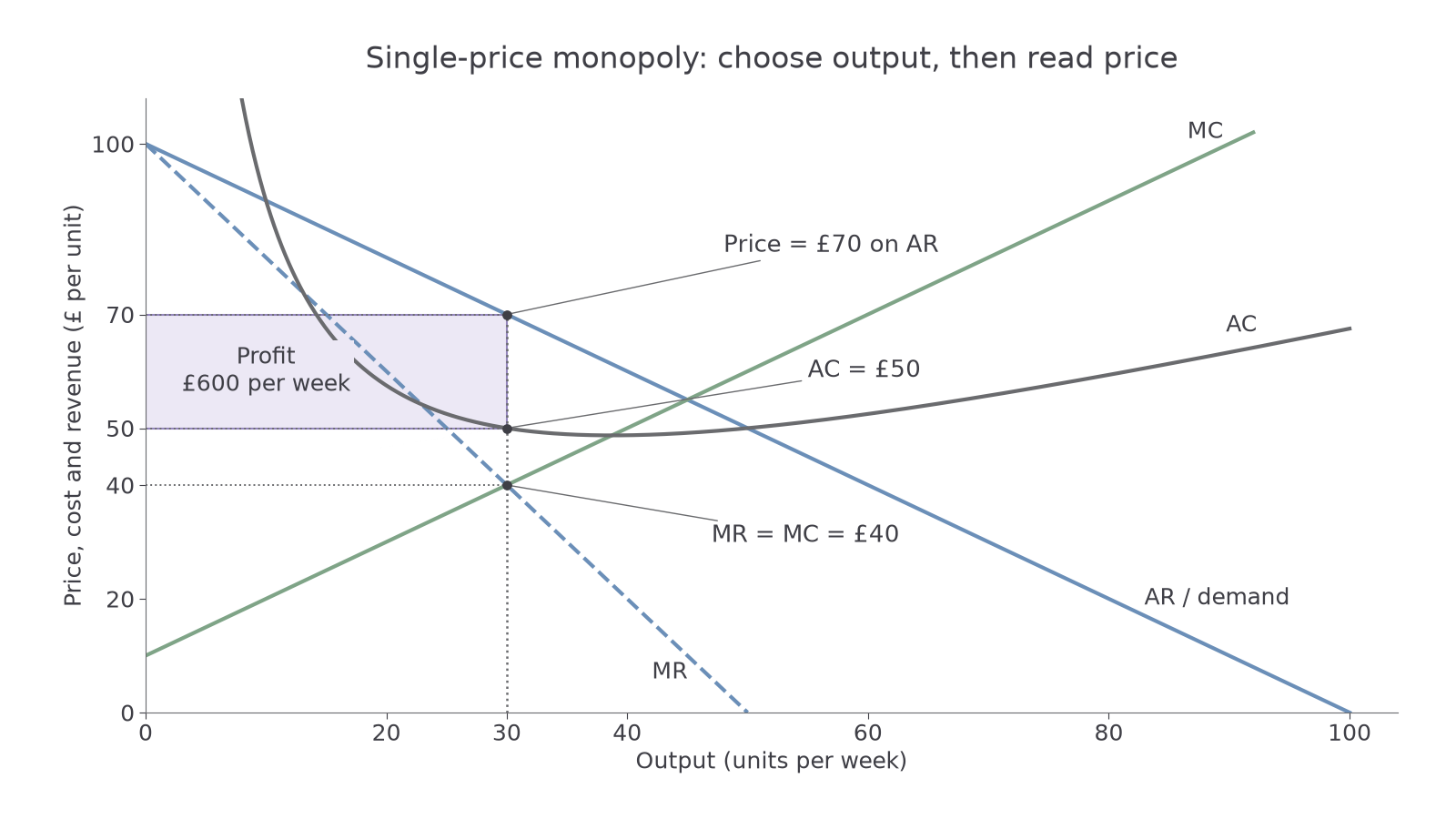
This is an original illustrative weekly market. Price, revenue and cost per unit are measured in pounds; output is units per week. AR falls from £100 at zero output to zero at 100 units. MR reaches zero at 50 units. MC rises from £10 and crosses MR at 30 units, where both are £40. At that output, AR gives a selling price of £70 and average total cost (AC) is £50.
Why stop at 30? Below this output, MR exceeds MC: an additional unit adds more revenue than cost, raising profit. Above it, MC exceeds MR: further output reduces profit. This is the relevant crossing where MC cuts MR from below. The firm charges £70, not £40: MR is not the price paid by customers. Nor does it maximise profit by choosing AR = MC; that is a different output condition.
Continue this lesson.
You’re previewing NovaLearn without an account. Create a free account to read the rest.
Create free account