3.2.5.1 - Fiscal policy and economic activity
Learn how tax and spending decisions influence demand, productive capacity and individual markets, and why their effectiveness depends on economic conditions.
Fiscal instruments and automatic stabilisers
Fiscal policy uses government spending, taxation and the budget balance to influence economic activity.
Expansionary fiscal policy increases demand through higher government purchases, increased transfers or lower taxes. Contractionary fiscal policy restrains demand through the opposite changes. The budget balance records revenues minus expenditure over a period; lower revenues or higher expenditure tend to make that balance less positive. The deficit/debt lesson examines its financing.
Discretionary changes are deliberate policy decisions, such as announcing a new infrastructure programme or changing a tax rate. Automatic stabilisers operate under existing rules. In a downturn, lower incomes and profits reduce tax receipts while unemployment-related benefits rise. Disposable income and consumption therefore fall less than they would without these changes, cushioning the downturn. In a recovery, receipts rise and some benefit spending falls, moderating demand growth.
An observed larger deficit does not by itself prove that ministers introduced a new stimulus: it may reflect the downturn. Nor does the size of the deficit alone describe the policy stance, because timing, the starting balance and the economic cycle matter. Transfers influence consumption indirectly; government purchases enter aggregate demand directly.
Transmission through aggregate demand
A fiscal change affects aggregate demand through the spending decisions it creates or prevents.
In , additional purchases by government initially raise . Suppliers receive revenue and pay workers, whose extra spending creates further income: the multiplier mechanism taught earlier. Income-tax cuts or higher benefits raise disposable income, but the increase in consumption depends on how much recipients spend. Corporation-tax cuts may encourage investment by raising its expected post-tax return, although weak sales expectations can outweigh that incentive. Taxes and transfers are not separate AD components.
With spare capacity, firms can raise production and employment, so an outward AD shift has a relatively large real-output effect. Near capacity, scarce labour and inputs make supply steeper; more of the demand increase appears as a higher price level. In either case the fiscal change shifts AD, while the economy moves along the unchanged short-run aggregate supply curve.
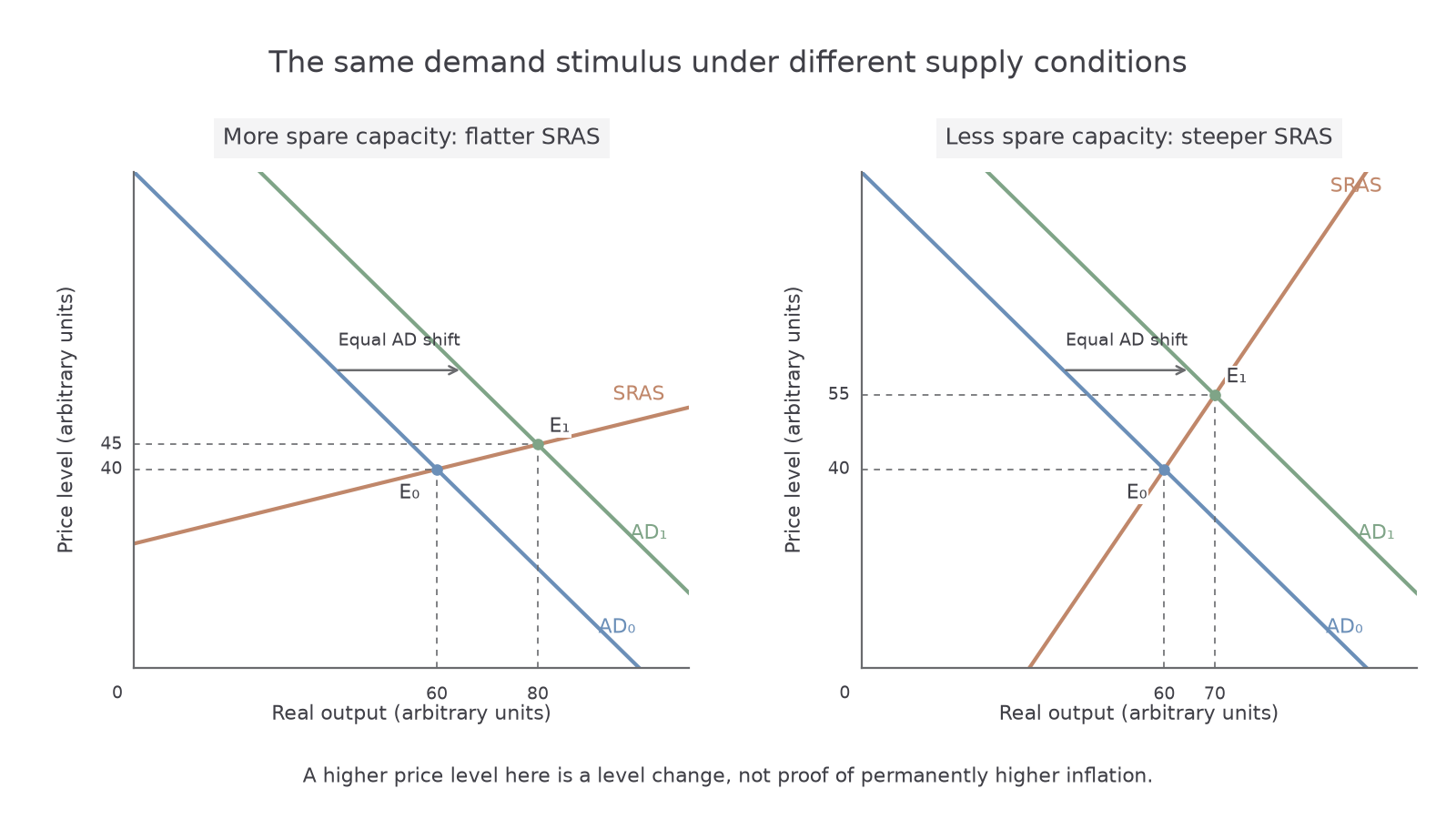
Illustrative AD/AS models, with arbitrary real-output and price-level units. Both panels show the same AD shift; the supply conditions differ.
Read the axes and intersections before interpreting the policy. Left-panel equilibrium moves from to , raising output from 60 to 80 and the price level from 40 to 45. In the right panel, output rises from 60 to 70 while the price level rises from 40 to 55. These values illustrate assumptions, not a prediction for the UK. A one-off higher price level is not automatically a permanently higher inflation rate.
To practise construction on paper, draw price level vertically and real output horizontally, start with intersecting AD and SRAS curves, shift AD right, and project each equilibrium to both axes. Keep SRAS unchanged for a pure demand stimulus. The text tasks here assess the resulting interpretation.
Transmission through aggregate supply
Fiscal measures can change production costs and future capacity as well as current spending.
Public investment in transport can reduce delivery times and improve access to jobs. Spending on education and training can raise skills and labour productivity. If these changes increase productive capacity, long-run aggregate supply shifts right. The result requires useful projects and effective delivery: expenditure is an input, not proof of productivity growth. Construction may raise AD immediately while capacity improves years later.
A lower employer payroll tax can reduce unit labour costs, potentially shifting SRAS right. A lower marginal income-tax rate may increase the reward to employment or extra hours, but labour-supply responses are uncertain. Investment allowances or lower profit taxes can improve expected returns, supporting capital formation. Financing the measures with other taxes or borrowing may offset part of these gains.
Continue this lesson.
You’re previewing NovaLearn without an account. Create a free account to read the rest.
Create free account