3.1.8.9 - Other market interventions
Learn how price controls, state provision, rules, property rights and pollution permits change resource allocation, and how to choose a method that fits the market failure.
Price controls and rationing
A maximum price prohibits charging above a ceiling. It binds when below the unregulated equilibrium. A minimum price prohibits charging below a floor and binds when above equilibrium. Controls outside these ranges need not change the market outcome.
In the exact illustrative market, demand is and supply is . With pounds per unit and units per week, equilibrium is £60 at quantity 40. A maximum £40 makes quantity demanded 60 and quantity supplied 20: a shortage of 40. A minimum £80 makes quantity demanded 20 and quantity supplied 60: excess supply of 40.
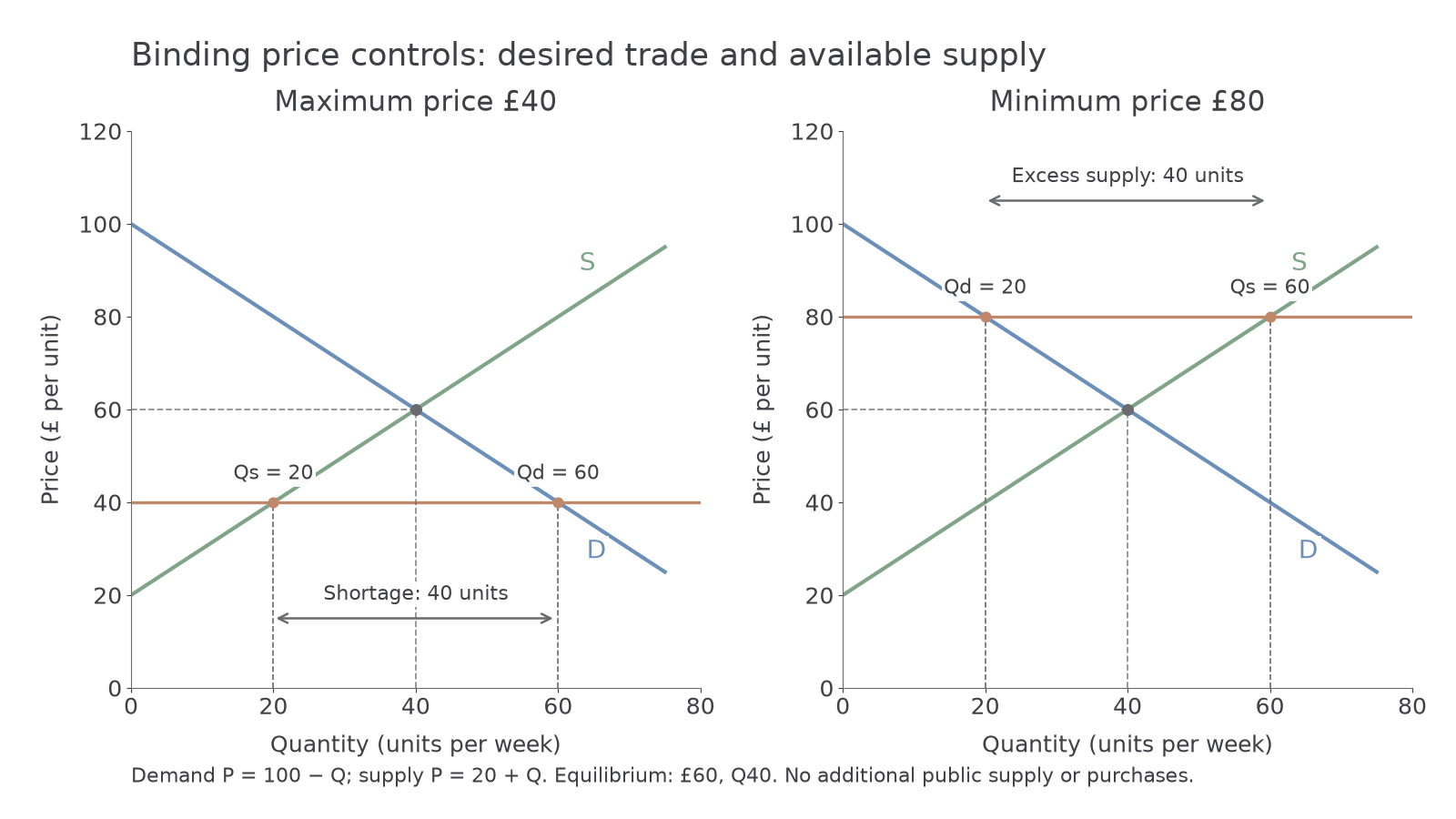
A lower permitted price helps the buyers who obtain the good, but scarcity remains. Queues, waiting lists, favouritism or illegal resale may replace price rationing. Suppliers may reduce maintenance or long-run capacity if returns fall. Under the ceiling, without state supply, at most 20 units can be sold in this model; quantity demanded is not the quantity traded.
A floor can support receipts for units sold, but it does not guarantee every producer sells the desired amount. Without a buyer for the surplus, trade is demand-limited here to 20. Government purchases can absorb a surplus at a fiscal and resource cost. A floor used to discourage a harmful good may reduce consumption, but remaining sellers retain the extra receipts; the price difference is not automatically government revenue. Distribution and externalities therefore matter alongside the shortage or surplus.
State provision and access
State provision means government arranges or supplies a service, often using public expenditure. Provision and production are different: government can commission a private contractor. This method can address cases where charging individual users fails, such as a non-excludable public good with a free-rider problem, or where merit-good access and external benefits are priorities.
Tax funding can let a service operate without depending on each user's willingness or ability to pay. Publicly funded vaccination, for example, can expand use when infection protection benefits others or low income prevents access. Capacity, appointments and outreach still determine whether people actually receive it; setting a zero money price does not produce infinite resources.
Public spending has an opportunity cost. Staff and facilities used here cannot simultaneously produce other services. Weak user price signals can create excess demand, while waiting lists become a rationing device. Government may misjudge needs or fund inefficient delivery. Comparing social benefit, real cost and alternative provision is more useful than equating a zero user charge with a free social resource.
Rules and information
Regulation can address a failure by specifying behaviour rather than just changing a price. Emissions limits, safety requirements and compulsory disclosure each target different problems. A clear prohibition may be useful where a small amount of dangerous activity is unacceptable; disclosure can help consumers make informed decisions when sellers know more.
A uniform technical standard can be expensive if firms have different ways to reduce harm. It may require one technology even where another achieves the same outcome more cheaply. An outcome standard, such as a maximum emission level, can preserve more flexibility. Monitoring and enforcement remain necessary: a rule on paper does not ensure compliance.
Rules may also have unintended effects. Fixed compliance costs can deter small entrants, reducing competitive pressure. A label with too much technical information may not correct consumer misunderstanding. The choice depends on the cause of the failure, how observable compliance is, and whether the rule's benefits exceed its resource and entry costs. Price incentives and well-designed rules can complement each other.
Continue this lesson.
You’re previewing NovaLearn without an account. Create a free account to read the rest.
Create free account