3.2.6.2 - Comparative advantage and trade
Use opportunity costs to explain specialisation and gains from trade, distinguish those gains from absolute productivity, and judge how trade benefits, costs and changing UK patterns fit the model.
Absolute and comparative costs
A country's most productive industry need not be the industry in which its relative advantage is greatest.
Absolute advantage means producing more output with the same resources, or using fewer resources for a given output. Comparative advantage means producing at a lower opportunity cost. It compares what must be forgone, not simply who produces most.
Consider these illustrative maximum monthly outputs using the same quantity of a comparable productive input in each country. Resources can be divided between the goods, and opportunity costs are constant.
| Country | Wheat only (tonnes) | Machines only (units) |
|---|---|---|
| A | 100 | 50 |
| B | 80 | 20 |
A has absolute advantage in both goods. To find comparative advantage, calculate output forgone per unit gained. A gives up tonnes of wheat for one machine; B gives up tonnes. A therefore has comparative advantage in machines. For wheat, reverse the fractions: A forgoes machines per tonne, B . B has comparative advantage in wheat despite its absolute disadvantage.
Always name the unit of the ratio. “A's opportunity cost is 2” is incomplete: it is two tonnes of wheat per machine. With two goods, lower relative cost in one implies higher relative cost in the other; equal opportunity costs leave no gain from this particular source of specialisation.
Gains from specialisation and exchange
Moving resources towards lower-opportunity-cost production can increase the quantities available to both countries.
Start with each country devoting half its resources to each good: A produces 50 tonnes of wheat and 25 machines; B produces 40 tonnes and 10 machines. World output is 90 tonnes of wheat and 35 machines. Do not add tonnes and machines into a meaningless single output total.
Now A produces 20 tonnes and 40 machines, while B specialises completely in wheat, producing 80 tonnes. These combinations lie on their respective production possibility frontiers (PPFs). World output rises to 100 tonnes and 40 machines: both goods increase using the same resources. Partial specialisation by A is sufficient; complete specialisation by both countries need not preserve the initial amount of every good.
A then exports 10 machines to B in exchange for 30 tonnes of wheat. A consumes 50 tonnes and 30 machines; B consumes 50 tonnes and 10 machines. Compared with the starting position, A has five more machines with the same wheat, and B has ten more tonnes of wheat with the same machines. Each consumption point lies beyond its own PPF; production remains on the PPF. Trade changes consumption possibilities, not the physical domestic production frontier by itself.
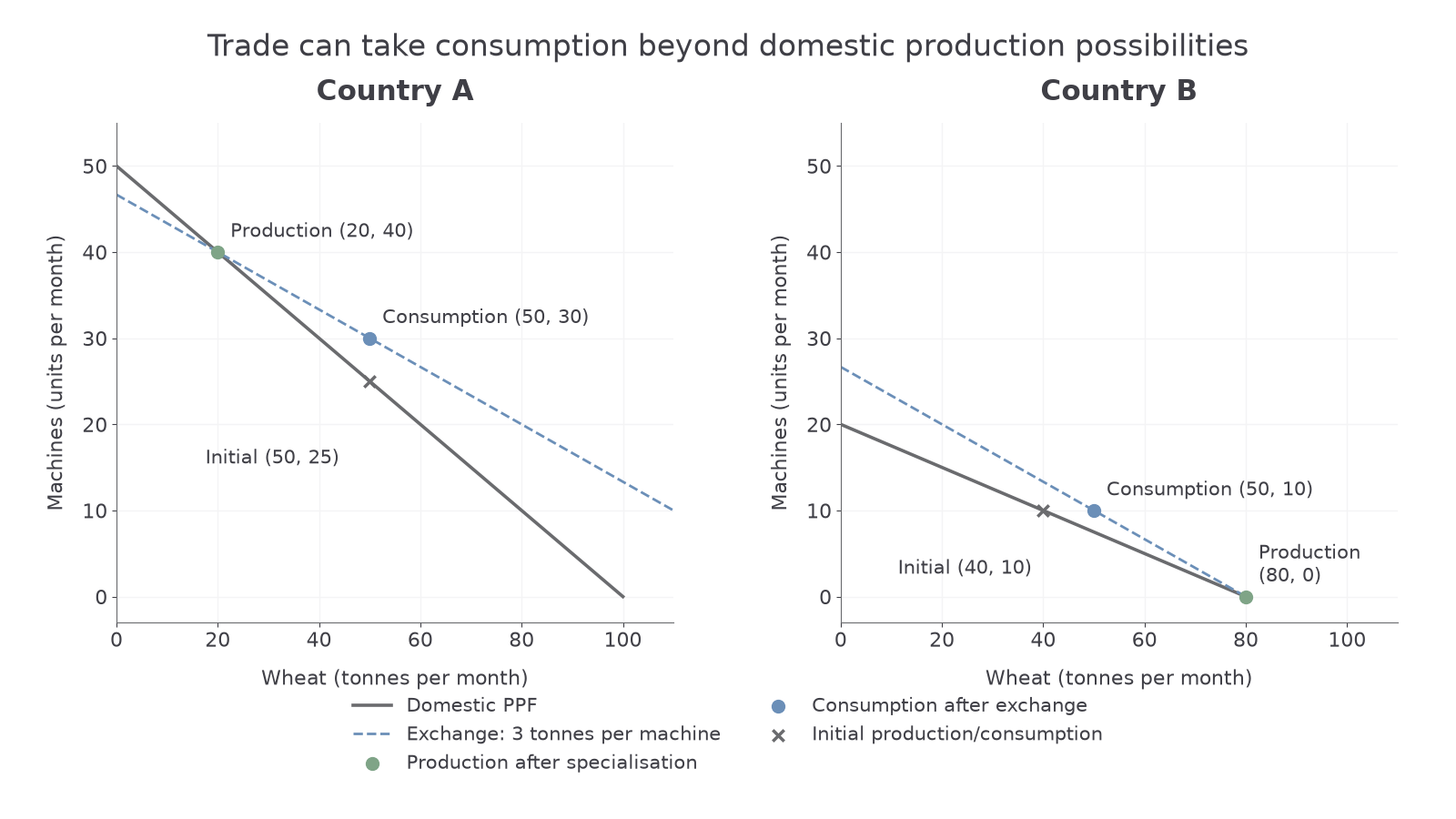
The terms of trade describe the price of exports relative to imports. Here the exchange ratio is three tonnes of wheat for one machine. A receives more wheat than the two tonnes it sacrifices to make a machine; B pays less than the four tonnes it would sacrifice domestically. Mutually beneficial terms lie strictly between two and four tonnes per machine in this model. At an endpoint one country gets no strict relative-cost gain; bargaining determines how the gains are shared. Real terms-of-trade indices compare export prices with import prices, so more favourable terms mean more imports obtainable for a given amount of exports.
Wider gains from trade
Trade can raise efficiency through mechanisms beyond the fixed-opportunity-cost model.
A larger market lets a firm spread fixed costs across more sales, exploit specialised machinery and benefit from economies of scale. Average costs can fall even when the original production techniques were similar across countries. Competition from foreign suppliers reduces the protection of inefficient firms and creates pressure to innovate, while consumers gain variety and access to goods unavailable domestically.
Continue this lesson.
You’re previewing NovaLearn without an account. Create a free account to read the rest.
Create free account