3.1.2.1 - Utility and rational choice
Learn how the rational-choice model links incentives, satisfaction and decisions about one extra unit, and why diminishing marginal utility helps explain a downward-sloping demand curve.
Rational choice and incentives
Rational choice means choosing the feasible option expected to give the greatest benefit according to the decision maker's preferences.
A consumer has limited income and time. The traditional model assumes that the consumer can compare alternatives, has consistent preferences and uses relevant information to choose the best available option. Utility means the satisfaction or benefit the consumer receives. Maximising utility does not mean buying the most expensive product or spending every pound. A person may prefer leisure to extra income, or gain satisfaction from giving to others.
An incentive changes the expected reward or cost of an action. A cheaper train fare can make rail travel more attractive relative to driving. A longer journey increases the time sacrificed and may reverse that decision. The opportunity cost includes the value of the best alternative use of the traveller's money and time, not just the printed fare.
Consider an illustrative journey. Driving costs £8 in fuel and parking; taking the bus costs £3. If both journeys take the same time and are equally convenient, the bus leaves £5 for other valued uses. A rational consumer would choose it under those assumptions. If the bus takes an extra hour and that hour is worth more than £5 to the consumer, driving may instead maximise utility. The change in choice need not be irrational: the relevant trade-off has changed.
The model predicts responses to incentives, rather than claiming that everybody likes the same things. It is a useful starting point, but real people may lack information, struggle to process choices or act against their own longer-term plans. Later behavioural models examine those influences; they do not make every unexpected choice irrational.
Total and marginal utility
Total utility measures satisfaction from all units consumed, whereas marginal utility measures the change from one extra unit.
Total utility (TU) is the satisfaction from a given quantity. Marginal utility (MU) is the additional satisfaction from increasing consumption by one unit. For a change in quantity, average marginal utility over that change is:
For one extra unit, subtract the previous total from the new total. The following invented schedule measures one person's satisfaction from sandwiches eaten during one meal in hypothetical utility units. These units illustrate the model; they are not pounds and cannot reliably compare different people's happiness.
| Sandwiches consumed | Total utility (utility units) | Marginal utility of the last sandwich |
|---|---|---|
| 0 | 0 | — |
| 1 | 12 | 12 |
| 2 | 21 | 9 |
| 3 | 27 | 6 |
| 4 | 30 | 3 |
| 5 | 30 | 0 |
The third sandwich adds utility units. TU rises from 21 to 27 even though MU falls from 9 to 6. Diminishing marginal utility is the hypothesis that successive units add less satisfaction as consumption rises, other things equal. Falling MU therefore does not mean falling TU. TU falls only if the extra unit has negative MU, for example when further eating becomes unpleasant.
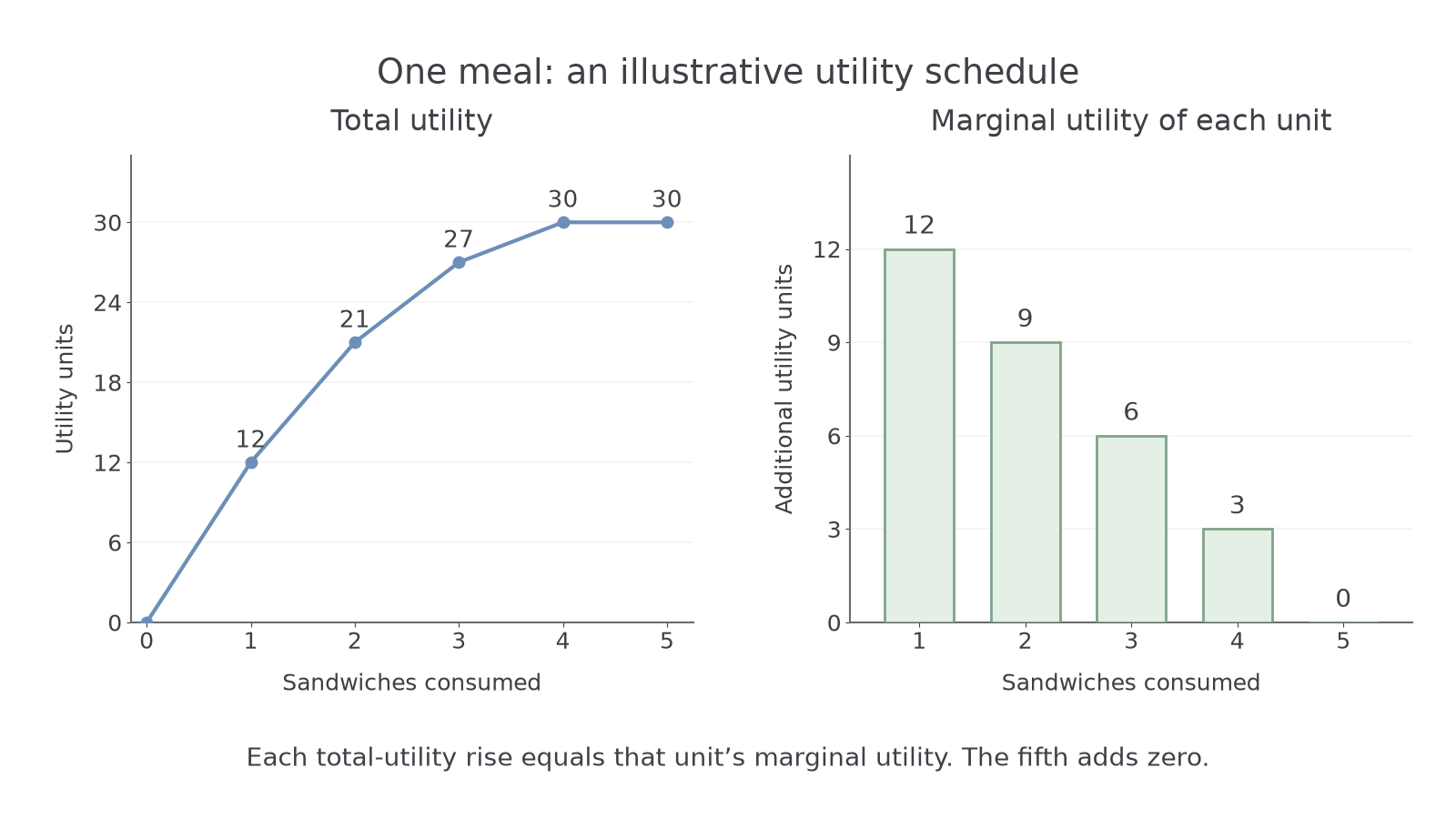
The left panel joins the discrete TU observations; its progressively smaller rises correspond to the falling MU bars on the right. At the fifth sandwich the rise is zero. The schedule describes this meal and these preferences, rather than a universal biological law. Consumption period, variety and circumstances matter: a second bottle of water may be extremely valuable if the first was insufficient during an emergency.
Utility maximisation at the margin
A consumer should compare the benefit and cost of the next unit rather than judging the whole purchase by its average benefit.
The margin means the point of a small change: one extra journey, hour of work or unit consumed. Past spending does not by itself justify another purchase. What matters is whether the next unit adds more benefit than the value of the resources sacrificed for it.
To make that comparison transparent, suppose a consumer's maximum willingness to pay for four available music downloads, taken successively, is £8, £6, £4 and £2. These are illustrative money-valued marginal benefits, not the hypothetical utility units used above. Each download costs £3, and there are no other costs or benefits. The first three are worth more than their price. The fourth gives £2 of benefit but sacrifices £3 that could be used elsewhere, so buying it reduces net benefit.
The consumer buys three downloads. Their total valued benefit is , their total cost is , and their net benefit is £9. Buying four would raise valued benefit to £20 but cost to £12, reducing net benefit to £8. “More consumption gives more gross satisfaction” is therefore not sufficient to justify another purchase.
If marginal benefit exactly equals marginal cost, the consumer is indifferent about that extra unit in this simple model. With divisible quantities and smooth relationships, equality is the usual stopping condition; with indivisible units, choose the last unit whose benefit at least covers its cost, recognising any tie. Income constraints may prevent even a worthwhile purchase. Uncertainty also means the decision compares expected benefits with costs, rather than guaranteed outcomes.
This is a single-good marginal comparison. You do not need the equi-marginal utility rule across different goods for this specification.
Diminishing utility and demand
Diminishing marginal utility helps explain why a consumer is willing to buy more units when their price falls.
As successive units provide less additional satisfaction, the consumer's maximum willingness to pay for them tends to fall. In the download example, a £5 price justifies the first two purchases: marginal benefits of £8 and £6 exceed the price, but the third benefit of £4 does not. At £3, the third becomes worthwhile. Quantity demanded rises from two to three as price falls, holding preferences, income and other relevant conditions constant.
This supports a downward-sloping demand curve: a higher price requires a larger benefit to justify the next unit, so fewer units qualify; a lower price makes units with smaller marginal benefits worth buying. It is a movement along a demand relationship for the same consumer and conditions, rather than a change in tastes. It does not imply that every unit of a good has the same value or that the price of the good measures total satisfaction.
The explanation is a model-based hypothesis. It may work well for repeated consumption during a period, yet the pattern can depend on context. Complementary consumption or changes in circumstances can alter the benefit of the next unit. A concert ticket may be worth more if friends decide to attend too. That changes the relevant preferences or social benefits, so it is not the same “other things equal” comparison.
To apply the model, identify the extra unit, its benefit and the cost sacrificed, then state what is held constant. The model can explain the direction of a response without predicting its exact size. The equi-marginal principle is not needed here.
Quick recap
Rational consumers compare feasible choices using their preferences and relevant costs. Marginal utility is an addition to total utility; when it diminishes, total utility can still rise. Decisions about one extra unit depend on its benefit and opportunity cost. Lower prices can make additional units worthwhile when marginal benefits decline.