3.1.6.5 - Trade unions, wages and employment
Learn what gives trade unions bargaining power and why the same negotiated wage increase can have different employment effects in competitive and monopsony labour markets.
What makes collective bargaining effective?
A trade union represents workers collectively and negotiates with employers over pay and conditions.
Collective bargaining can give workers more influence than individual negotiations. The threat of coordinated withdrawal of labour can impose costs on an employer. Its strength depends on the proportion of workers represented, their willingness and ability to act together, financial resources to sustain action, and whether employers can recruit replacements, automate, relocate or wait out a dispute. Bargaining arrangements and legal constraints also affect which actions are feasible; the model does not assume unlimited strike power.
Demand for labour matters. Where workers have essential skills and few substitutes, labour demand may be relatively inelastic and replacement difficult. A wage increase may then cause a smaller employment response and the cost of a stoppage may be large. If employers can substitute easily or final-product demand is very elastic, higher labour costs are more likely to reduce hiring or output, limiting the sustainable pay rise. A labour shortage may strengthen workers' outside options; high unemployment may weaken them.
An employer's financial position and product-market conditions affect what can be afforded. Higher productivity may allow more pay without the same increase in unit cost. However, profit alone does not determine the bargain: the parties' alternatives and negotiating strength matter. Public-service employers may also face a budget constraint rather than a simple profit-maximising objective.
Where a powerful union faces a powerful employer, there is bargaining power on both sides, sometimes called bilateral monopoly. Supply and MRP help identify the parties' opportunities, but do not uniquely determine the negotiated wage. The diagrams below examine the consequences if a particular common wage is successfully agreed and enforced.
A negotiated wage above competitive equilibrium
In the basic competitive model, a binding wage above equilibrium raises pay for those employed but reduces the quantity of labour demanded.
The original graph uses demand and supply , with in worker-equivalents offering identical hours. The starting equilibrium C is £16 per hour and 80. Suppose a union successfully negotiates £20 while demand and underlying worker supply remain unchanged.
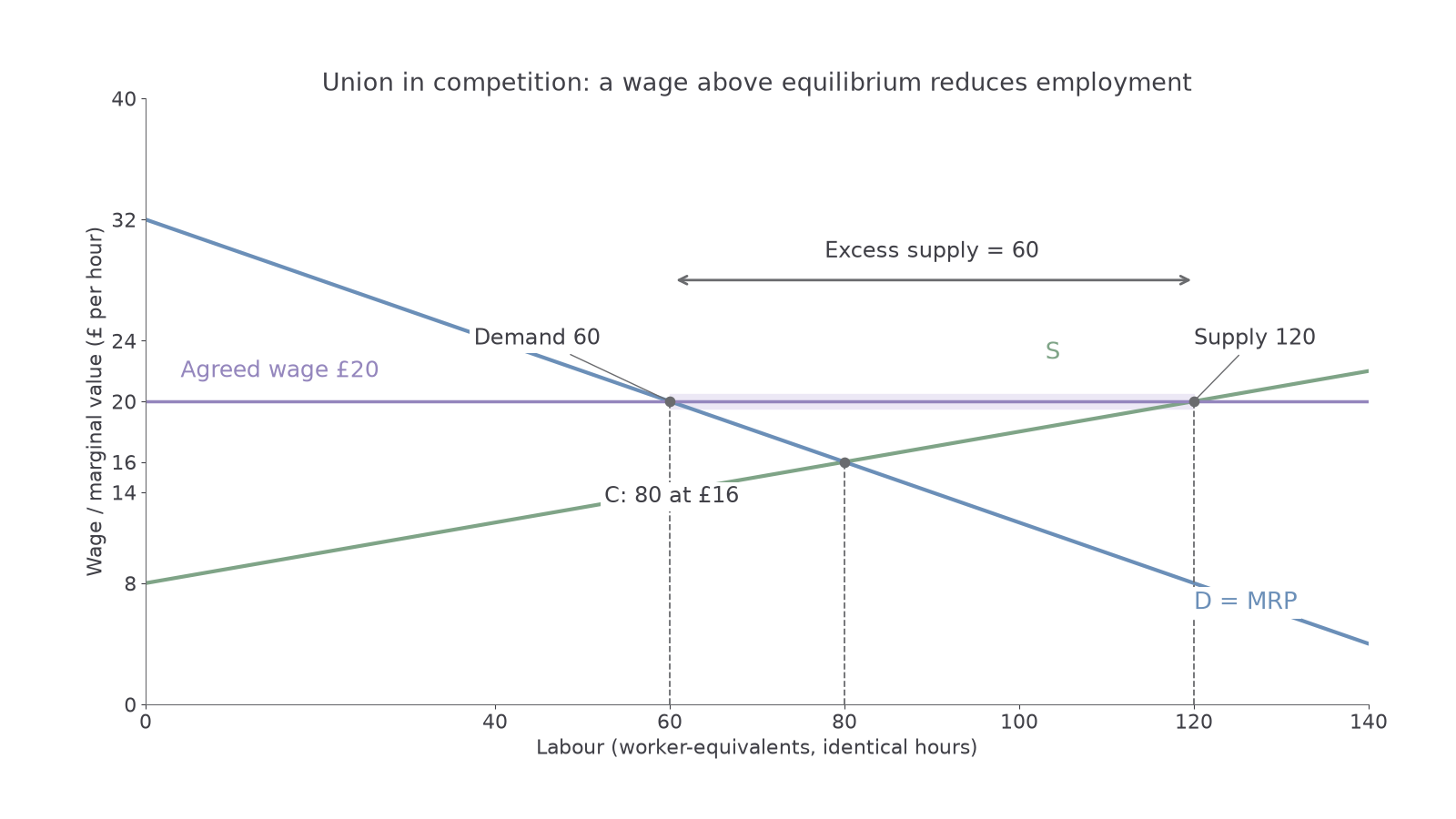
At £20, employers demand 60 while 120 offer labour. Employment falls from 80 to 60 and excess supply is 60. That excess supply is not the same as the reduction in employment, which is 20. Some of the people offering labour at the higher wage were not offering it at the original wage. Nor does the diagram establish a national unemployment increase of 60: people may find work elsewhere.
Winners and losers differ. Those retaining jobs receive £4 more per hour, but people losing jobs or unable to obtain one do not receive that higher wage. The hourly wage bill, , falls from pounds to pounds. Thus a higher individual wage does not guarantee higher total earnings for the group. With less elastic labour demand, the employment loss is smaller and the total wage bill could instead rise.
This result assumes the union changes the wage alone. If an agreement also improves productivity, reduces turnover or secures additional product demand, labour demand can shift right and employment may be maintained. Do not add such a shift automatically; explain and support its mechanism.
Continue this lesson.
You’re previewing NovaLearn without an account. Create a free account to read the rest.
Create free account