3.1.8.4 - Externalities in production
Learn how production affects people outside a transaction, use marginal private and social curves to identify over- or under-production, and interpret the welfare consequences and the role of property rights.
Costs beyond the producer's accounts
A production externality is a cost or benefit of production affecting third parties that the producer's decision does not fully take into account.
Private costs are borne by the producer, such as wages, materials and equipment use. A negative externality imposes additional costs on others, such as a factory's untreated discharge damaging a downstream user's water. Social cost includes private cost and external cost. Ordinary payments for inputs are not automatically externalities; neither is a change in a competitor's revenue just because a new firm offers a better product.
Use marginal measures when judging the next unit. Marginal private cost (MPC) is the extra cost borne by the producer; marginal social cost (MSC) also includes the extra harm to others. For negative production effects, MSC exceeds MPC. For a positive production spillover, such as useful knowledge reaching other producers, the external gain can be represented as MSC below MPC, after accounting for that gain.
In that positive representation, the producing firm's own bill has not become smaller: the lower social cost reflects benefits outside the firm. The same positive effect can alternatively be represented on the benefit side, but it must not be counted on both sides in one calculation. The diagrams here put production spillovers on the cost side and assume no consumption externality, so MPB = MSB.
The social efficiency rule is MSB = MSC at an interior optimum: units whose social benefits exceed costs add welfare; units whose costs exceed benefits reduce it. A competitive private market instead equates MPB and MPC. The two quantities coincide only if all relevant effects are aligned. These diagrams assume known effects, comparable monetary values, competition and no other distortion.
External costs cause over-production
A producer that does not bear pollution damage can supply units whose social cost exceeds their benefit.
The graph is an illustrative model: quantity is units per period and marginal values are pounds per unit. MPB = MSB falls as quantity rises; MPC rises; MSC is £20 above MPC because each unit imposes £20 of external damage.
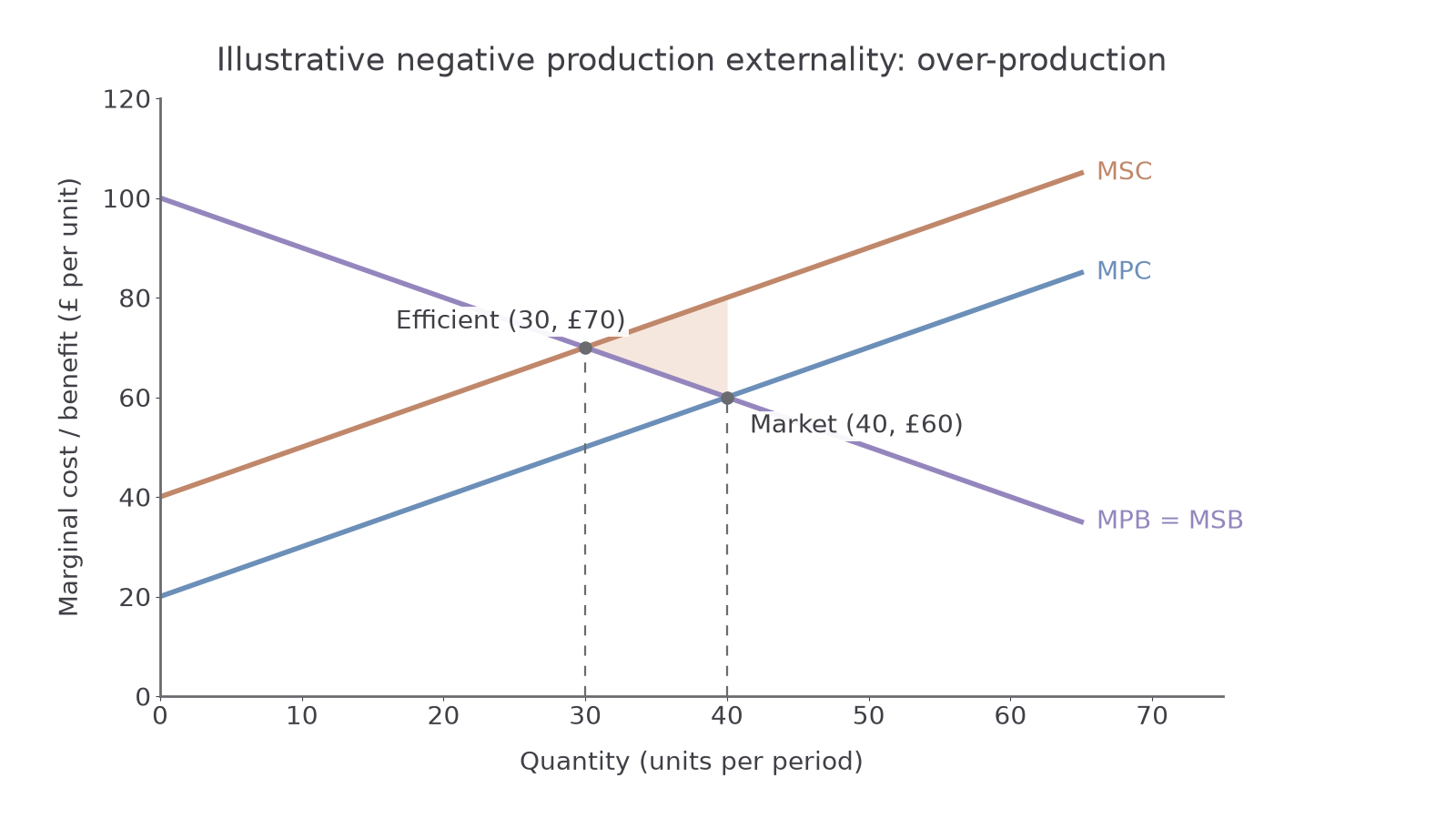
The private market produces 40 units, where MPB = MPC = £60. The socially efficient quantity is 30, where MSB = MSC = £70. The market therefore over-produces by 10 units. £70 is the marginal social value at the efficient point, not an observed market price after an unspecified policy.
Between 30 and 40, MSC exceeds MSB. At quantity 40, the social cost of the marginal unit is £80 but its benefit is £60: a £20 excess. Summing the excess costs of the unwanted units gives the shaded welfare loss, not the whole external-damage bill. For these straight curves it is a triangle:
The total external cost at market output is instead 40 × £20 = £800 per period. Some pollution can remain at the efficient quantity: reducing output to zero would also sacrifice benefits. The model seeks the quantity balancing social benefits and costs, not “no production regardless of consequences”.
For notebook construction, label Q horizontally and marginal costs/benefits vertically, draw MPC and higher MSC, and one falling MPB = MSB curve. Mark both intersections and quantities. Shade only the gap between MSC and MSB from efficient to market quantity. A movement to a different quantity is not itself a shift in the social-cost curve. Text marking here assesses supplied-diagram interpretation, not drawing performance.
External gains cause under-production
A producer unable to capture the full benefit it creates for others may supply fewer units than would maximise social welfare.
Continue this lesson.
You’re previewing NovaLearn without an account. Create a free account to read the rest.
Create free account