3.2.6.2 - Protectionism and trading arrangements
Explain how trade restrictions change incentives, prices and welfare, use a tariff diagram accurately, and distinguish a customs union, the Single European Market and the World Trade Organisation.
Tariffs, quotas and export subsidies
Protectionism changes the terms on which foreign producers compete with domestic firms.
A tariff is a tax on imports. A specific tariff charges a fixed amount per unit; an ad valorem tariff charges a percentage of value. It raises the landed import price and may permit domestic producers to charge more. The importer pays the tax initially; who ultimately bears it depends on prices and elasticities.
A quota limits the quantity imported. A binding quota restricts supply and can raise the domestic price, creating quota rents for those entitled to sell at that price. Unlike a tariff, it does not automatically give the government tax revenue; who receives the rent depends on how import licences are allocated or auctioned. A non-binding quota changes nothing because imports were already below its limit.
An export subsidy pays domestic producers for exports, improving their incentive or ability to compete abroad. It costs public money and can redirect output from domestic buyers towards exports. If subsidised supply reduces world prices, competing overseas producers lose revenue; domestic buyers may face higher prices as exporting becomes more attractive. The precise incidence depends on market conditions. Other protection includes discriminatory procurement and administrative barriers. A legitimate safety standard is not automatically protectionist, though it can restrict trade and may be used discriminatorily.
Reading and constructing a tariff diagram
A tariff diagram separates domestic production, domestic consumption and imports at each price.
Use the following illustrative competitive market for a homogeneous good. The country is small enough to take a constant world price of £20; supply from abroad is perfectly elastic at that price. Domestic inverse demand is , and inverse supply is , where price is pounds per unit and quantity is units per month. Without trade, supply and demand intersect at price £50 and quantity 50.
With free trade, the price is £20: domestic supply is 20 and demand is 80, so imports are . A £20-per-unit tariff raises the import-inclusive price to £40. Domestic firms expand supply to 40, buyers reduce demand to 60, and imports fall to . These are movements along unchanged domestic curves. The tariff raises the horizontal foreign-supply price line; it does not itself shift domestic demand or supply.
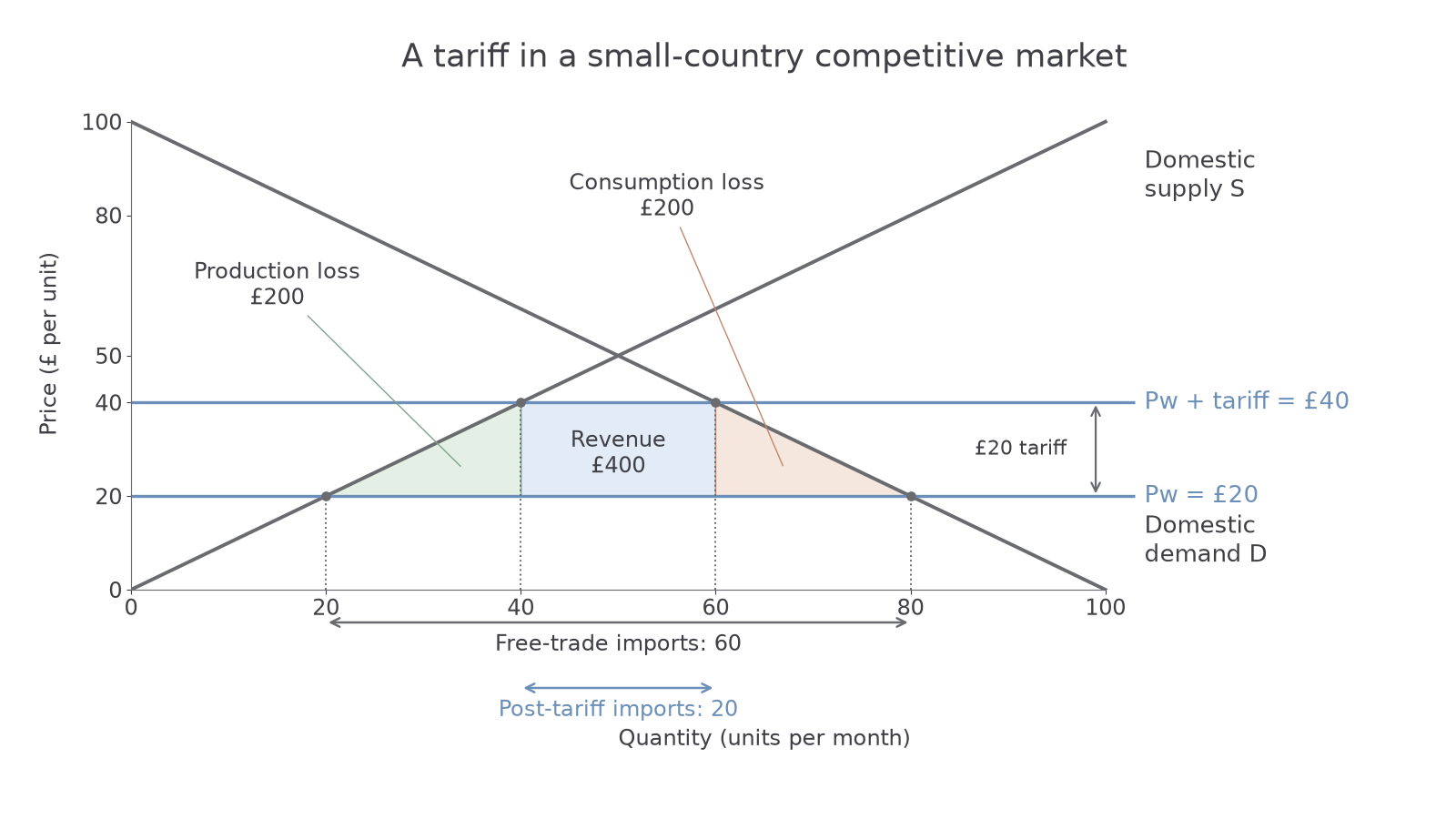
To construct this in a notebook, label price and quantity axes, draw domestic demand and supply, and add the world-price line below the no-trade equilibrium. Project its two intersections down to the quantity axis and identify the import gap. Add the world price plus tariff line, project its intersections, and mark the smaller import gap. Label the tariff height and the relevant welfare areas. Text assessment here checks interpretation; notebook drawing is practice rather than an uploaded marked performance.
Government revenue is tariff times remaining imports: per month. Under these straight-line curves, consumer surplus falls by £1,400; producer surplus rises by £600. Revenue and producer gains are transfers within this economy, not the whole welfare loss. The production distortion is : extra domestic output costs more resources than imports would. The consumption distortion is also £200: some purchases worth more than the world cost disappear. Net national welfare falls £400: .
This conclusion assumes no external benefits, retaliation or change in the world price. A large country's tariff might lower the foreign price, giving a terms-of-trade gain, but retaliation can remove it. The diagram identifies mechanisms; its assumptions determine the welfare judgement.
Arguments and consequences of protection
Governments protect industries for different reasons, so the case must be judged against the objective and feasible alternatives.
An infant-industry argument says a new producer may need time to learn and achieve scale before competing with established overseas firms. Temporary protection can be defensible where learning creates benefits firms cannot fully capture and future efficiency is credible. It fails if protection preserves high costs indefinitely, firms lobby to extend it or the state cannot identify promising industries. A targeted training or investment measure may address the problem more directly.
Continue this lesson.
You’re previewing NovaLearn without an account. Create a free account to read the rest.
Create free account