3.1.5.7 - Price discrimination
Learn when a firm can charge different customers different prices for the same service, how it chooses those prices, and who gains or loses. Use the conditions, a two-market diagram and real examples to judge effects on access, profit and welfare.
Conditions for discrimination
Price discrimination means charging different prices for the same product where the difference is not explained by a difference in the cost of supplying it.
A first-class and a standard-class seat are different products. A delivery surcharge reflecting extra transport cost is also not, by itself, price discrimination. By contrast, different admission prices for students and other adults watching the same screening can discriminate between customer groups. Some price differences mix cost and demand effects, so investigate rather than classify solely from a price list.
Three conditions matter. First, the seller needs market power: a price taker selling an identical product cannot simply charge one group more than its rivals. Second, the seller must identify or induce separation between customers with different willingness to pay or demand responsiveness. Age or student status can identify groups; restrictive booking conditions can induce self-selection. Third, arbitrage must be prevented: low-price customers must not be able to resell to high-price customers until the price difference disappears. Identity checks, personal tickets and a service consumed on the premises can help.
With group-based discrimination, differing price elasticities allow profitable price differences. Demand that is less price elastic at the relevant prices supports a larger price–cost margin. A customer group is not necessarily less elastic simply because it has a higher income: substitutes, timing and the purpose of purchase also matter. The firm still faces each group's demand constraint; discrimination does not remove scarcity or permit unlimited prices.
Two-market pricing
A profit-maximising discriminating firm allocates output until the marginal revenue from each separate market equals the marginal cost of total production.
If MR is higher in market A than B, moving a unit from B to A increases revenue with the same total production cost. At the optimum, , subject to the demand and capacity constraints. With rising MC, it is MC at total output that matters; the firm must not treat each market as if it were a separate factory with its own unrelated cost curve.
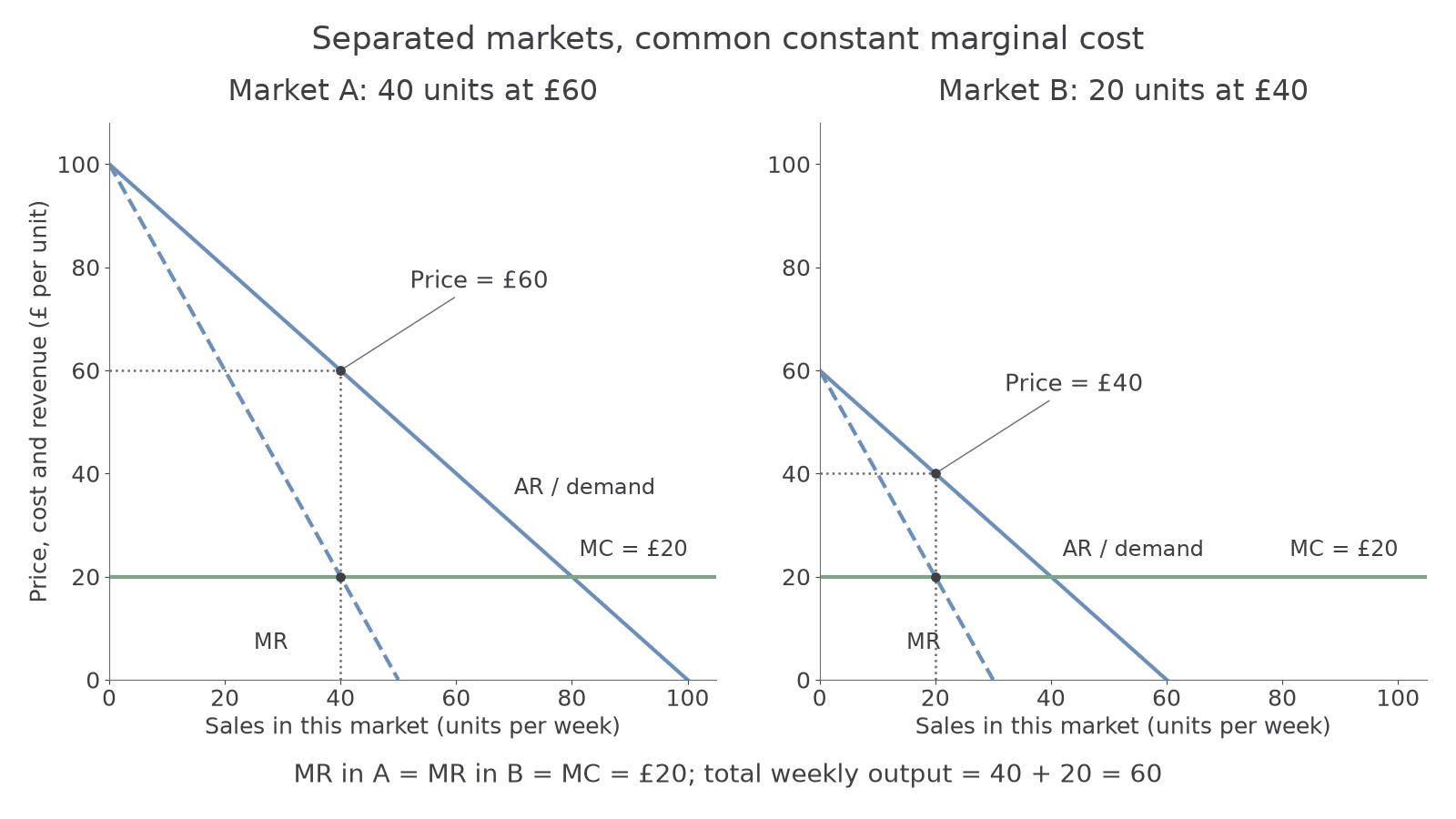
The diagram is an original illustrative admission service with spare capacity and constant MC of £20 per customer. Each horizontal axis shows customers per week in that market; the vertical axes have the same pounds-per-customer scale. In A, AR falls from £100 to zero at 100 customers and MR reaches zero at 50. MR = MC gives 40 customers; the price read from AR is £60. In B, AR falls from £60 to zero at 60 customers and MR reaches zero at 30. MR = MC gives 20 customers and a price of £40. Total output is 60, not 40 or 20, and both last customers add £20 to revenue and £20 to cost.
At these choices, A has the less price-elastic demand: its absolute elasticity is 1.5, compared with 2 in B. These are supplied interpretations of the model, not new elasticity calculations to memorise. The £60 price therefore carries the larger margin over the common £20 MC. The diagram does not mean a steeper demand line alone establishes lower elasticity: elasticity depends on price and quantity as well as slope.
Revenue is £60 × 40 + £40 × 20 = £3,200. Variable cost is £20 × 60 = £1,200, leaving £2,000 toward fixed costs and profit. This contribution is not automatically economic profit: subtract fixed economic costs too. For example, with £1,500 weekly fixed cost, economic profit is £500.
Continue this lesson.
You’re previewing NovaLearn without an account. Create a free account to read the rest.
Create free account