3.1.6.2 - Labour supply to occupations
Learn how wages, working conditions and access to training influence the number of people willing and able to work in an occupation, and distinguish a movement along labour supply from a shift.
The supply of workers to an occupation
Labour supply to an occupation means the number of workers willing and able to offer their labour at different wage rates.
Define the market carefully: a supply curve for qualified electricians in a region is different from a curve for all workers nationally. People willing to become electricians but lacking required qualifications cannot immediately fill those jobs. Keep hours and skill requirements comparable when counting workers; an employer might adjust hours as well as headcount.
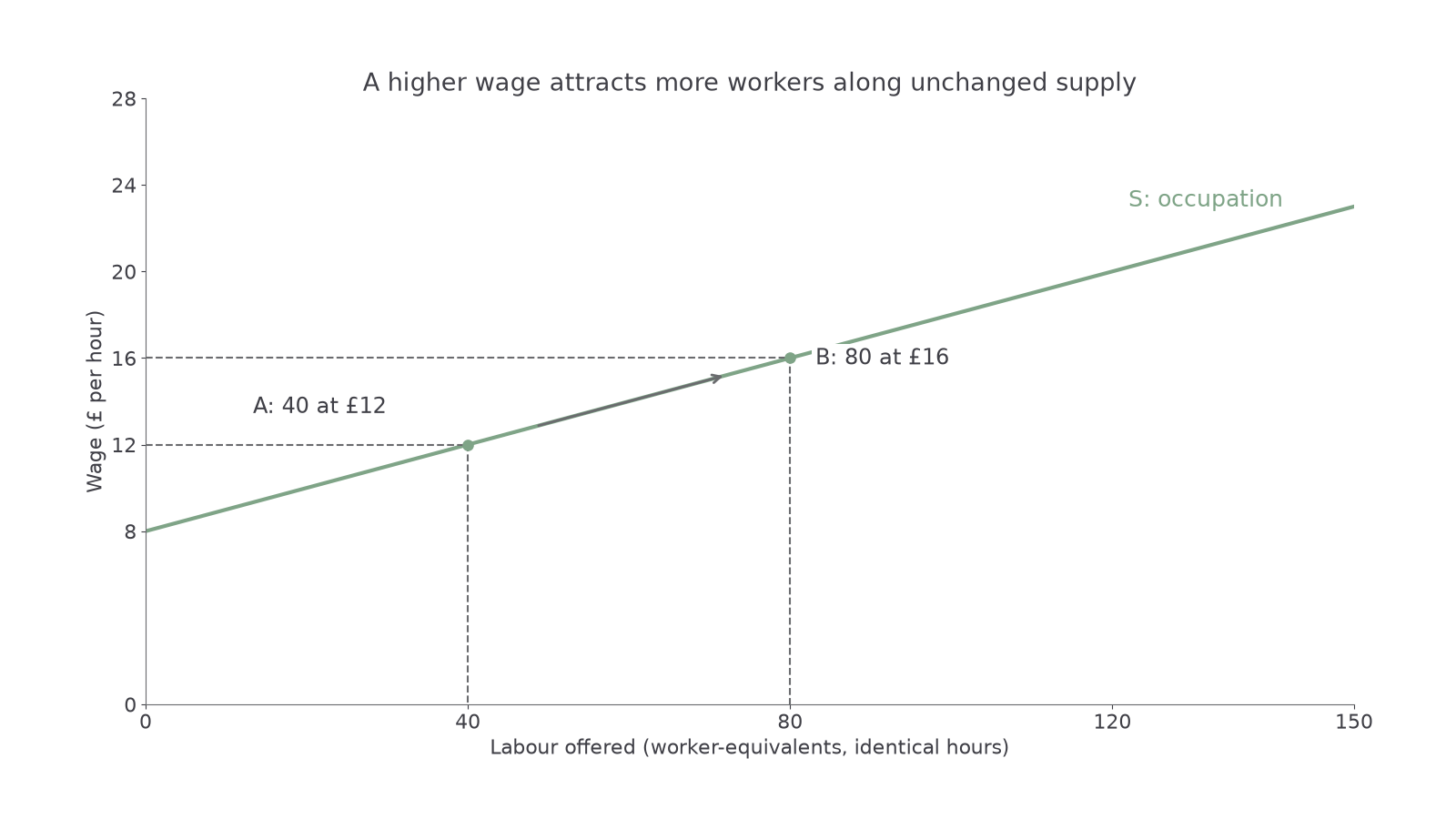
The usual occupational market supply curve slopes upward. A higher wage, other things equal, attracts workers from other occupations or regions, encourages qualified people to return, and makes entering the occupation more worthwhile. This describes a movement along an unchanged supply curve, not a shift.
In the original illustrative graph, supply is , where is pounds per hour and is worker-equivalents offering the same hours. At £12, 40 are supplied; at £16, 80 are supplied. The wage rise increases quantity supplied from A to B. It does not show how many firms actually employ: employment also depends on demand.
This lesson concerns supply to an occupation. The determinants of an individual's choice of hours and the backward-bending individual supply curve are outside the required scope of 3.1.6.2.
Pay and non-monetary rewards
Workers compare the overall attractiveness of a job, rather than responding only to its headline wage.
Monetary considerations include basic pay, bonuses, pensions, paid leave and predictable earnings. A precarious contract with high hourly pay may be less attractive than a stable contract with lower pay. Take-home income and travel or childcare costs can affect whether taking a job is worthwhile.
Non-monetary considerations include job satisfaction or dissatisfaction, safety, stress, working hours, flexibility, autonomy, status, location and promotion opportunities. Meaningful work and supportive conditions may attract people at a wage that would not attract them to a dangerous, exhausting job. An unpleasant job may need a higher wage to recruit otherwise comparable workers: a compensating wage differential. Different people value the same conditions differently, so do not assume a single preference for everyone.
Continue this lesson.
You’re previewing NovaLearn without an account. Create a free account to read the rest.
Create free account