3.1.8.10 - Government failure
Learn why intervention can misallocate resources, how information and incentives create unintended consequences, and how to compare realistic policies with the market outcome.
Misallocation and the counterfactual
Government failure occurs when government intervention leads to a misallocation of resources. It can direct too many resources towards low-value activity, too few towards beneficial activity, or waste resources in delivery. A missed administrative target alone does not establish the economic loss; trace the effect on benefits, costs and allocation.
Market failure and government failure can coexist. Pollution gives a reason to consider intervention, but a badly targeted policy may create larger losses than it removes. The relevant comparison is a feasible policy against the likely outcome without it and against practical alternatives. Comparing a real policy with an imaginary costless, perfectly informed government is unhelpful.
Nor does every expense establish failure. Inspectors use resources but may prevent harm worth much more. A redistribution policy can intentionally trade some efficiency for greater equity; whether that is desirable also involves values. Identify the mechanism, net effects and objective before declaring the intervention a failure.
Inadequate information
Government needs information about private responses, social damage, costs and alternatives. Firms may know their technology better than officials; future damage and demand are uncertain. A policy can be well-intentioned yet use an incorrect marginal signal.
The exact illustrative pollution model has MSB , MPC and MSC . The market produces 40, ignoring a £20 marginal external cost. Efficient output is 30. A £20 tax would align private supply with MSC, but an official who mistakenly sets a £60 tax shifts consumer-price supply to . Output falls to 10, consumers pay £90 and producers retain £30.
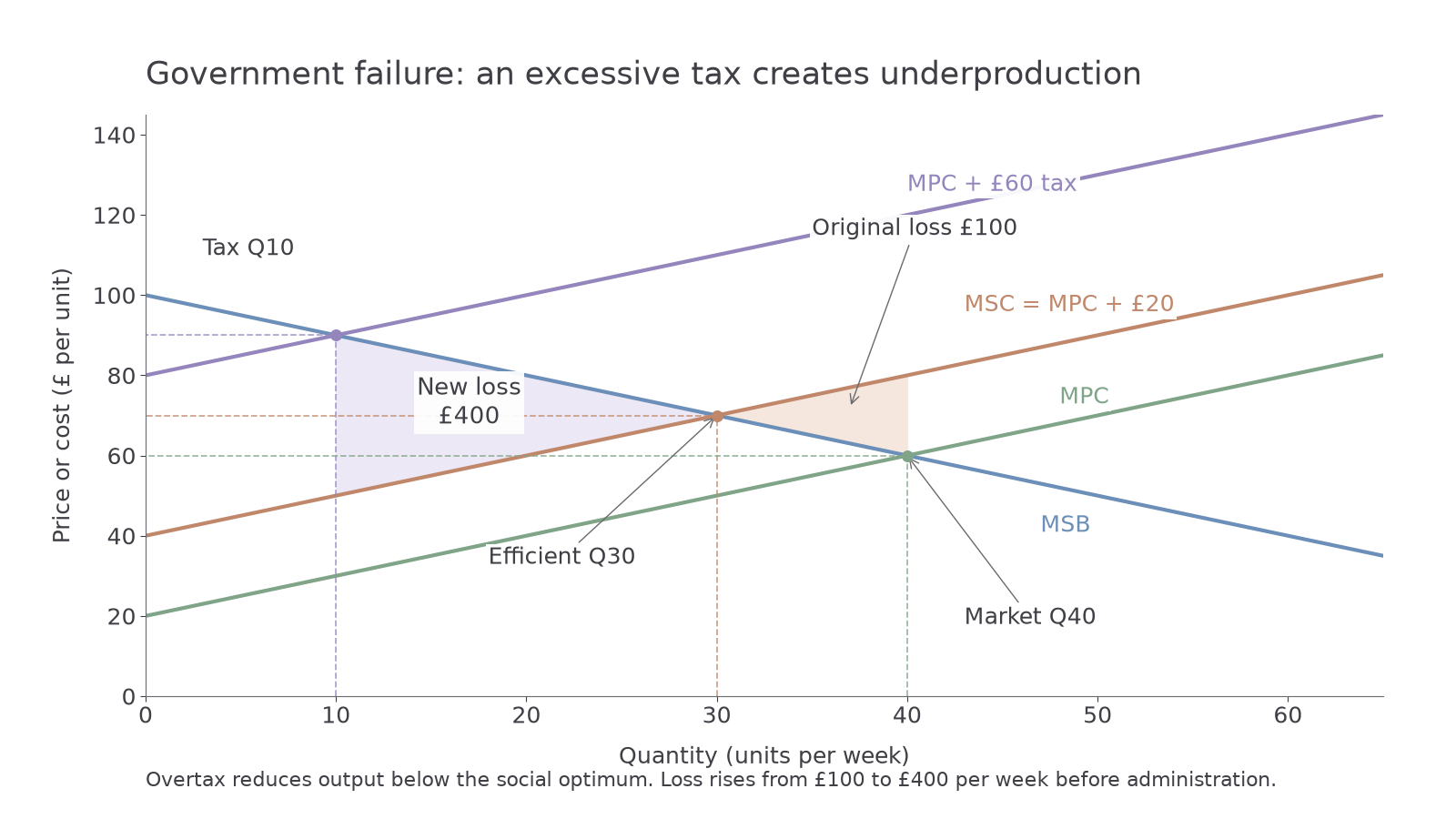
Units between 10 and 30 have social benefits greater than social costs but are no longer produced. The loss is per week. Before intervention, the overproduction loss between 30 and 40 was only . The tax reduces pollution yet worsens net welfare by £300 in this model, even before administration. Tax revenue is a transfer, not evidence that this loss was recovered.
This does not show all pollution taxes fail. It shows why estimating the relevant marginal damage and responses matters. Pilots, independent evidence and review can improve estimates; waiting for perfect information may also let substantial harm continue. The practical decision weighs uncertainty on both sides.
Objectives and political incentives
Governments pursue objectives that may conflict. Cheap energy today may be politically attractive but encourage harmful use and reduce funds for cleaner investment. A subsidy aimed at protecting current jobs may preserve a low-productivity firm and draw workers or capital away from activities with greater benefits. Conversely, abruptly removing support can cause unemployment where workers cannot move quickly. Time horizon and adjustment capacity matter.
Political incentives can amplify these conflicts. Benefits concentrated on a small organised group may attract lobbying, while costs spread across taxpayers are less visible. Ministers may favour projects completed before an election over maintenance with later benefits. Regulatory capture is one particular influence problem: the regulator favours the regulated industry. It is different from an honest forecasting error or an unavoidable trade-off between objectives.
Disagreement among economists can reflect different evidence about responsiveness and adjustment, as well as different weights placed on efficiency and equity. A job-protection policy cannot be judged from jobs saved alone: ask about resources displaced, alternative employment, fiscal costs and the duration of support. Clear objectives make these trade-offs visible rather than treating every conflict as automatic failure.
Continue this lesson.
You’re previewing NovaLearn without an account. Create a free account to read the rest.
Create free account