3.1.6.6 - The National Minimum Wage
Learn how a legal wage floor affects pay, employment and different groups of workers, and why its effects depend on the labour market and the level at which it is set.
A legal wage floor
A minimum wage sets a legal lower limit on the hourly pay of covered workers.
The National Minimum Wage is a statutory wage floor rather than a payment from government. Employers pay it. UK minimum-wage entitlement depends on worker eligibility, age and apprenticeship status; the higher statutory rate is called the National Living Wage. These are distinct from the voluntary real Living Wage. Source: Department for Business and Trade guidance, updated 6 January 2026. The rates below are illustrative model values, not current UK legal rates.
A floor is binding when it is above the wage that would otherwise be paid. If a market already pays £16 per hour, a £14 floor does not mechanically raise that market's wage. A floor may still affect nearby pay grades if employers preserve differentials, but that is a separate response, not an automatic consequence of the legal minimum.
For a covered worker who retains the same hours, raising hourly pay increases earnings. However, earnings equal hourly pay multiplied by paid hours. If an illustrative worker moves from £12 for 30 hours to £14 for 24 hours, weekly earnings fall from £360 to £336. The worker's disposable household income also depends on taxes, benefit withdrawal, other earners and household needs. A rise in the hourly wage is therefore not proof that every affected household becomes better off.
A floor in a competitive labour market
In a competitive labour market, a binding wage floor raises the wage but can reduce the quantity of labour employers demand.
The model assumes many wage-taking employers and workers, comparable labour, enforceable coverage and no immediate change in productivity or product demand. Labour demand slopes down because employing another worker is worthwhile only if their marginal revenue product covers the wage. Market labour supply slopes up because a higher wage attracts more people or hours.
The illustrative graph measures workers horizontally and hourly pay vertically. Demand is and supply is , where is the number of workers and is pounds per hour. Without the floor they meet at 80 workers and £12. At a £14 floor, employers demand 60 workers while 100 workers wish to supply labour. The excess supply is 40 workers; employment falls by 20, not 40. The additional 20 are people attracted into this market by the higher wage.
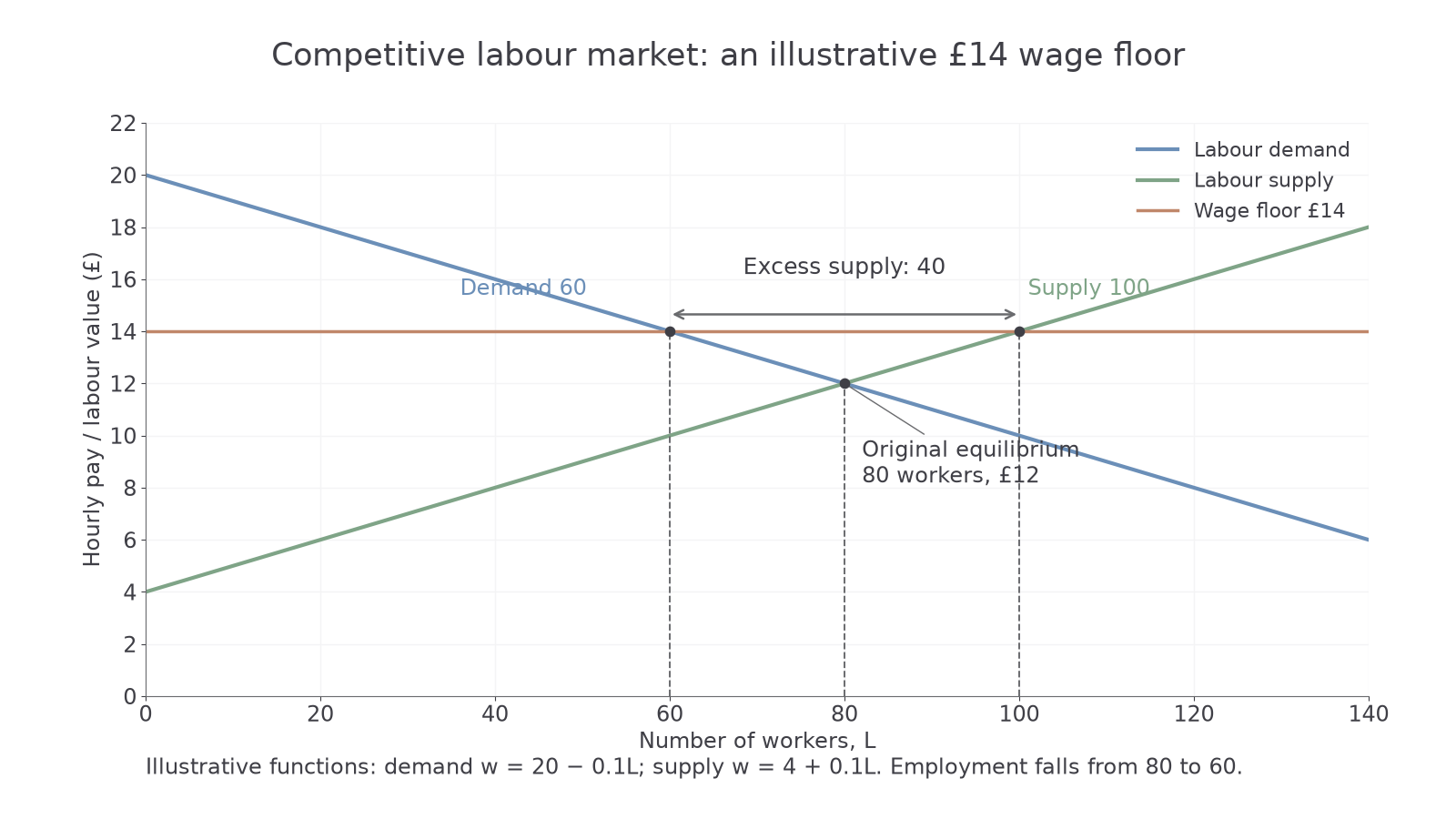
To construct this model on paper, label the axes and downward demand/upward supply, mark their original intersection, then draw a horizontal floor above it. Read employment from demand at that wage and labour supplied from supply. The gap between those quantities is excess supply. The policy creates movements along the existing curves; it does not itself shift labour demand or supply.
Workers retaining jobs gain higher hourly pay, while displaced workers lose earnings and new entrants may fail to find work. If demand is more wage elastic, a given wage increase produces a larger employment reduction. Over time, employers may substitute machinery, alter products or leave the market. In the short run they may instead reduce profits, raise prices or cut hours. Which adjustment dominates is an empirical question.
Continue this lesson.
You’re previewing NovaLearn without an account. Create a free account to read the rest.
Create free account