3.1.8.5 - Merit and demerit goods
Learn why merit and demerit classifications involve values, how incomplete information can distort consumption, and how that differs from external effects on other people when judging under- or over-provision.
Desirable consumption involves a judgement
Calling a product a merit or demerit good expresses a judgement about how much people should consume, not just a description of its market price.
A merit good is judged to be something people ought to consume more of than they would choose through the market alone. A demerit good is judged to be something people ought to consume less of. Education and harmful forms of addictive consumption are often discussed in those terms, but the classification depends on priorities, evidence and the circumstances of use.
The normative element matters even where some consequences are well established. A judgement may give weight to long-term wellbeing, informed autonomy, distribution or effects on children. Another person may give different weight to freedom of choice. Neither the presence of a subsidy nor a tax proves a product's classification: policy decisions themselves can be disputed.
This is different from the public/private distinction. A rival, excludable product can be judged a merit good. A school place using a teacher's time does not become non-rival just because education is valued socially. Merit also does not mean every additional unit is useful: benefits and costs must still be compared at the margin.
Perceived benefits can differ from informed benefits
Imperfect information can make consumers choose a quantity different from the one they would choose with an accurate understanding of their own long-term effects.
Someone may underestimate the future private benefit of learning, so perceived MPB lies below informed MPB and too little is chosen. Someone may underestimate an activity's long-term harm to themselves, making perceived net private benefit too high and consumption excessive. Incomplete information can therefore contribute to under-provision of a merit good or over-provision of a demerit good even without a third-party effect.
The following illustrative diagrams isolate information failure. There are no external effects: MPC = MSC, and informed private benefit equals MSB. “Perceived MPB” is the benefit guiding the uninformed decision; it is not automatically the true benefit. All values are pounds per unit and quantity is units per period.
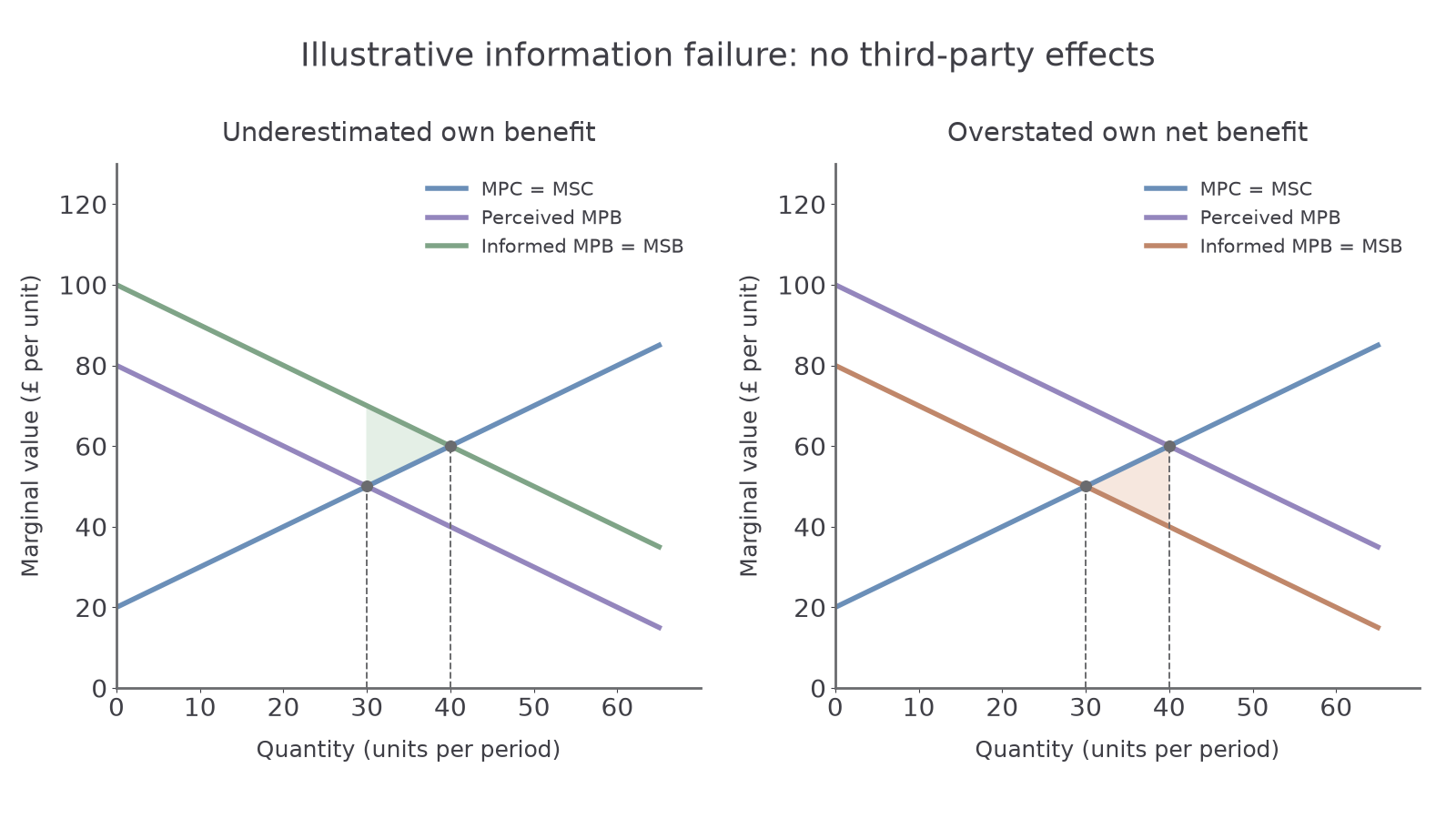
On the left, perceived MPB meets cost at 30, but informed MPB = MSB meets it at 40. Missing units could have benefits above costs. On the right, perceived MPB gives 40, while informed MPB = MSB gives 30; the extra units have costs above informed benefits. In both cases the shaded triangle is £100 of net welfare loss per period in this model, with base 10 units and height £20 per unit.
It would be incorrect to call the entire gap between perceived and informed benefit an externality: the missing information here concerns the consumer's own consequences. Information provision may change the perceived curve towards informed benefit. It may not fully change behaviour if habits, self-control or affordability also matter; those are different mechanisms to identify.
For notebook construction, label the two benefit curves distinctly, draw MPC = MSC, and mark perceived and informed intersections. Use informed social benefit against social cost for the welfare interval. Text assessments interpret the supplied representation; they do not verify construction.
Externalities are a separate question
Merit or demerit judgements may coexist with external effects, but neither classification logically guarantees the other.
Education can benefit its learner and also others through knowledge sharing or improved cooperation. Only the latter is the external benefit. Where a positive consumption externality is present, MSB exceeds informed MPB: even a fully informed learner may buy too little because they cannot capture all gains to others. This differs from underestimating their own return.
Continue this lesson.
You’re previewing NovaLearn without an account. Create a free account to read the rest.
Create free account