3.1.5.2 - Objectives and decisions of firms
Learn how firms choose output under different objectives, why profit maximisation uses marginal reasoning, and how owners' and managers' interests can affect decisions.
Choosing profit-maximising output
The traditional theory of the firm assumes that firms aim to maximise economic profit, the difference between total revenue and total economic cost, including opportunity costs. This is an assumption for predicting decisions, not a claim that every business behaves this way.
Marginal revenue (MR) is the extra revenue from another unit; marginal cost (MC) is its extra cost. If MR exceeds MC, that unit increases profit. If MC exceeds MR, it reduces profit. For continuously variable output, an interior profit maximum is therefore at , where MC crosses MR from below: increasing output before the crossing adds profit, and increasing it after the crossing removes profit. Merely finding any equality is insufficient. For indivisible units, choose the last unit whose extra revenue covers its extra cost, subject to feasibility.
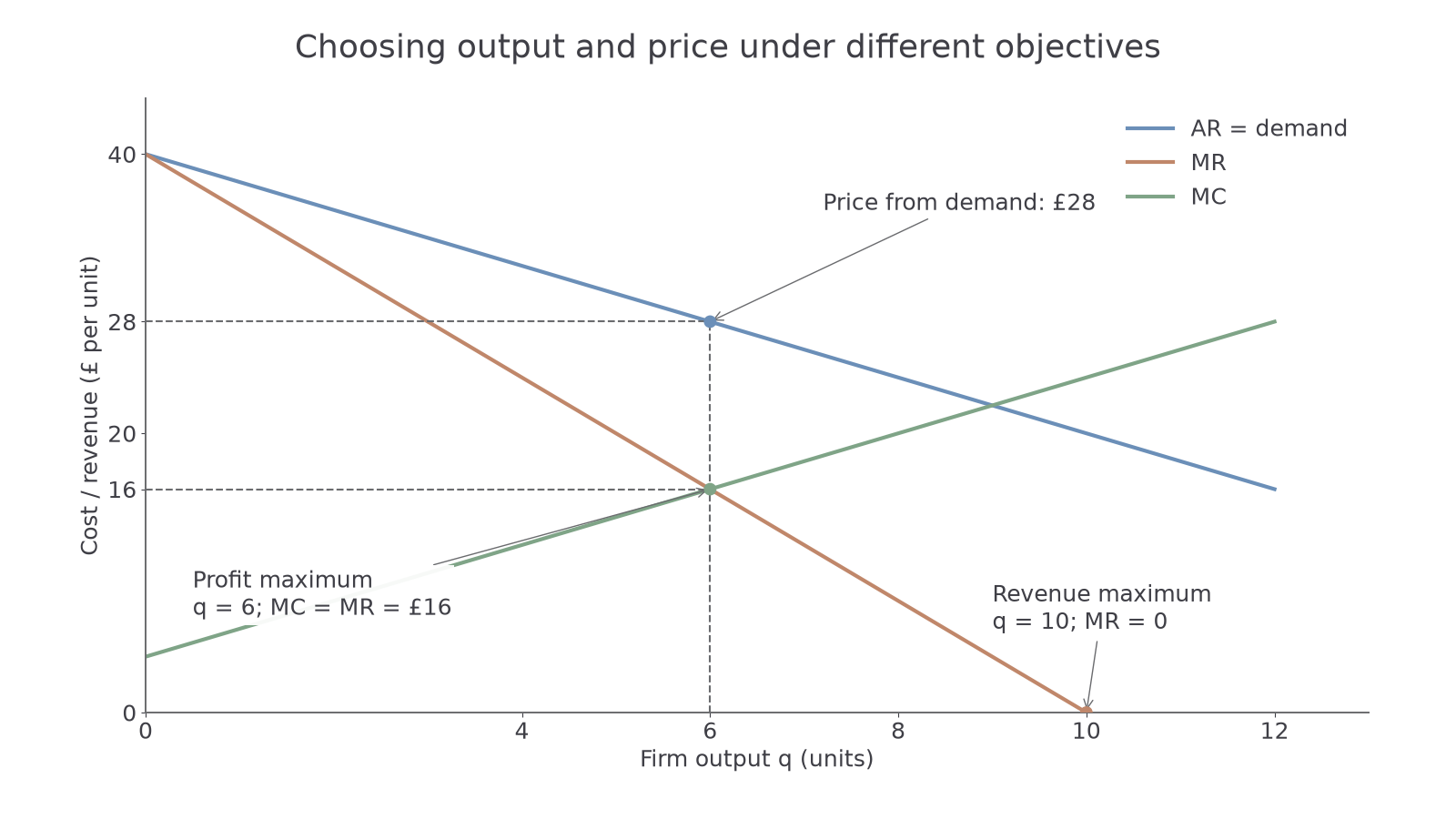
The illustrative firm in the graph has , and , measured in pounds per unit. Their equality is at , where MR and MC are both £16. Read the selling price from the demand/AR curve at that output: £28, not £16. MC=MR chooses output; demand tells the firm the price buyers will pay. At output 10, MR is zero and total revenue is at its maximum, but MC is positive, so revenue maximisation is not profit maximisation.
Suppose total cost at output 6 is £76. Revenue is , giving £92 profit. Total profit is not the vertical distance between MR and MC: that distance describes the effect of an extra unit. Costs must include normal profit before any surplus is called economic profit. If even the best feasible output makes a loss, compare continuing with closing; the rule alone does not guarantee a positive profit.
Alternative business objectives
A firm's objective changes the trade-off it is willing to make between present profit, size, risk and the quality of its offer.
A survival objective gives priority to keeping the business operating, perhaps by protecting cash flow during a downturn. This can mean accepting low current profit. Growth expands capacity, assets or operations and may require investment that reduces current profit. Quality prioritises reliability, service or product standards; it can increase costs but may improve reputation and future sales. These objectives can support profit over time, so different behaviour does not automatically prove that profit is irrelevant.
Sales-revenue maximisation targets the highest total revenue, not the highest output or profit. With the illustrated downward-sloping demand, revenue peaks where MR=0. Market-share growth raises the firm's fraction of market sales. Cutting price, advertising or adding outlets can expand that share while reducing profit margins. Market share must use a consistent market and measure: sales value and units sold need not give the same share.
The following data are original illustrative feasible choices. They describe the same firm as the graph, with total cost .
| Output, units | Price, £ per unit | Total revenue, £ | Total cost, £ | Profit, £ |
|---|---|---|---|---|
| 6 | 28 | 168 | 76 | 92 |
| 8 | 24 | 192 | 112 | 80 |
| 10 | 20 | 200 | 156 | 44 |
| 12 | 16 | 192 | 208 | −16 |
Continue this lesson.
You’re previewing NovaLearn without an account. Create a free account to read the rest.
Create free account