3.1.1.1 - Economic methodology
Learn how economists use models and evidence to explain people's choices, distinguish testable claims from value judgements, and reach reasoned decisions when both consequences and priorities are disputed.
Economics as a social science
Economics studies how people and institutions make choices about resources and how those choices affect others.
It is a social science because its subject is human behaviour: households choose what to buy, firms choose what to produce, and governments choose policies. Economists seek explanations that can be checked against evidence, rather than treating every opinion as equally well supported. A useful question is not just “What happened?” but “What mechanism could explain it, and what else would we expect to observe if that explanation were right?”
For example, a bus operator raises fares. An economist might predict that some passengers will switch to walking or another service because bus travel has become less attractive relative to its alternatives. The size of the response depends on available alternatives, people's incomes and why they travel. Someone who must reach work and has no alternative may continue travelling. Economic reasoning therefore connects incentives to choices under particular conditions; it does not assume everyone responds identically.
Microeconomics studies particular agents and markets, such as this operator and its passengers. Macroeconomics studies the economy as a whole, including total output, employment and inflation. They connect: if many households cut spending, individual firms may sell less and total output may fall. Equally, an economy-wide fall in income can change demand for one firm's service. An individual example alone does not establish the size of the aggregate effect.
Models, assumptions and causal tests
A model simplifies reality so that we can trace a particular economic relationship and test its implications.
An economist may hypothesise that a higher bus fare reduces journeys, ceteris paribus: other relevant influences are held constant. This is a reasoning device, not a claim that the real world stops changing. Income, service frequency, weather and alternatives may change at the same time. A fall in journeys after a fare rise fits the hypothesis, but does not establish that the fare caused the entire fall.
Economics shares with natural sciences the use of hypotheses, logical models, measurement, predictions and attempts to challenge explanations. It shares with other social sciences an interest in institutions, culture and human decisions. Its distinctive emphasis includes incentives, constraints, trade-offs and comparisons with what would have happened under another choice.
Controlled experiments can be difficult: economists cannot usually randomly assign whole countries to different tax systems, and changing a policy can affect people outside a comparison group. Nevertheless, economics can use experiments. A randomly offered travel discount could compare otherwise similar groups; a policy change in one area could be compared with an unaffected area. The second approach is persuasive only if the areas would otherwise have followed similar paths. Neither method removes the need to examine data quality and assumptions. Natural sciences also face limits on experimentation, for example in studying climate; “economics never experiments” is an inaccurate distinction.
The counterfactual is the outcome that would have occurred without the change being studied. It is not directly observed for the same person at the same time, so researchers must estimate it. A model's assumptions make that estimate possible and also create reasons for caution.
People may use habits, respond to fairness, lack information or change expectations when policy changes. A model assuming predictable, fully informed decisions can still reveal one mechanism, but its predictions need checking. Disagreement may concern the assumptions or strength of the mechanism, rather than whether evidence matters.
Positive claims and normative judgements
A positive statement concerns what is, was or may happen; a normative statement contains a judgement about what ought to be.
Positive statements are capable, in principle, of being tested using evidence. “Higher fares will reduce journeys” is positive even before the prediction has been tested. “Every fare rise doubles journeys” is also positive, although it is unlikely to survive testing. Positive does not mean true, agreeable or favourable.
Normative statements depend on values, such as fairness, freedom or the importance of one group's wellbeing. “Bus travel ought to be free for everyone” cannot be settled by counting journeys alone. Evidence can inform its consequences, but deciding whether those consequences justify the policy requires priorities.
| Statement | Classification and reason |
|---|---|
| “The operator carried 10,000 passengers yesterday.” | Positive: records can test the claim. |
| “A fare subsidy would increase journeys.” | Positive: an outcome prediction, subject to conditions. |
| “The subsidy is unfair to people who walk.” | Normative: applies a judgement of fairness. |
| “The subsidy would increase journeys, so it should be introduced.” | Mixed: a testable prediction followed by a value-based recommendation. |
Words alone are not a reliable test. A statement about how things “should” behave under a specified model may describe a testable prediction. Ask whether disagreement could be resolved through observation alone, or whether it also requires agreeing on what matters. Separate the positive and normative elements of a mixed claim before assessing it.
What evidence can establish
Useful economic evidence has a clear measure, a relevant comparison and limits that the conclusion respects.
The table is an illustrative dataset, not evidence about an actual town. Town A introduces a fare discount between Periods 1 and 2; Town B does not. Each period is one month. Journeys are measured in thousands, using the same counting method.
| Town | Period 1 journeys | Period 2 journeys | Period 3 journeys |
|---|---|---|---|
| A | 100 | 120 | 110 |
| B | 100 | 105 | 106 |
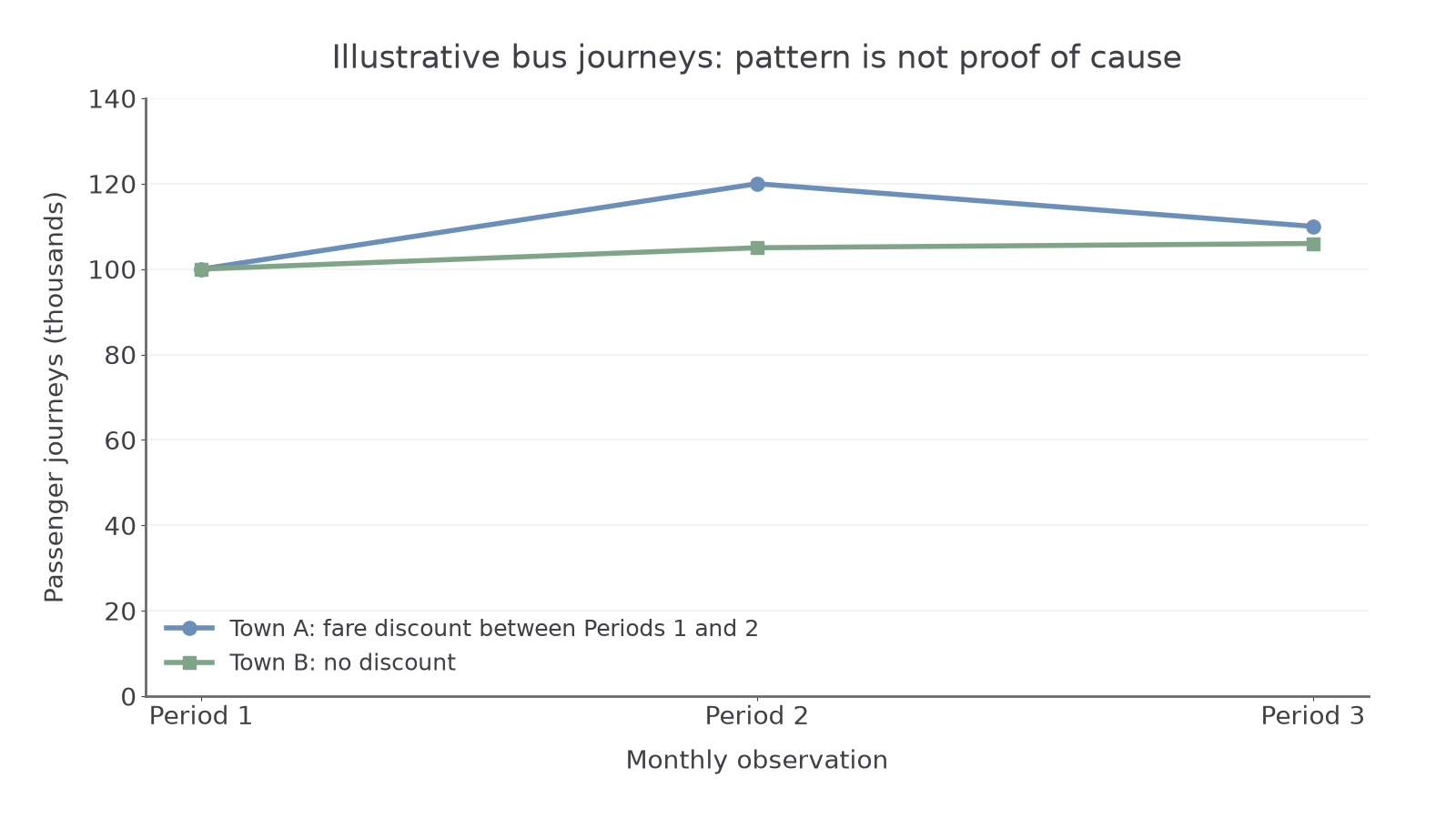
The graph plots the same table: time is horizontal and monthly journeys in thousands are vertical. A's line rises sharply then falls; B's rises slightly in both intervals. Its vertical axis begins at zero, so the size of the difference is visible without a truncated scale. Reading the pattern is a starting point for investigation, not a causal test by itself.
Between Periods 1 and 2, A gains 20,000 journeys while B gains 5,000. The change in A exceeds B's by 15,000. Both rise, so describing A's entire increase as the effect of the discount would ignore influences common to both towns. If B is a valid counterfactual and other differences are absent, the excess increase supports a discount effect. It does not prove those assumptions are met.
Period 3 qualifies the story: A's journeys fall from 120,000 to 110,000 while B's continue rising. A remains above its starting level, but the initial increase is not sustained in full. A road closure or service disruption would be a competing explanation worth investigating, not a fact to invent from the table.
Check the units, population covered, time window and definitions before comparing sources. A series indexed to 100 in a base year shows change relative to that year's level, not 100 actual journeys. A graph with a shortened vertical axis may exaggerate the appearance of a small change. Consistent collection and transparent methods strengthen reliability; even an official source may contain sampling error, revisions or a modelled estimate.
Numerical evidence shows magnitude and patterns. Interviews about unreliable services may explain why passengers changed behaviour, but a few interviews do not measure the size of the effect for all passengers. Combining appropriate numerical and qualitative evidence can test a mechanism better than either alone. Correlation means variables vary together; causation means one change produces another. A credible causal argument needs a mechanism and a defensible comparison, not merely two lines moving together.
Why policy judgements can differ
A policy judgement combines beliefs about consequences with priorities about whose interests and which outcomes matter.
Consider a real, dated example. London's Ultra Low Emission Zone charges vehicles that fail its emissions standards. The March 2025 London-wide ULEZ One Year Report estimated that average roadside nitrogen dioxide concentrations across London were 27% lower than in its estimated scenario without the ULEZ and its expansions. This is a comparison with a modelled counterfactual, not a claim that concentrations fell 27% in one year or that the latest expansion alone caused that amount. Source: London City Hall's report.
The estimate is relevant to a positive question about air quality. An economic mechanism is that charging the use of more polluting vehicles gives drivers an incentive to switch vehicles, change travel or avoid charged journeys. The strength of that response depends on affordable alternatives. Testing the effect requires examining the counterfactual and other influences on pollution.
The policy recommendation is a different question. One person may give greatest weight to cleaner air for residents; another may emphasise the burden on a driver who cannot afford a replacement and has poor public transport. Evidence about pollution, household costs and available alternatives can improve the judgement, but cannot determine how much moral weight to attach to health, freedom or distribution. Political beliefs about the appropriate role of government may also differ. These are possible perspectives, not claims about what every supporter or opponent believes.
There are therefore two sources of disagreement. Economists may disagree positively about the scale, timing or distribution of effects because they use different evidence or assumptions. They may agree about those effects yet disagree normatively about the best option. A defensible conditional judgement identifies both: support may be stronger if substantial air-quality gains are credible and assistance makes adjustment affordable. New evidence can change the first assessment; a different value priority can change the recommendation even with unchanged evidence.
Quick recap
Economists use simplified models, mechanisms and evidence to investigate human choices. Positive claims can be tested; normative judgements also depend on values. Sound policy reasoning examines the counterfactual, the reliability and limits of evidence, and the priorities behind a recommendation.